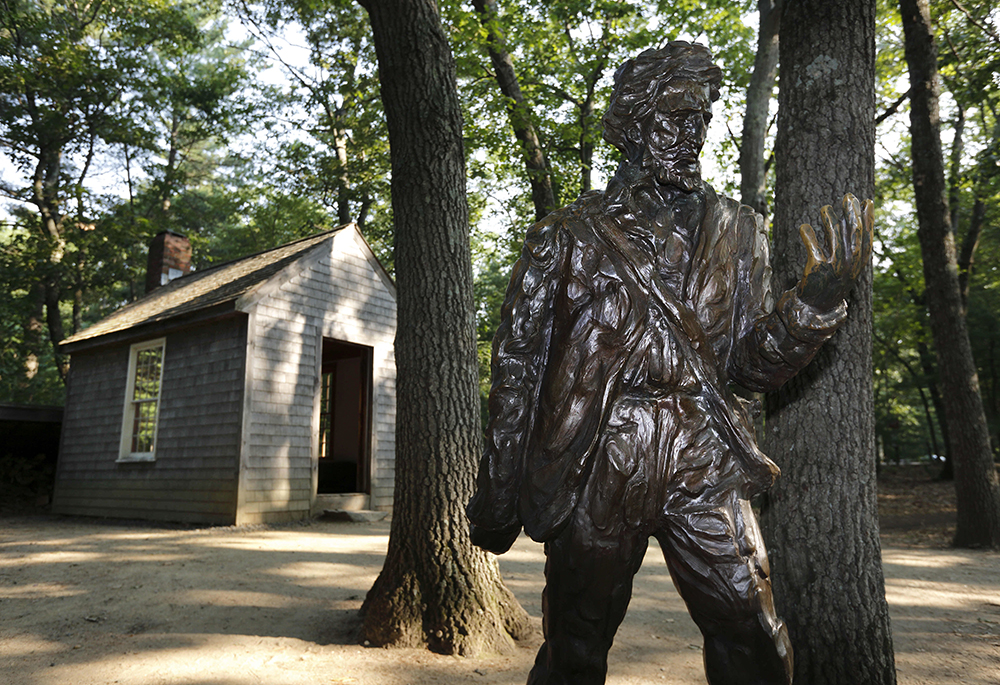
In this file photo, a statue of Henry David Thoreau stands outside a replica of his cabin near the shores of Walden Pond in Concord, Massachusetts. (AP Photo/Michael Dwyer, File)

by Peter Gilmour
Join the Conversation
Send your thoughts to Letters to the Editor. Learn more
Recently I was delighted to come across a new book about Henry David Thoreau, Thoreau's God, by Richard Higgins from the University of Chicago Press. It rekindled the initial thrill of encountering Walden (subtitled Life in the Woods) as an undergraduate English major. I fantasized about living in mid-19th century Massachusetts with Thoreau and other luminaries of American letters — Nathaniel Hawthorne, Herman Melville, Ralph Waldo Emerson among them.
Higgins sees Thoreau's concept of God "as a riddle, rather than as the oxymoron many people have taken it to be." He calls Walden Thoreau's "modern-day scripture, [that] offers a fundamentally religious vision of our relationship to nature."
For me, Thoreau's prolific writings, filled with aphorisms, axioms, metaphors, contradictions and conundrums rival the Wisdom books of the Old Testament. Prolific he was, filling 47 volumes of journals, about 7,000 pages, some 2 million words. Thoreau distilled his two-year stay at Walden Pond, where he filled several journals, into a more concise book structured on the four seasons of the year. Higgins' book distills Thoreau's thought into an even more concise book of just over 200 pages.
One striking thought from this book: "The soil of conventional religion was too thin in which to grow his soul," and later, "he saw the natural world as the soil of the soul."
Can we get more mundane than dirt? Soil Seeing or Soul Seeing? I wonder.
My initial wondering led me to recall my visit to Walden Pond long ago. My expectations were high, thanks to Thoreau, thinking I would find ecstatic beauty and be lifted, if not to the seventh heaven, at least halfway. That wasn't to be the case. Instead, Thoreau's words help me encounter the presence of the divine in the ordinary, rather than in the extraordinary.
Advertisement
Thoreau's God reminds me once again where the presence of the divine is best found.
As we struggle both individually and collectively as a church to figure out the depth and breadth of synodality, might Thoreau's be another voice we need to heed? Henry David Thoreau as a synodal conversation partner?
Thoreau harbored disdain for institutionalized religion. Yet he worked hard to encounter something more; sometimes seemingly hostile to religion, other times using familiar religious language and offering provocative thoughts about nature and presence of the divine in and through the natural world.
Has the papacy caught up with some of Thoreau's spirituality rooted in soil? I think so. Castel Gandolfo, a palace traditionally reserved for papal use, now includes a living museum of reverence for our natural world. It is named Borgo Laudato Si', a testimony to and manifestation of the late Pope Francis' encyclical on the environment.
I look forward to my pilgrimage there, just as I looked forward to visiting Walden Pond years ago. I will skirt the clatter and chatter that is endemic to the Eternal City to hear the soul of the natural world sprouting forth from the soil at Castel Gandolfo. I look forward to meeting the spirit of Henry David Thoreau on the shore of Lake Albano, another natural body of water, though much larger than Thoreau's pond.
Soul Seeing? Soil Seeing? It's one and the same.