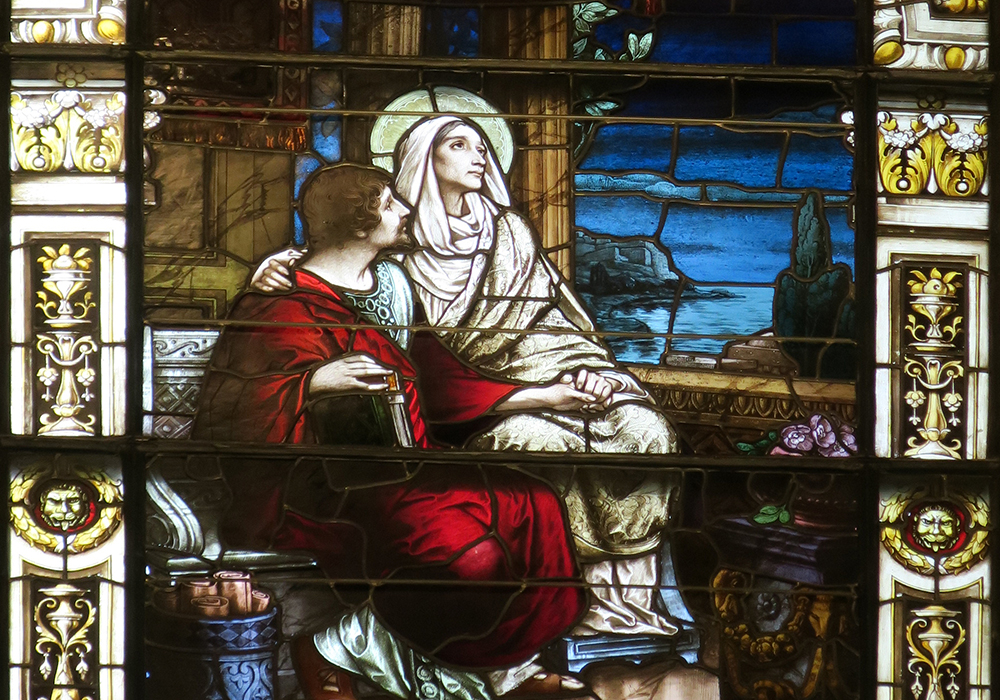
St. Augustine and St. Monica are depicted in stained glass at the Cathedral Basilica of St. Augustine, in St. Augustine, Florida. (Wikimedia Commons/Nheyob, CC BY-SA 4.0)

by Colleen E. Mitchell
Join the Conversation
Send your thoughts to Letters to the Editor. Learn more
Editor's note: This is part of an occasional series on Augustinian spirituality. Pope Leo XIV is the first pope from the Order of St. Augustine, a religious order founded in 1244 on the values of community and friendship; service to the poor; and intellectual pursuits. Today there are some 2,800 Augustinians across 47 countries.
Do women have a different approach to Augustinian spirituality than men? The historical dearth of women's writing on the topic makes it difficult to know for sure, and while male Augustinian friars lead active lives, Augustinian nuns are mostly cloistered, living as something of an enigma throughout time.
Still, Augustine's Rule is applied equally, regardless of gender. Both men and women are called to live in common, forsaking private property and obeying their superior. All are asked to serve one another in charity and to forgive one another as they hope to be forgiven. All long for spiritual beauty and together engage in an insatiable search for God.
When the Order of St. Augustine was founded in 1244 in Tuscany, it consisted of mendicant hermits who were lay men. Pope Innocent IV gave them the Rule of St. Augustine, and they became what we today call the Augustinians. It is not clear exactly when women religious were first aggregated to the order; this history is not well documented. While St. Augustine himself was cautious of being alone with the opposite sex and communicated with them through letters, that correspondence indicates a great respect for the female theological mind.
Advertisement
Fortunately, the Augustinian tradition has four canonized female saints whom we can look to, learn from and petition: St. Monica (circa 332-387), St. Clare of Montefalco (1268-1308), St. Rita of Cascia (1381-1457) and St. Magdalene of Nagasaki (1611-1634). Unfortunately, none of these women left any of their own writing behind, so we are reliant on their male contemporaries for their stories. We are left to fill in the blanks.
St. Monica
Monica, the mother of St. Augustine of Hippo, is depicted in the Confessions as a devout Christian woman who handled her husband's anger deftly, impressed St. Ambrose with her faithfulness and cried many tears on her son's behalf. In Augustine's telling, she was dutiful and devoted — both to her son and to God.
Monica, as far as we know, was never formally educated and likely married around the age of 12, according to the norms of the time; she lived as a widow for over a decade and died at about 55 years old. When she was very ill before her death, she broke with Roman funerary custom and told her son to bury her where they were staying in the port city of Ostia, rather than back in North Africa by her husband's side; she knew it did not matter where her earthly body would be buried, so long as her soul would be reuniting with God.
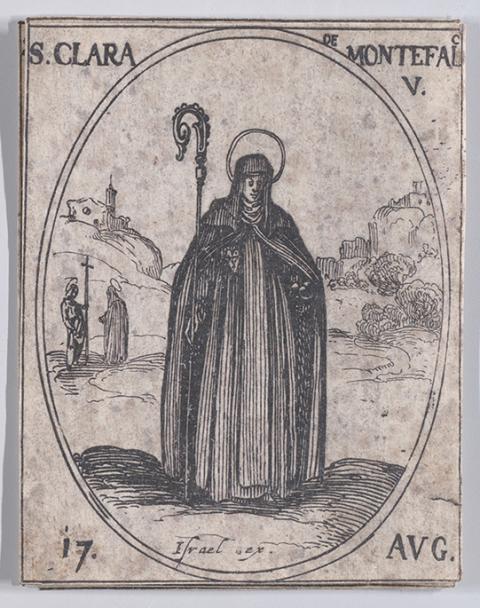
"Ste. Claire de Monte-Falco, vierge ('St. Clare of Montefalco, Virgin'), August 17th, from Les Images De Tous Les Saincts et Saintes de L'Année ('Images of All of the Saints and Religious Events of the Year')," 1636, by Jacques Callot (Metropolitan Museum of Art)
St. Clare of Montefalco
At just 6 years old St. Clare of Montefalco joined a hermitage built by her father, where she and her older sister Giovanna lived as Franciscan tertiaries; later their community grew into a formal convent of nuns under the Rule of St. Augustine. Giovanna died shortly afterward, and at 23 years old, Clare was elected abbess of the convent.
Deeply prayerful and humbly penitent, Clare was a cloistered mystic with a particular devotion to the passion of Christ. According to Clare's first biographer, Berengario di Donadio di Saint-Affrique, she received a stigmata in her heart following a vision of a pilgrim Christ carrying the cross and seeking a fitting place to plant it.
Upon her death, Clare's surviving sisters wished for her body to be examined for sainthood immediately, but she was not canonized until 1881 by Pope Leo XIII.
St. Rita of Cascia
St. Rita of Cascia had hoped to take up religious life but her parents wished to see her married instead. Obedient, Rita wed Paolo Mancini and had two sons. After nearly 20 years of marriage, her husband was killed by a rival family. Her sons died not long after.
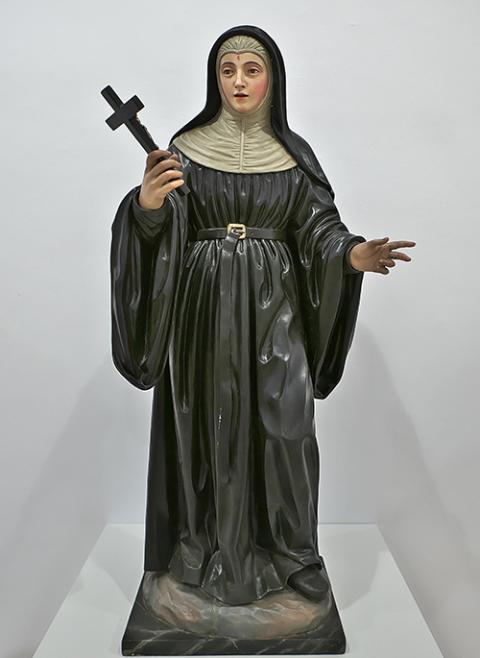
A statue of St. Rita of Cascia in the Parish of Our Lady of Sorrows, in Seville, Spain. (OSV News/Sebastian Santos Rojas, CC-4.0)
Rita, widowed and childless, requested to join an Augustinian convent in Cascia, but the nuns there required her to broker peace between the warring families first. Rita did so, among many other miraculous things, for which she is known as "the saint of the impossible." Like Clare, she too was devoted to Christ's passion and received a stigmata, hers on the forehead from the crown of thorns. The first biography of her life, written by Fr. Agostino Cavallucci, was not published until more than 100 years after her death. St. Rita was canonized by Pope Leo XIII in 1900.
St. Magdalene of Nagasaki
Magdalene's parents, both devoted Christians, were martyred when she was around 10 years old. When two Augustinian friars arrived in Nagasaki in the early 1620s, she sought them out and became their interpreter. Moved by their spirituality, she became a tertiary of the Order of Augustinian Recollects. Magdalene taught catechism to children, begged for alms for people in poverty, visited the sick and modeled remarkable hope and perseverance in the face of adversity.
When persecution of Christians continued to intensify in Japan, Magdalene sought refuge in the hills of Nagasaki before voluntarily turning herself into authorities as a follower of Jesus Christ. After 13 days of extreme physical torture, she died as a martyr at only 23 years old. She was beatified by Pope John Paul II in 1981 and canonized among the 16 martyrs of Japan in 1987.
What would we know of these women if they had told their own stories? How would they describe Augustinian spirituality and its importance in their lives? We do not know, but from their silences, we can hear a call to search for truth.