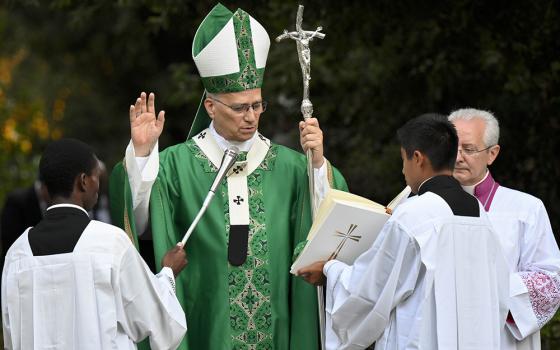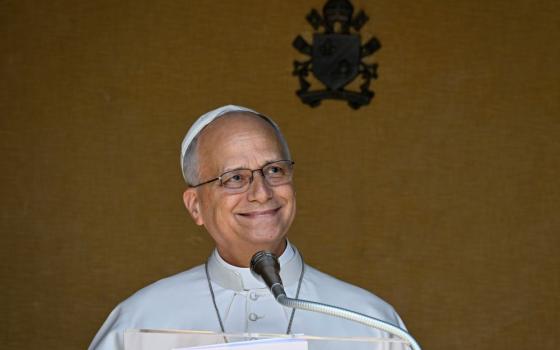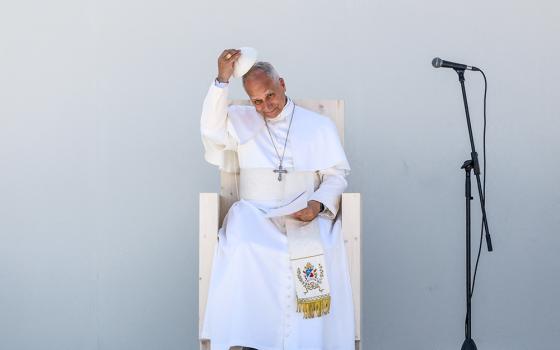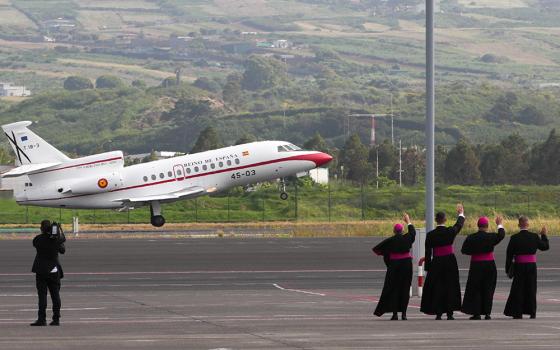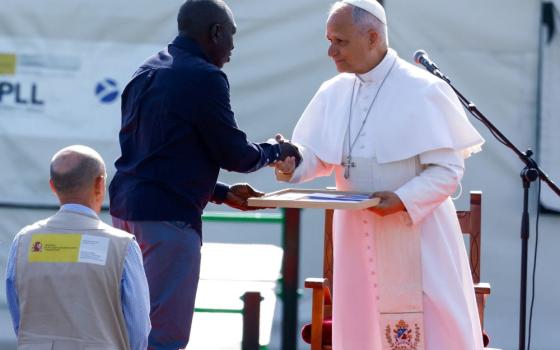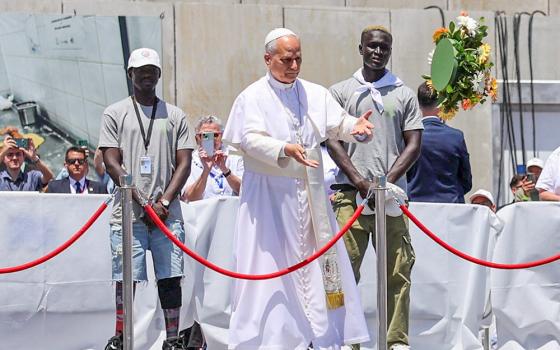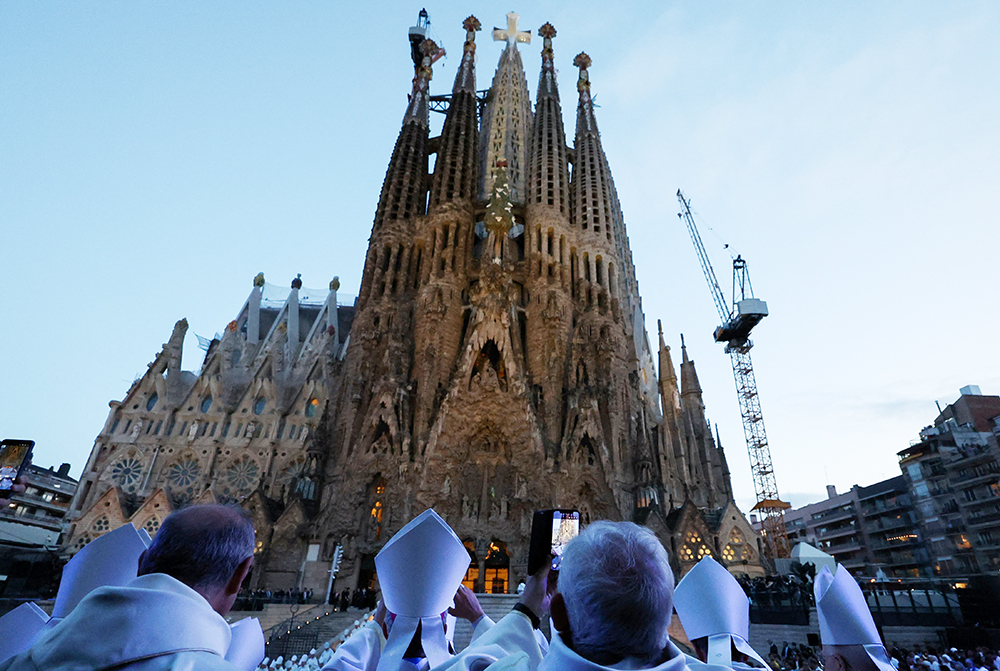
Members of the clergy stand outside the Basilica of the Sagrada Familia in Barcelona on the day of the inauguration and blessing of the Tower of Jesus Christ by Pope Leo XIV during his apostolic journey to Spain, June 10, 2026. (OSV News/Reuters/Nacho Doce)

Join the Conversation
Send your thoughts to Letters to the Editor. Learn more
Under the concrete towers of Barcelona's famed Basilica of the Sagrada Família, running upward in parallel to the cranes that continue to shepherd their rise, Pope Leo XIV recalled the Christian significance of the architectural wonder that has become renowned worldwide.
"It is precisely faith that shapes the stones and gives meaning to the edifice we inhabit together," the pope said Wednesday (June 10) under glowing red and yellow beams of light refracted through the basilica's stained glass windows.
Leo closed his two-day stint in Barcelona June 10 by celebrating Mass at the Sagrada Família on the death centenary of Antoni Gaudí, the basilica's architect, who precisely 100 years to the day was killed by a tram car in Barcelona and who today is on the path to being recognized as a saint in the Catholic Church.
Prior to celebrating Mass, Leo lit a candle before Gaudí's tomb in the Sagrada Família crypt.
Outside, the basilica narrates in stone the story of the Gospels along its facades. Its construction began in 1882 and today it attracts almost 5 million visitors a year, converting it into the most recognizable icon of one of the world's most-visited cities.
Yet the pope stated that beyond the sinuous, art nouveau architecture that draws tourists worldwide in admiration, the basilica "has Christ as its foundation and crowning glory, its beginning and end."
"Dear brothers and sisters, we cannot believe in Jesus and promote war. We cannot believe in Jesus and kill the innocent," Leo said in his homily. "We cannot believe in Jesus and abandon those who suffer, those who weep, those who flee from misery."
When Pope Benedict XVI blessed the basilica's altar in 2010, its central spire had barely taken form. But Leo on Wednesday blessed the Tower of Jesus Christ, the tallest of the basilica's planned 18 towers standing at 566 feet, which was completed in February and adorned with a massive four-armed cross which can be recognized from any direction.
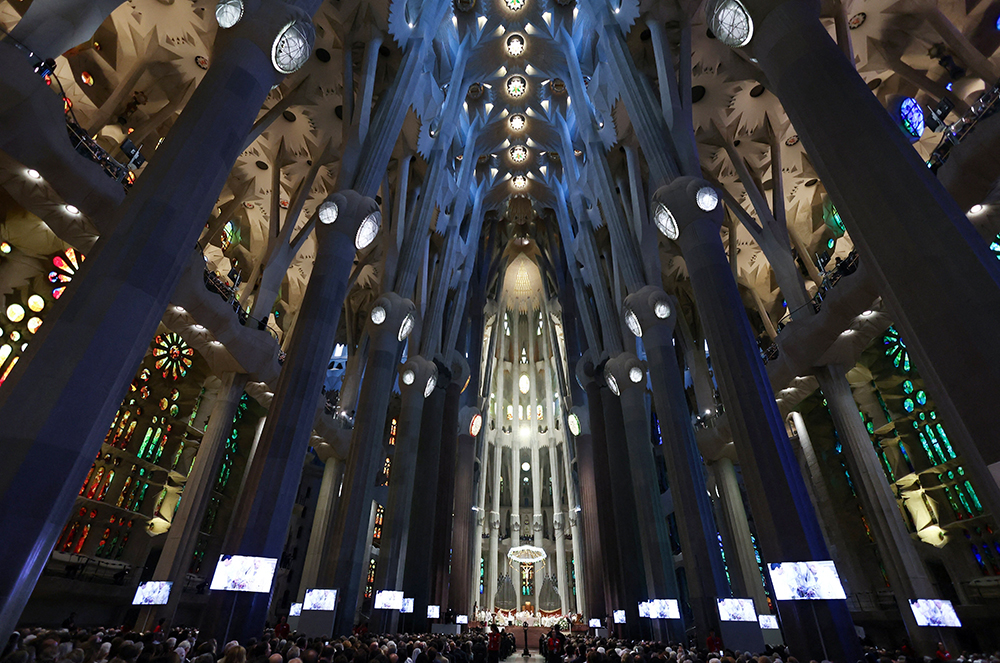
Pope Leo XIV celebrates Mass at the Basilica of the Sagrada Familia in Barcelona during his apostolic journey to Spain, June 10, 2026. (OSV News/Reuters/Yara Nardi)
Before Spain's royals, prime minister and Barcelona Cardinal Juan José Omella in attendance at the Mass, the pope called the basilica an "architectural masterpiece" which is an "eloquent catechesis made of stones, colors and light," recalling how ancient cathedrals were in themselves tools of evangelization.
"In this age in which image is so prevalent, it becomes even more evident how art and beauty are privileged channels of evangelization," he said.
As the dusk sky contrasted with the illuminated cross atop the basilica following Mass, Leo processed outside and offered his blessing for the building's tallest tower, sprinkling holy water on the sprawling structure and surrounding crowd. The approximately 120,000 people gathered around the basilica held out paper lanterns that pulsated in synchronization, and the entire basilica was illuminated in a choreographed light show that culminated in fireworks.
Just as Benedict's consecration of the altar opened the basilica's nave for daily Mass — effectively changing the city's relationship with the building — some say that Leo's blessing could change how Catalonians see the Sagrada Família from the outside.
"For Barcelona, the Sagrada Família was always seen as a bit of an enemy, due to the Mass tourism," said Chiara Curti, an architect and Sagrada Família expert who has authored two books on the basilica and its architect. "But today, everyone is very proud that this tower of Jesus Christ shines from every part of the city."
"The world has started to identify Barcelona with the Sagrada Família," she told reporters ahead of the Mass, "and now this will make it be identified with a large cross."
Leo leans into Catalan culture
For much of his two days in Barcelona, what mattered most to the pope's Catalan audience was not so much what he said but how he said it.
The polyglot pope put to rest weeks of speculation in the Spanish press over whether he would speak in Catalan with the very first words he spoke at Barcelona's cathedral on Tuesday, beginning his greeting with "Estimats germans i germanes" ("Dear brothers and sisters").
From sanctuaries to an olympic stadium, crowds wooed upon Leo's speaking in Catalan, the official language, in tandem with Spanish, of the semi-autonomous region of Catalonia of which Barcelona is the capital.
From the enthusiasm of the crowds receiving him, it seems his language skills earned him forgiveness from the Catalan public after revealing at the start of the trip that he was a fan of the Real Madrid soccer team, the bitter rival of Barcelona's main team.
And in contrast with the sea of Spanish flags present at the pope's events in Madrid, sparingly few were seen over the course of his two days in Barcelona — children receiving the pope outside the Abbey of Our Lady of Montserrat waved dual-sided Vatican/Catalonia flags upon his arrival.
His Barcelona leg, sandwiched between a more politically tinged three-day visit to Madrid and two days that will highlight the plight of migrants in Spain's Canary Islands, took on a more spiritual contour.
After praying the rosary before the statue of Our Lady of Montserrat — a statue of a Black Madonna venerated throughout northeastern Spain — Leo noted how Jesus' mercy "exposes the violence that can lurk in our words and attitudes."
"Let us ask Mary, Queen of Peace, to teach us to renounce hurtful words, hasty judgment, gossip and slander," he said.
Advertisement
In Barcelona's cathedral, he called on Christians to become modern day "martyrs" in a world marked by deep division and individualism, "that is, witnesses and prophets of unity, of welcome, of harmony and of peace, even at the cost of sacrifice and renunciation."
And in one of the most striking moments of his Barcelona trip the pope responded to the testimony of a woman who shared the story of her battle with depression.
Leo said there is "something deeply wrong with a certain notion of progress that subjects people to pressures, expectations and tensions that compromise healthy balances," and that Christians must not "spiritualize pain, superficially attributing it to 'God’s will' or to some mysterious plan of his."
"This risks minimizing that suffering, silencing it and hurting people," he said. "God does not want suffering. He carries it with us and invites us to trust in him with perseverance."
The National Catholic Reporter's Rome Bureau is made possible in part by the generosity of Joan and Bob McGrath.