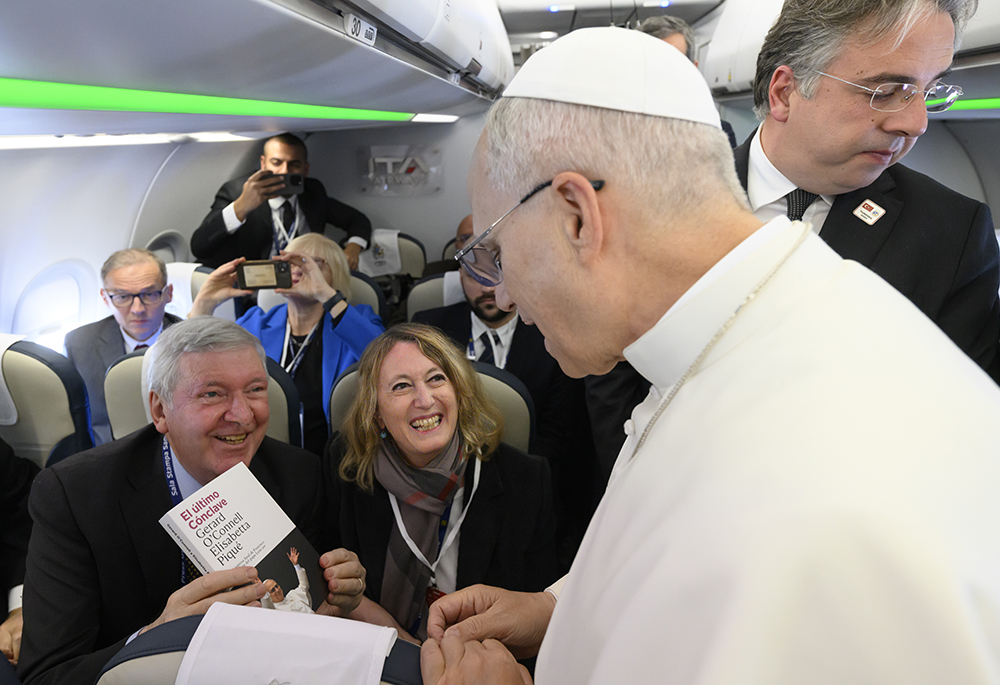
Elisabetta Piqué and Gerard O'Connell give a Spanish-language edition of their book, The Election of Pope Leo XIV: The Last Surprise of Pope Francis, to Leo during a flight from Rome to Ankara Nov. 27, 2025. (Courtesy of Gerard O'Connell and Elisabetta Piqué)
Join the Conversation
Send your thoughts to Letters to the Editor. Learn more
The cardinals who participated in the conclave that elected Pope Leo XIV described his election as willed by the Holy Spirit.
Yet a new book suggests that Cardinal Robert Prevost's path to the papacy was far less inevitable, shaped by fragile alliances and small human moments that influenced perceptions inside the Sistine Chapel and ultimately produced the first U.S.-born pontiff.
In The Election of Pope Leo XIV: The Last Surprise of Pope Francis, set to release March 25, veteran Vatican journalists Elisabetta Piqué and Gerard O'Connell offer an insider's account of the entire papal transition, from the moment of Francis' death to the wake of Leo's election.
Written in diary form, the book blends personal observation — such as descriptions of the cold chapel at Casa Santa Marta where Francis' body was laid before it was transferred to St. Peter's Basilica — with detailed reporting on conversations among cardinals in the days leading up to the conclave and a ballot-by-ballot reconstruction of the votes.
The book cites on-the-record interviews with cardinals before and after the conclave and cites numerous unnamed sources to describe what took place within the conclave itself, despite its participants being sworn to secrecy.
The authors also describe small but telling disruptions within the secret election: security alarms triggered inside the Sistine Chapel, cardinals oversleeping after surrendering their cellphones and a voided ballot before the final count due to a technical snafu.
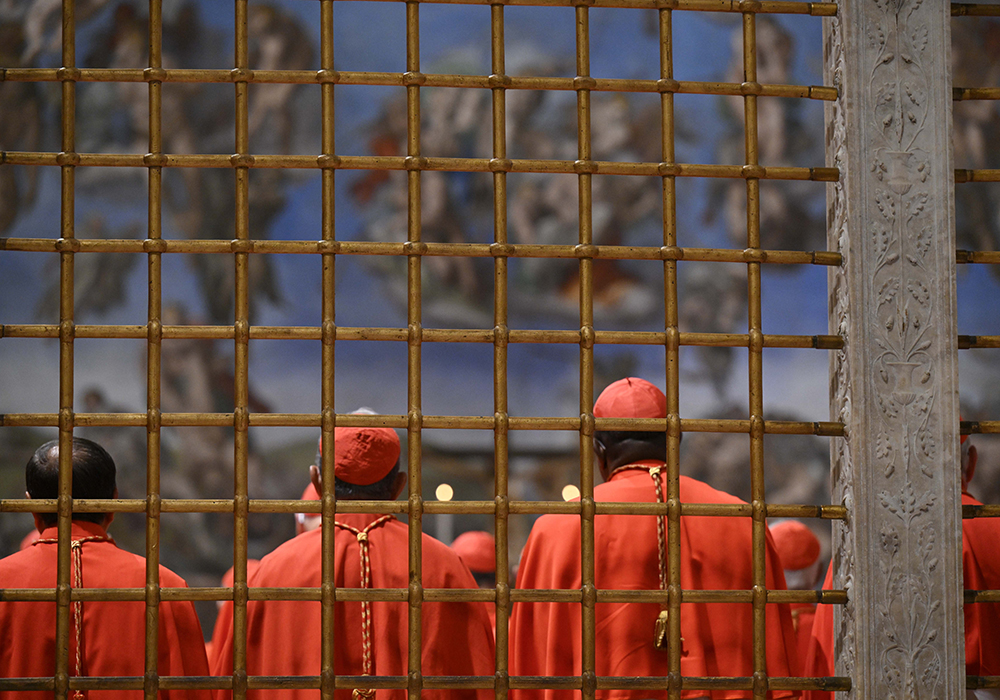
Cardinals enter the Sistine Chapel at the Vatican May 7, 2025, at the start of a conclave to elect a new pope. (CNS/Vatican Media)
Front-runners fell aside
Just as in O'Connell's 2019 conclave tell-all book which provided the authoritative account on Francis' election, the new book reconstructs the voting in detail and reveals the surprising path to Prevost's election.
Contrary to the widely held belief that Cardinal Pietro Parolin, Vatican secretary of state under Francis and now Leo, would lead the race, O'Connell reports that conservative-favorite Cardinal Peter Erdo of Esztergom-Budapest garnered the most votes in the conclave's first ballot on the evening of May 7.
The Hungarian cardinal was seen as a theological conservative who embraced his country's hardline position on restricting migration, placing him in stark contrast with Francis' advocacy on behalf of migrants. His early lead suggested a highly coordinated push among the conservative bloc of cardinals going into the conclave, while the more progressive vote remained scattered.
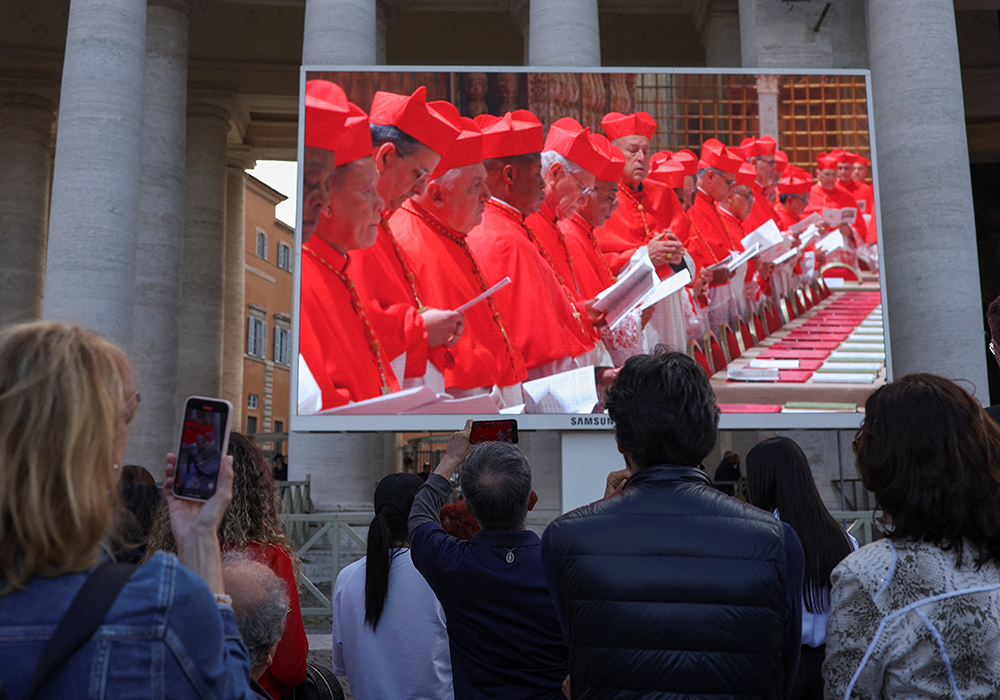
People watch a screen in St. Peter's Square at the Vatican as cardinals from around the world gather in the Sistine Chapel May 7, 2025, on the first day of the conclave to elect the next pope. (OSV News/Reuters/Amanda Perobelli)
Prevost and Parolin were the other cardinals who received between 20-30 votes in the first election, according to the book, but their similar numbers conveyed very different messages.
Some cardinals believed Parolin to enter the conclave with 40- 45 votes secured. Instead, his disappointing first-ballot performance appeared to represent his high-water mark. In subsequent votes, the one-time favorite gained little ground.
Prevost, by contrast, had not figured prominently in pre-conclave media speculation. His initial showing surprised some electors and positioned him as a viable alternative as support began to consolidate.
Cardinal Luis Antonio Tagle, frequently cited in media coverage as a papal contender, underperformed, as did Cardinal Pierbattista Pizzaballa, who reportedly received only one or two votes.
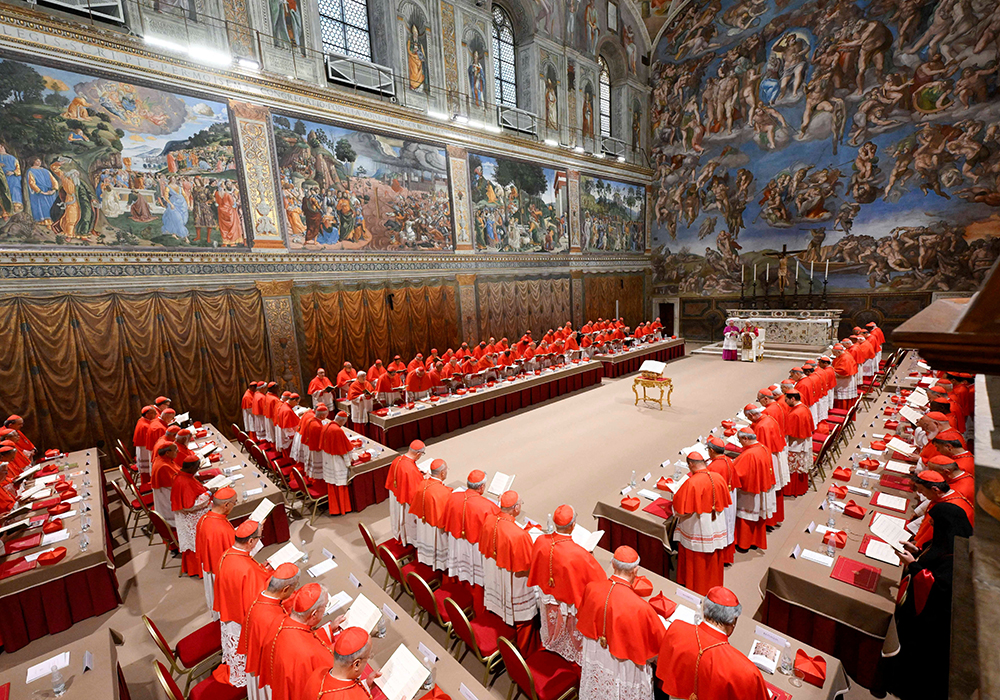
Pope Leo XIV, right, stands in the Sistine Chapel among cardinals after being elected at the Vatican, May 8, 2025. He became the first American pope in history. (OSV News/Vatican Media via Reuters/Francesco Sforza)
How votes shifted toward Prevost
Piqué and O'Connell suggest that small details inside the chapel influenced how candidates were perceived.
For example, Erdo was among the three cardinals randomly selected to assist in counting the first ballot by reading aloud each of the 133 names the electors voted for, including his own. The cardinal's voice, however, grew weaker as the tally progressed. Cardinals later noted that the conservative front-runner "looked very old."
The following morning, Prevost was randomly chosen to perform the same task. He read the ballots aloud for two consecutive votes after no candidate secured the required two-thirds majority. Whereas Erdo's weak performance may have sunk his candidacy, Prevost's steely resolve impressed his audience. He read out his own name more frequently as he gained votes in each ballot.
By the end of the morning session, Erdo's support had diminished, Parolin had made limited gains, and Cardinal Jean-Marc Aveline of Marseille briefly emerged as another possible consensus figure. But the trajectory increasingly favored Prevost.
Advertisement
The book also offers insight into how media coverage directly impacted the cardinals' thinking in the days before the conclave.
Piqué recounts writing an article to describe what she described as common knowledge among Vatican insiders: that Francis did not want Parolin to be his successor. She writes that the late pope's declining trust in his No. 2 had been an open secret in the Vatican. It is later recounted how her article circulated among several Latin American cardinals "who had been convinced that Parolin would have been Francis' choice to succeed him."
After learning that isn't the case through her article, they considered another option.
O'Connell also cites sources as later saying that the backlash over a video of Tagle singing karaoke to John Lennon's "Imagine" that had circulated online ahead of the conclave "caused many of his would‑be supporters to reconsider and abandon him."
The lived experience of the conclave
Beyond vote counts and shifting alliances, the book savors the ordinary human elements that unfolded alongside the solemn election ritual.
Immediately prior to the first vote taking place in the Sistine Chapel, O'Connell writes that an active SIM card was detected in the highly secured space. One of the older, unnamed cardinals had unintentionally brought in their phone in the pocket of their cassock, setting off security alarms.
On the first day of the conclave several cardinals had slept in since they had to surrender their cell phones which they used for alarm clocks, the book recounts. The Vatican later provided alarm clocks for the cardinals to use to avoid a repeat of the day's events.
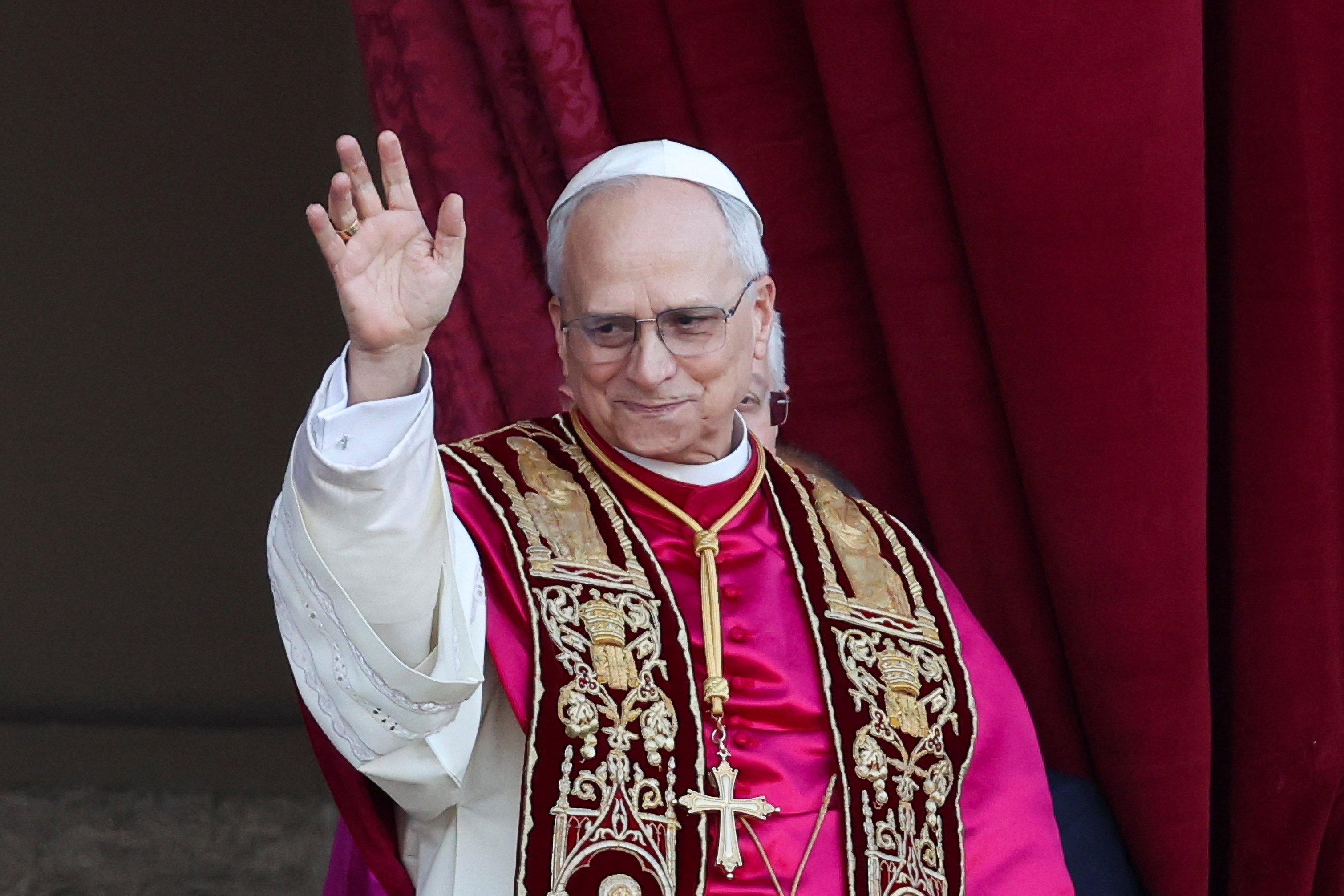
Cardinal Robert Francis Prevost, who has chosen the papal name Leo XIV, appears on the central balcony of St. Peter's Basilica at the Vatican May 8, 2025, following his election during the conclave. He is the first U.S.-born pope in history. (OSV News/Reuters/Claudia Greco)
And, in the decisive round of voting, a double ballot was unintentionally cast. Per the rules of the conclave set out by St. John Paul II, if the number of votes does not match the number of voters, the vote is void and must be redone. The man who would become pope therefore had to wait through another round of voting before his election was confirmed.
Yet by all accounts Prevost remained calm and at ease.
After the morning's voting on May 8, which saw his stock rise, Prevost had lunch with his brother cardinals and then retired to his room to prepare the text of what would become his first speech as pope, the authors write.
Upon returning to the Sistine Chapel, new cardinals were selected to assist with the voting. In a widely circulated anecdote confirmed in the book, Tagle was seated next to Prevost and offered him a hard candy while the names were read allowed.
And after addressing the world for the first time as pope shortly after, Leo returned to Casa Santa Marta, the Vatican hotel where cardinals stay during the conclave for a festive dinner.
He eats very little, O'Connell writes. "He spends his time going around the tables and greeting his former companions from a historic and surprising conclave that ultimately lasted less than twenty‑four hours."
The National Catholic Reporter's Rome Bureau is made possible in part by the generosity of Joan and Bob McGrath.