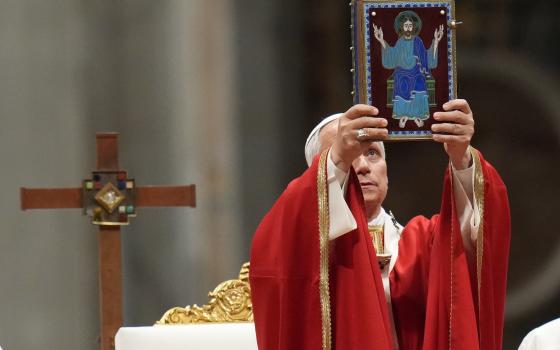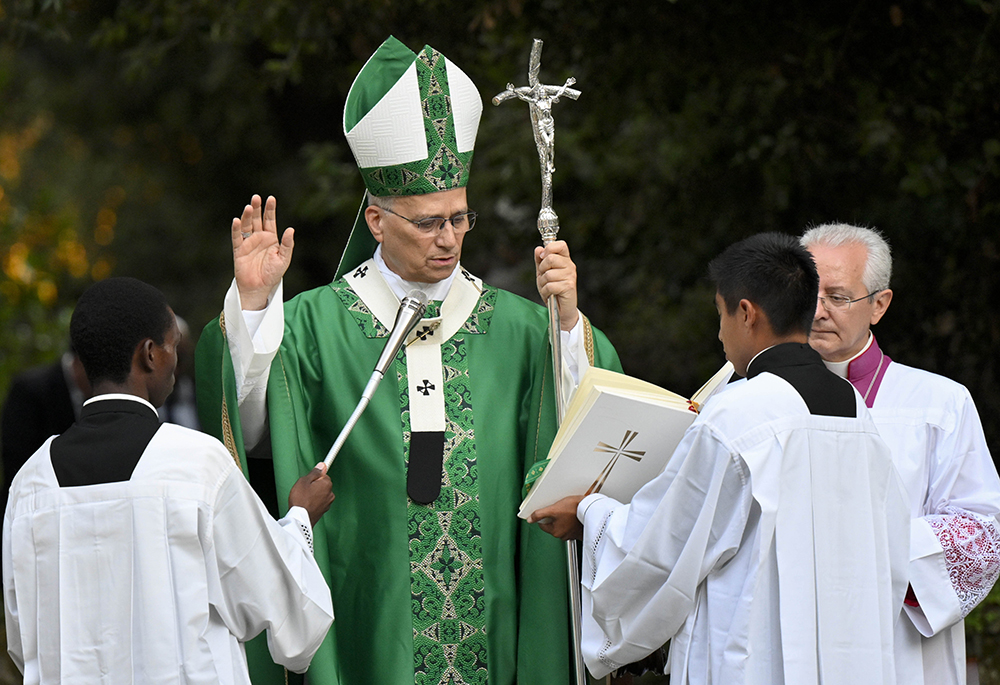
Pope Leo XIV celebrates Mass for the Care of Creation on the grounds of the Borgo Laudato Si’ ecology center in Castel Gandolfo, Italy, Sept. 1, 2026. (CNS/Vatican Media)

Join the Conversation
Send your thoughts to Letters to the Editor. Learn more
Celebrating a new form of the Catholic Mass "for the care of creation," Pope Leo XIV urged Catholics to contemplate nature as well as the ways they have shirked their responsibility to care for it.
"From contemplating creation and encountering its creator, there arises an awareness of our particular place within God's wondrous plan, and of the responsibility that we bear both personally and collectively for preserving the original harmony," Leo said while celebrating Mass in the papal gardens at Castel Gandolfo, outside Rome, on Sept. 1.
During the intimate Mass marking the church's celebration of World Day of Prayer for the Care of Creation and attended by Vatican staff, Leo remarked that the Gospel invites believers to contemplate God's creation, "a task that is certainly not difficult in the setting of these beautiful gardens."
It was only the second time the pope has celebrated a Mass "for the care of creation" using a new formulary for the Mass he introduced into the Roman Missal last July.
The Vatican's liturgy office promulgated the Latin text of the new formulary last year. But English and Spanish translations were approved only last month (August), making this the first year in which Catholic communities in the United States can celebrate the new Mass during the Season of Creation — a monthlong period devoted to prayer and action for the care of creation which runs from Sept. 1, the World Day of Prayer for the Care of Creation, through Oct. 4, the feast of St. Francis of Assisi.
Advertisement
This year's observance ends during the 800th anniversary of the death of St. Francis: the founder of the Franciscan order, namesake of Pope Francis and a central inspiration for the late pope's encyclical on the care of creation, "Laudato Si', on Care for Our Common Home."
In a nod to the patron saint of ecology, Leo quoted extensively in his homily from St. Francis' "Canticle of the Sun."
Beginning Mass amid the lush green surroundings of the papal garden on Tuesday, Leo invited the congregation to "recognize with humility the ways in which we have been unfaithful in safekeeping creation and caring for the dignity of each person."
In his homily, the pope asked the faithful in the coming weeks to "set aside a few moments to pause from the frenzy of our daily lives, in order to savor the profound harmony of which we ourselves are a part."
"Let us place in 'silent mode' the many noises generated by human activity, so that we may hear the melodious voice of creation, through which God, the author of all things, speaks to us," he said.
Contemplation of nature, Leo added, "is a first step towards an authentic ecological conversion."
"It is not yet too late, and the Season of Creation calls us to a profound conversion," he said.
Celebrating Mass in the same spot as he did last year to inaugurate the new formulary, the pope prayed "for the conversion of many people, inside and outside of the church, who still do not recognize the urgency of caring for our common home."
Leo, who has continued the church's advocacy for environmental issues which was championed by his predecessor Francis, warned in his encyclical Magnifica Humanitas of the far-reaching environmental consequences of the AI revolution.
One of the prayer intentions offered during the Mass asked that the work and research of those working in artificial intelligence "may be increasingly oriented toward the common good, safeguarding human work and service of fraternity and peace."
The pope's celebration came as local churches worldwide seek to better understand and embrace the new formulary of the Mass.
Bishops' councils across Latin America, Europe, Africa and Asia with other Catholic organizations hosted a webinar in June to explain how to celebrate the new formulary of the Mass and why it should be celebrated on the day of prayer for creation.
"The new Mass is a significant step to enable our liturgical celebrations of this special day, aligning our faith and deeds," said Bishop Allwyn D'Silva, chair of the Office for Human Development at the Federation of Asian Bishops' Conferences said in a statement on the new formulary. "Ultimately, the Eucharistic celebration of Creation Day is an opportunity to celebrate God as Creator and renew our appreciation of the sacred gift of creation, while inspiring us to care for it more fervently."
The National Catholic Reporter's Rome Bureau is made possible in part by the generosity of Joan and Bob McGrath.