(Unsplash/Clément Duguerre)

by Sr. Ilia Delio
Join the Conversation
Send your thoughts to Letters to the Editor. Learn more
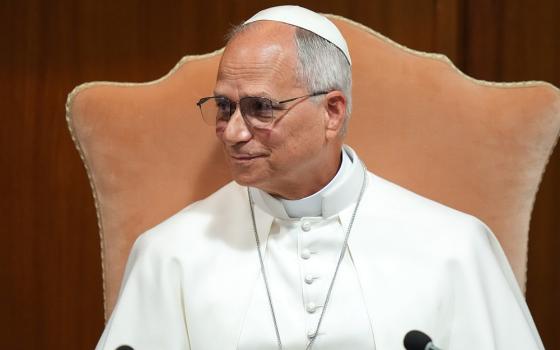
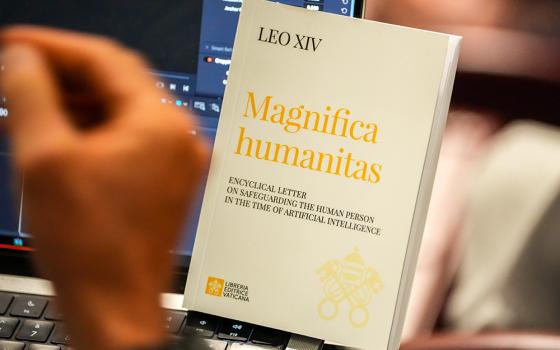
Pope Leo XIV's encyclical Magnifica Humanitas arrives at a moment of genuine civilizational urgency. Its concern for human dignity, its alarm at the displacement of labor, its refusal to treat artificial intelligence as a neutral instrument — all of these are worthy moral interventions. The encyclical asks the right questions.
Yet a reading alongside Teilhard de Chardin's ultrahumanism, and the theological tradition running through Carl Jung and Paul Tillich, suggests that the encyclical's answers are constrained by a metaphysics no longer equal to the evolutionary world it seeks to address.
This essay does not dismiss Leo's concerns; it argues that Teilhard provides a more adequate — and ultimately more hopeful — theological grammar for engaging AI, one that honors the church's deepest instincts about the divine-human relationship while refusing to set evolution and grace in opposition.
The most revealing word in Magnifica Humanitas is a verb: remain. "Our duty in the age of AI," Leo writes, "is to remain profoundly human." The governing images — for example, Babel set against Jerusalem — are images of protection, of guarding a grandeur already given. The encyclical understands the human person as a finished essence, dignified from outside, to be preserved against a technological force that threatens to dissolve it.
Leo builds carefully on the tradition of imago Dei, on the relational anthropology of the Trinity, on integral ecology extended into the digital sphere. Against the transhumanist fantasy of escaping weakness, he makes finitude the very medium of love and openness to God. This is the wisdom of the cross, and it is right.
Advertisement
But the verb remain is also a symptom. To remain is to hold a position against a threatening advance. It presupposes that what the human is has already been determined — that the image of God is a status to be defended rather than a process to be undergone. The relational anthropology Leo invokes actually points in the opposite direction. If the person is constitutively relational, then a new and vast web of machinic and noospheric relations is not the death of personhood but its next medium. Leo has laid the anthropological foundation for a bolder argument and he then builds upon it.
Teilhard de Chardin offers the theology of the other verb: become. Evolution is not background scenery for the human story; it is the story. The human person is not a fixed essence deposited into a changing world but the growing tip of an evolutionary process that has always moved through convergence toward greater complexity and consciousness.
Teilhard's key distinction — transhumanism versus ultrahumanism — is precisely the distinction between using technology to escape the individual human body and using it as the medium through which humanity deepens into a richer collective consciousness. The noosphere, his term for the sphere of collective mind, is not the replacement of biological life but its intensification.
Where Leo reads the next evolutionary threshold as Babel, Teilhard reads it as Christogenesis — the continuing birth of Christ in and through the rise of consciousness. Grace does not bypass evolution; it is evolution's interior direction.

Unsplash/David Clode)
The deepest difference between Leo and Teilhard is theological: It concerns where God is. Throughout Magnifica Humanitas, the divine is given, revealed, conferred — always acting upon the human from beyond. This Thomistic inheritance secures the gratuity of grace and the objectivity of revelation. But it also carries costs that the current technological moment makes newly visible. A wholly transcendent God who acts discontinuously with our own consciousness produces a psychic splitting — it exiles the divine from the interior and leaves the inside religiously inert.
Tillich's God is not a being "out there" but the Ground of Being in which we participate. Jung located the image of God in the depths of the psyche; the work of a lifetime is its reconciliation with the waking ego. Teilhard, arriving at the same place from evolutionary science, insisted that consciousness was not added to matter from outside but was present from the beginning as its interior — what he called the "within" of things.
This convergence illuminates a dynamic Leo observes but cannot explain. He notices, with real acuity, that people are turning to AI for counsel, companionship, even love. He is watching a projection in the Jungian sense — the numinous, exiled from the interior by a tradition that located God entirely outside, seeking a vessel and finding one in the machine. AI becomes a source of religious meaning precisely because the tradition taught people to seek God outside themselves and then emptied the inside.
The encyclical prescribes guarding the boundary. The deeper diagnosis is that the cure is the recovery of the divine ground — withdrawing the projection, inhabiting the interior, and recognizing the noosphere as a potential medium of the communion humanity was blindly seeking in the machine.
Teilhard asks: What is the human becoming through technology, and how do we ensure that becoming is directed toward greater love rather than mere complexity?
A full theological anthropology must also account for the shadow. The human is neither magnificent nor depraved but ambivalent and unfinished: a single unresolved knot in which nature's creativity and its capacity for the demonic are tied together. An anthropology that begins with the grandeur has already looked away from half of what we are.
Teilhard did not look away: He was acutely aware that the same convergence that could produce the noosphere could produce totalitarianism. He insisted that the noosphere required not merely intellectual convergence but amorization — the enkindling of love through global connectivity. Without a center of love, evolution would produce not ultrahumanism but its opposite: the impersonal domination of the mass.
In this, Leo and Teilhard agree on the danger; they disagree about the remedy. For Leo, the remedy is governance and protection. For Teilhard, it is the deepening of the interior life that technology must serve and cannot replace.
Teilhard allows us to reframe Leo's central question. The encyclical asks: How do we use technology while remaining human? Teilhard asks: What is the human becoming through technology, and how do we ensure that becoming is directed toward greater love rather than mere complexity?

(Unsplash/Miguel Bruna)
These are not the same question, and the difference is decisive. Leo's question presupposes a fixed human essence that technology might serve or threaten. Teilhard's question presupposes an evolving humanity for whom technology is not an instrument wielded from outside but a medium within which the next phase of evolution is being worked out.
A balanced response to Magnifica Humanitas can affirm what is genuinely right in it — the defense of finitude as the medium of love, the diagnosis of technology as encoding a vision of the human, the insistence that persons are not reducible to data and performance — while pressing for a more adequate metaphysics to carry those insights. But the encyclical's governing metaphysics — a wholly transcendent God conferring a fixed essence on a human creature now called to remain — is not adequate to a world in evolution. A tradition that exiles the divine from the interior and then wonders why the interior seeks God in the machine has not yet understood its own problem.
Teilhard offers not a rival Christianity but a more adequate one — adequate to evolution, to the shadow, and to the machinic world humanity now inhabits. His Christ is not the guardian of a fixed human essence but the Omega toward whom complexity and consciousness are drawn in love. His noosphere is the emerging medium of the communion the person was made for. And his finitude — accepted, loved, carried through — is the same finitude Leo rightly defends, but freed from the anxiety of a God who stands guard outside and given back to the Ground that sustains us from within.
The question Magnifica Humanitas poses is the right one: what does it mean to be human in the age of artificial intelligence? The answer it gives — remain — is too small for the tradition it invokes and too small for the moment it addresses.
Teilhard de Chardin shows what a bolder answer looks like: not the erasure of the human but its deepening; not the conquest of finitude but its transfiguration; not the guarding of an essence already given but the midwifing of a personhood still becoming. To find that way will not be to limit technology but to recover the divine depth we abandoned when we placed God entirely outside ourselves. Then, and only then, will humanity stop mistaking its own exiled divinity for the voice in the machine.