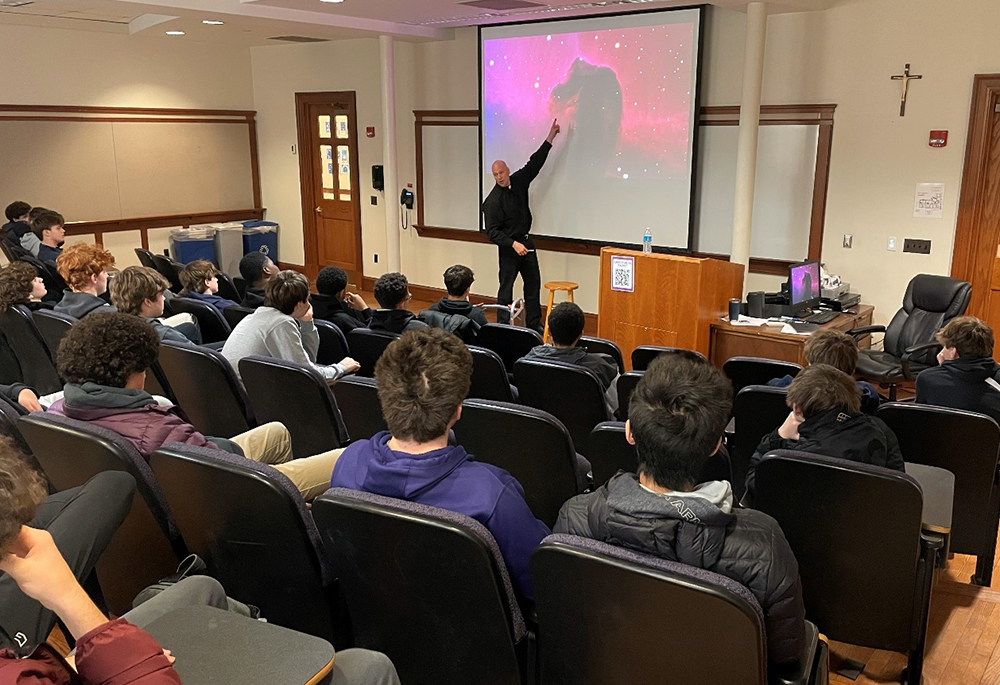
Jesuit in formation Rob Lorenz gives a presentation for Gonzaga College High School in Washington, D.C. (Courtesy of Ronald Jacobs)

Join the Conversation
Send your thoughts to Letters to the Editor. Learn more
For Rob Lorenz, the path to the priesthood ran through caves, deserts and nearly two decades in the National Park Service.
Lorenz, now 48, spent 17 1/2 years as a park ranger before entering the Jesuits at age 41. He worked at places including Carlsbad Caverns in New Mexico, Arches National Park in Utah and the National Mall in Washington, D.C., where he gave tours and programs on nature and U.S. history.
Even then, he said, the spiritual life he had absorbed through Jesuit education remained close to him. His work as a park ranger was shaped by the Ignatian idea of finding God in all things, even if, as a government employee, he could not use religious language with visitors.
His eventual move toward religious life was not sudden. "I would describe it as a flicker that grew to a flame," Lorenz told the National Catholic Reporter.
Lorenz is one of a number of many American men entering seminaries and religious communities well after the age traditionally associated with priestly formation. Sometimes described as "late vocations," they include men who spent years building careers, dating, living independently or moving away from the church before deciding to pursue the priesthood.
The term itself, however, can be misleading. Some men ordained later in life first thought about the priesthood as teenagers. Others did not begin to consider it seriously until their 30s or 40s.
A national survey of men preparing to become priests in the United States in 2026 shows that many are being ordained well beyond their 20s. The survey was conducted by the Center for Applied Research in the Apostolate, or CARA, at Georgetown University for the U.S. Conference of Catholic Bishops. Of the 428 men expected to be ordained this year, 334 responded. Their average age is 33. About half, 49%, are 30 or younger, while 38% are between 31 and 40. Another 10% are between 41 and 50, and 3% are 51 or older. Men being ordained for religious institutes tended to be older. Their average age is 37, compared with 33 among diocesan priests.
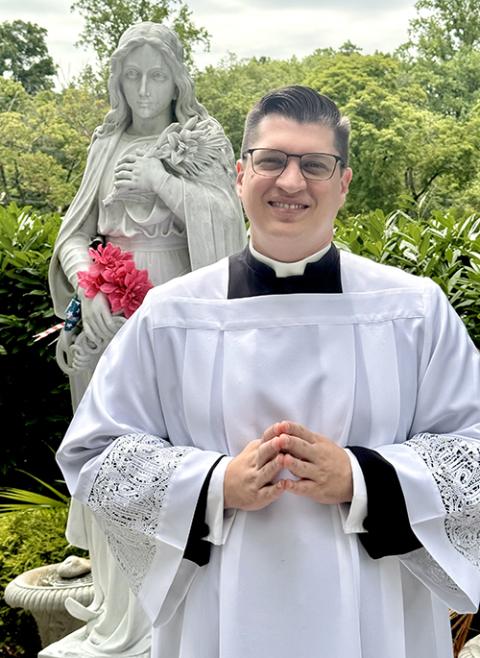
Archdiocese of Newark seminarian Joseph Grabowski Jr. (Courtesy of Archdiocese of Newark)
The findings also show that being ordained later in life does not always mean discovering a vocation later in life. On average, the men surveyed said they first thought about becoming priests at age 16 — about 17 years before their ordination. More than one-third, 36%, first considered the priesthood between ages 6 and 13, while another 22% first considered it during high school. But some came to the idea much later. About one in five said they first considered becoming a priest at age 22 or older. That share has remained fairly steady in recent years, averaging about 20% since 2014.
Many of the men also had significant education and work experience before entering seminary. More than half had already earned at least a bachelor's degree before beginning formation. Thirteen percent had earned a graduate degree. Nearly two-thirds, 64%, had worked full-time before entering seminary. Their previous jobs ranged from education and church ministry to business, engineering, technology, healthcare, construction and law. The figures show that for many men, the path to priesthood comes after years of college, work and adult life rather than immediately after high school or college.
Still, the data does not show a dramatic new rise in older priests being ordained. Since 1999, the average age at ordination has been about 35, generally ranging between 33 and 37. Men between 31 and 40 have also made up a large share of ordination classes for years. The 2026 survey instead shows how different the paths to priesthood can be. Some men enter formation young. Others arrive after years of work or study. And some may have thought about becoming priests for many years before finally deciding to enter seminary.
Sr. Thu Do, a research associate at CARA, said the long gap between first considering the priesthood and ordination has been remarkably consistent.
Historically, she said, candidates first considered the priesthood around age 17 and were ordained around age 35. For the class of 2026, those ages are 16 and 33.
"This ongoing trend demonstrates that entering the priesthood continues to require a deliberate, sustained period of discernment and formation before a final commitment is made," Do said.
The data also shows how often men bring substantial adult experience with them. Over the past decade, Do said, 60% of ordinands had completed a post-secondary degree before entering formation, while 62% had worked full-time. About 20% did not begin considering the priesthood until age 22 or older.
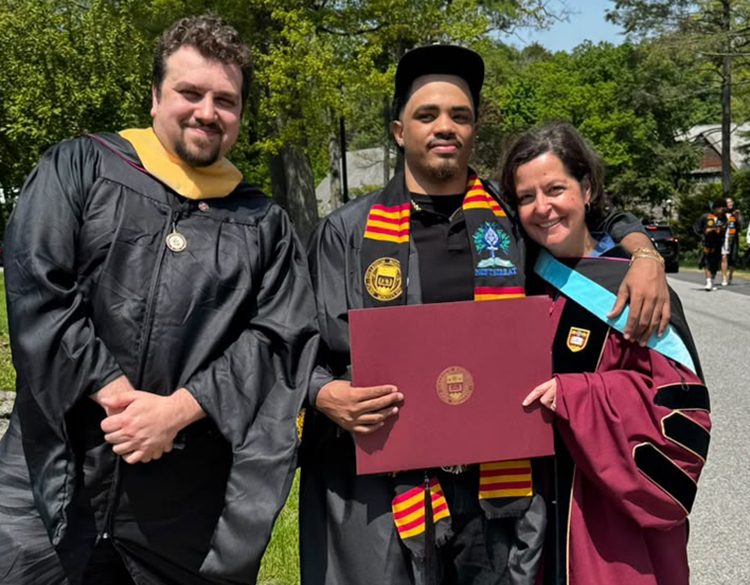
Jesuit in formation Mario Verde, left, student Pablo Abreu and student success director Genevieve Green pose at graduation at Boston College, May 2026. (Courtesy of Genevieve Green)
Mario Verde fits that latter pattern.
Verde, 40, entered the Jesuits at 33 after a path that included study at Syracuse University and St. John's College in New Mexico, work as a teacher and bartender, and years in which Catholic practice had largely disappeared from his life.
Growing up in the Boston area, Verde said his family stopped attending church regularly around the time of media reports on the clergy sexual abuse crisis. He remained interested in God but spent years looking outside the institutional church. In his late 20s, while living in Philadelphia, he returned to confession and began attending Mass again.
The idea of religious life came later.
"It was a surprise to me. It really was," Verde said.
Advertisement
By his early 30s, he had begun speaking with Jesuits and attending retreats. Looking back, Verde said entering later gave him experiences that now help him relate to people from different backgrounds.
"I think it was really an asset that I had lived life," he said.
He also said that by his 30s he had already experienced many of the possibilities of independent adult life, making it easier to accept what religious life required him to give up.
"I kind of know what I'm missing, and I'm OK missing it if that makes sense," Verde said.
Joseph Grabowski Jr., a seminarian for the Archdiocese of Newark, came to the priesthood by another route.
Grabowski, now 39, spent years in retail management and corporate procurement. He lived in New York City, stopped practicing his Catholic faith and was in a relationship with a woman for six years. The couple became engaged and lived together.
By 2019, he had begun returning to church. Then the COVID-19 pandemic disrupted both his career and his personal life. His employer shut down, his relationship ended and he began practicing his faith more intensely.
The idea of priesthood did not seriously enter his mind until late 2020. He was 34 when he began speaking with priests about seminary.
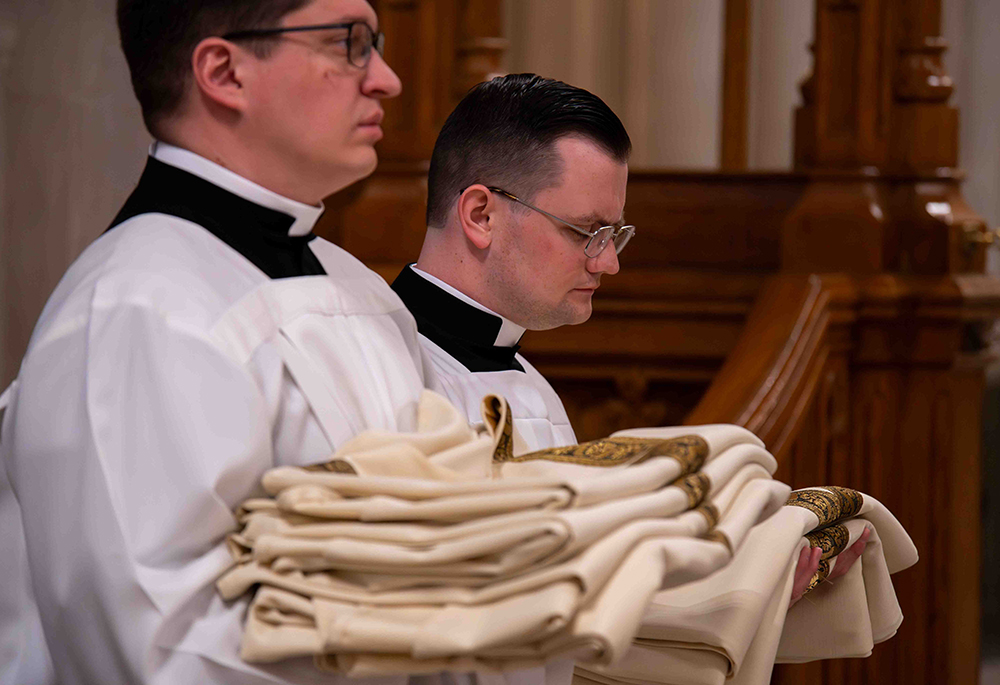
Archdiocese of Newark seminarian Joseph Grabowski Jr., left, is pictured with fellow seminarian James McElroy, serving at the archdiocese's presbyteral ordination Mass on May 23, 2026, at the Cathedral Basilica of the Sacred Heart in Newark. (Courtesy of Archdiocese of Newark)
"I had never thought about it as a kid, never dreamed about it. Never played Mass. Wasn't really something I'd ever thought of," Grabowski said.
He entered seminary in August 2022.
For Grabowski, entering formation older brought both strengths and challenges. He had grown accustomed to independence and to making decisions in the workplace. Seminary required him to adjust to a community in which many of his classmates were at least a decade younger.
"The biggest challenge for me was just kind of like overcoming my pride and overcoming the way that I have done things," he said.
But his years outside seminary also shaped how he understands the kind of priest he hopes to become. Having worked in the corporate world and lived through a long-term relationship, Grabowski said he believes he can better understand the lives of people he may one day serve.
Erick Tatro, 44, instead, is just at the beginning of that transition.
Tatro grew up in Michigan and Ohio, studied at Ohio State University and the University of Pittsburgh and pursued an academic career before moving into scientific communications. He now lives in New York City and manages publications for a pharmaceutical company.
This year, at 44, he decided to enter formation with the congregation of the Paulist Fathers.
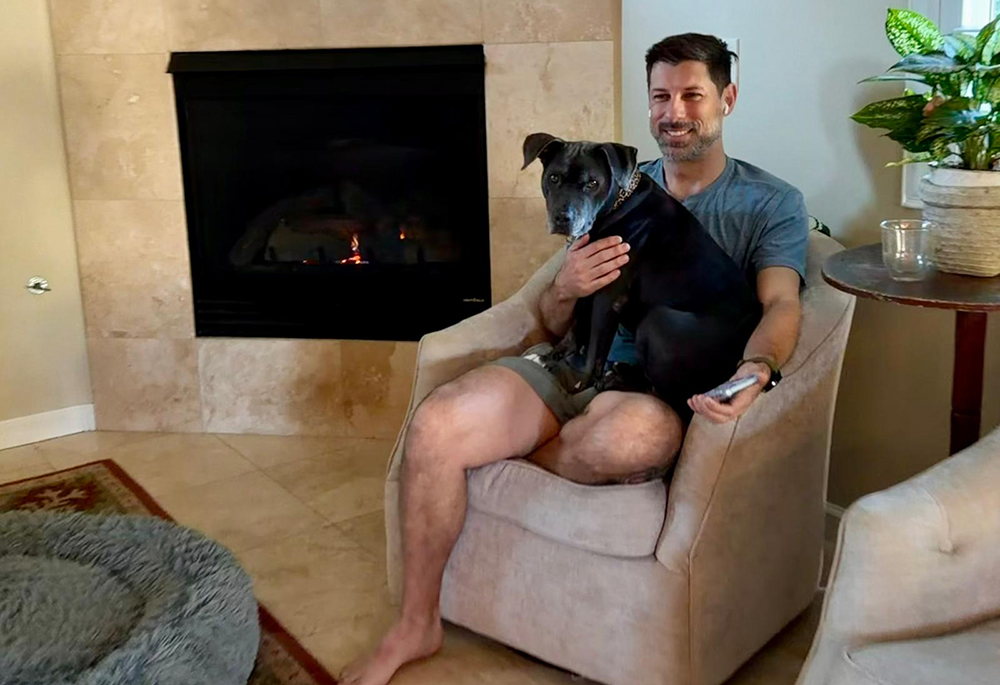
Paulist seminarian candidate Erick Tatro (Courtesy of Grant Lewis)
Tatro said the thought of priesthood had existed in some form for years, but he had assumed that his age had effectively closed the door.
"I realized the door is not actually closed for me like I thought it had been for this path at my age," he said.
A conversation with a fellow parishioner helped change that. While serving as an OCIA sponsor, Tatro was speaking with a friend about a Gospel passage when the friend asked whether he had ever considered becoming a Paulist Father. Tatro had read only hours earlier that one possible sign of a vocation was hearing the suggestion from someone who knew him.
"For me," he said, "that was like a spark."
Tatro said he sees his years outside religious life as an advantage rather than lost time.
"I think that having life experience to draw from out in the world can bring a diversity of experience and add to the potential pool of wisdom that you might have," he said, adding that it will likely help him empathize with those who may come to him for pastoral care.
CARA's figures suggest men like Verde, Grabowski and Tatro are not replacing younger vocations, but they remain a substantial part of the U.S. priesthood's pipeline. Do said ordinands in their 30s and 40s have made up an average of 54% of ordination classes over the past two decades. In 2026, they account for 48%.
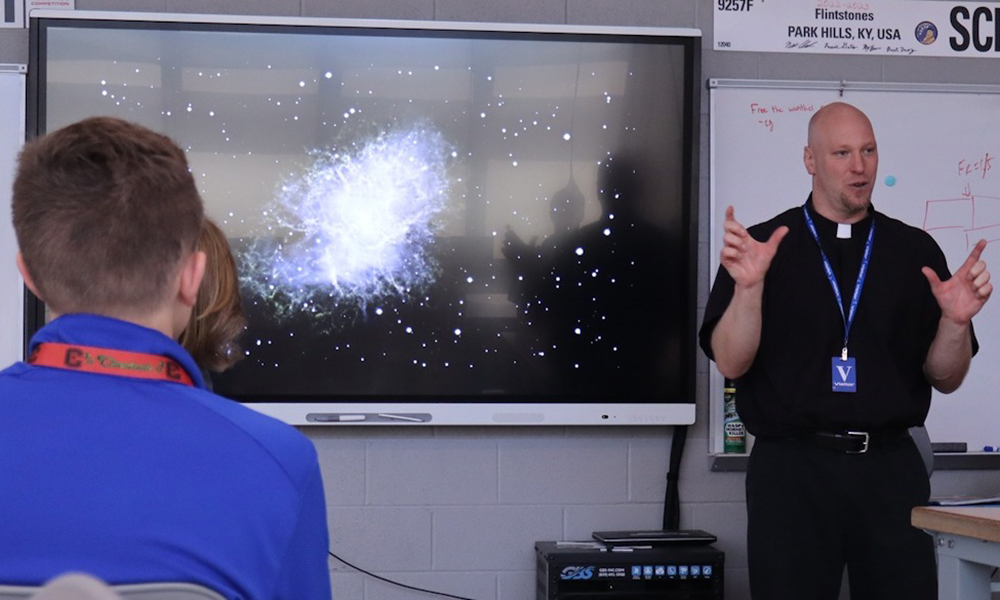
Jesuit in formation Rob Lorenz gives a presentation to students at Covington Catholic High School in Park Hills, Kentucky. (Courtesy of Bob Lind)
The pattern is especially strong among religious communities. Do said men in their 30s and 40s make up 80% of the 2026 ordinands from religious institutes, compared with 40% among diocesan ordinands.
At the same time, she cautioned that older vocations have limits as an answer to the long-term shortage of priests. Men entering later naturally have fewer potential years of active ministry, and CARA has seen a sharp decline in vocations among men 50 and older.
Lorenz, however, resists describing his own path as late at all.
When he entered the Jesuits, he recalled, his vocation director would put him aside, slap his hand and correct him whenever he used that word.
"It's all in God's time, Rob," Lorenz recalled him saying. "This happened just according to God's design. You weren't late, you were right on time for everything that God's called you to up to this point in your life."
"The park ranger life was my vocation for 17 years, and this is just the next iteration of me being faithful to God's call," he said. "And so I think no vocation is late as long as you're being faithful."