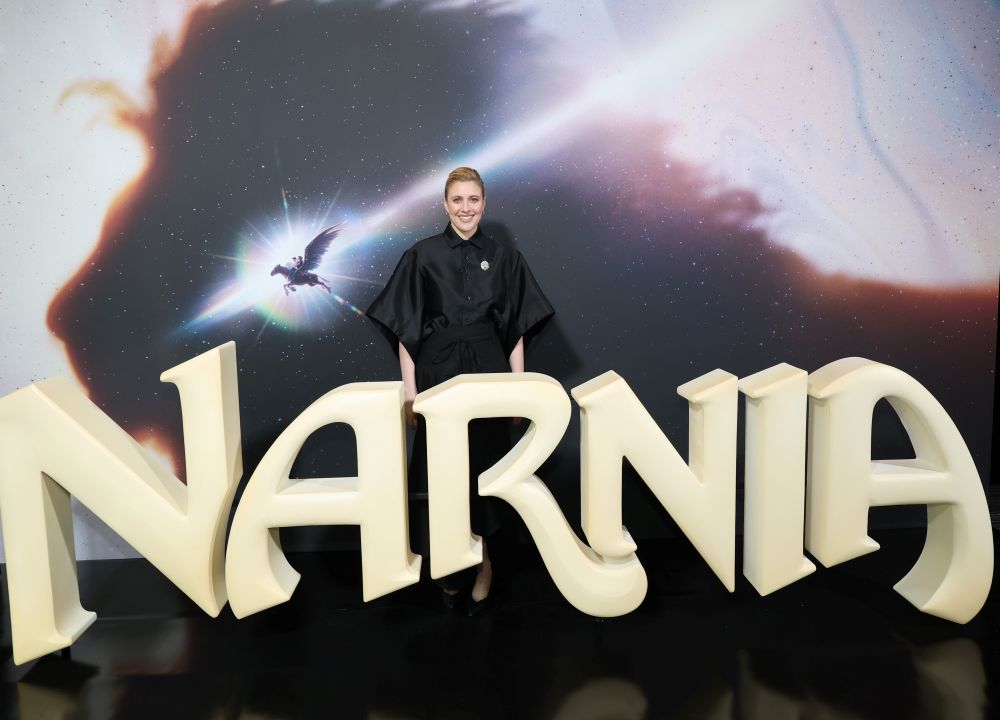
Greta Gerwig attends Netflix's Narnia IMAX exclusive sneak peek event at AMC Lincoln Square 13 on Oct. 13, 2026, in New York City. (Netflix/Getty Images/Kevin Mazur)

by Jim McDermott
Join the Conversation
Send your thoughts to Letters to the Editor. Learn more
When writer/director Greta Gerwig announced that the role of God-figure Aslan in her upcoming Narnia film "The Magician's Nephew" would be voiced by Hollywood legend Meryl Streep, she was ready to explain her choice.
"I wanted someone who was profound but not pretentious, who had gravitas but not morose self-seriousness," Gerwig said. "Someone who could communicate depth and pathos as well as joy and delight."
The movie releases in theaters Feb. 12 and on Netflix starting April 2
Predictably, this decision has generated negative reactions among some Christians, who have described the move as everything from a subversion of a beloved children's story to an attack on the very identity of God.
"There's a lot of Christians who will be concerned for their children and grandchildren," said Ted Baehr, founder and publisher of Christian film website Movieguide. "The gospel is not a myth." One commentator went so far as to argue that Gerwig was turning Aslan "transgender." A Catholic pastor in Los Angeles wrote that distributor Netflix "is distorting a message so brazenly."
Now, there are some pretty big leaps being made here, starting with the idea that The Chronicles of Narnia are themselves the Gospels (an interpretation that I suspect would horrify their author, C.S. Lewis), or that God can be reduced to a single gender. It's also worth noting that the Aslan of The Magician's Nephew is very clearly not the Christ-figure of some of the other Narnia books, but rather God the creator. Trinity gotta trinity, y'all. Lewis' family has said they're "thrilled" with the casting.
Fifty years ago, Hollywood produced another film about God, this one explicitly so. In 1977, Warner Brothers released its comedy "Oh, God!" in which musician John Denver plays Jerry, an assistant manager of a Los Angeles supermarket who is visited by God. And God is played by 81-year-old comedian George Burns.
Burns, who was famous in Hollywood for his wry delivery, big black glasses and ever-present cigar, played God as a kindly grandfather who sees the mess his children are making of the planet and wants them to know it doesn't have to be that way. He sends Jerry out to tell people, "You can love each other, cherish and nurture each other or you can kill each other." But the choice, he says, is theirs.
"Oh, God!" is, in fact, mostly just a series of chats. Jerry gets to ask God the questions that we all have, including why suffering is permitted and what's the deal with original sin. "Young people can't fall from grace," God says of Adam and Eve, whom he reveals were teenagers. "They're my best things."
Advertisement
Imagined by Larry Gelbart (award-winning writer of "Tootsie," TV's "M*A*S*H*" and "A Funny Thing Happened on the Way to the Forum"), directed by Carl Reiner and performed by Denver and Burns, these simple moments are unexpectedly satisfying. They speak to that desire for a God who is personal rather than omni-anything, and who cares enough to spend time with us.
"How come you have a voice like everybody's?" Jerry asks when God first speaks to him over an intercom. "Empathy," God responds. "I'm talking to you in a way you can accept. I'm relating." It's exactly the pastoral approach to which Pope Francis kept calling the clergy, and that Catholics have seen in Pope Leo XIV.
Still, upon the film's release, some Christians were not amused. "When God is not omnipotent, omniscient, and holy, a portrayal of the Divine becomes a limited anthropomorphism with a touch of magic," wrote one pastor in Christianity Today. "Stop right there," wrote another. "Any good Christian knows that no one has seen God at any time and that it is written in the Bible: 'My ways are not your ways.' "
The criticisms of Gerwig for casting Streep seem more overtly political, but in both cases the God figures serve as a useful Rorschach test, revealing critics' own biases and beliefs.
Intriguingly, that's exactly how Jesus himself often functions in the Gospels. Even before he opens his mouth, some want him dead and some drop everything to follow him. The presence of God reveals us to ourselves. When Jesus preaches that God is light, he means it. And whatever that illumination may show us is an opportunity, an invitation.
"You thought I picked you because you're better than everybody?" Burns' God asks Jerry at one point. "You're better than some, but not as good as others."
Being a religious person doesn't mean that we're right about everything, or even about the important things, like the identity or desires of the almighty. How could we possibly be confident in what is so completely beyond our understanding?
We would do well to receive media depictions of God as reminders that being religious is a commitment to listen, and to strive to grow from what we learn. The Lord is not just a sweet old Jewish man or a CGI lioness voiced by one of our most celebrated actors. But that's not to say God can't speak to us through them, either.