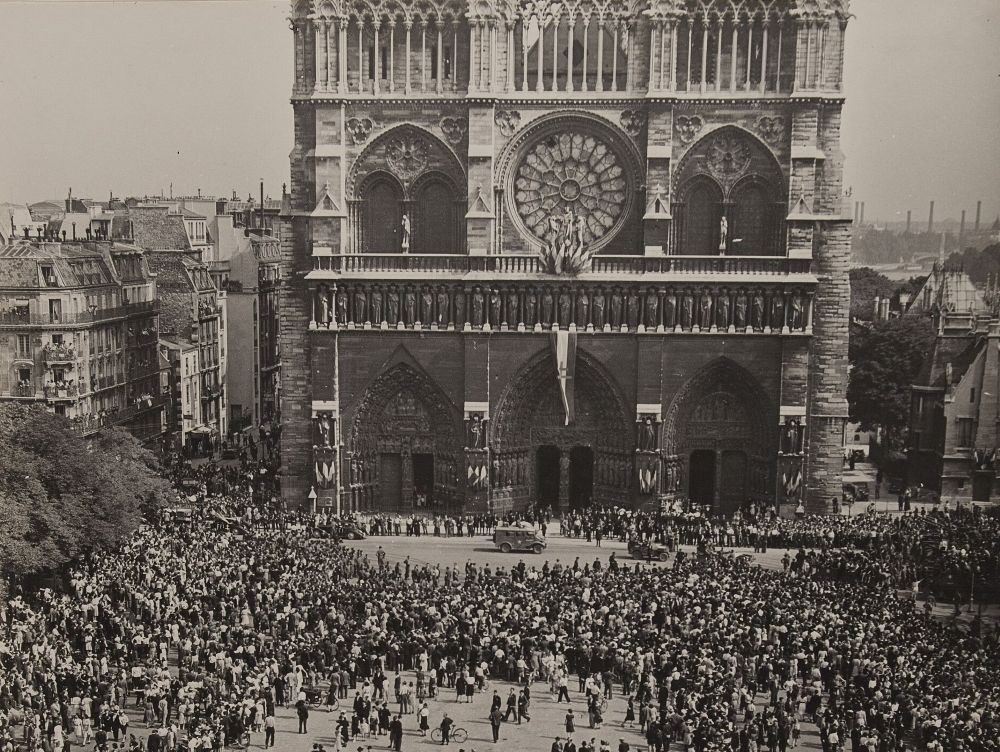
A crowd gathers in the square in front of the Cathédrale Notre-Dame de Paris on Aug. 26, 1944, awaiting the arrival of Gen. Charles de Gaulle after Paris was liberated from the Germans. (Wikimedia Commons/CC0 1.0 Universal Public Domain/Préfecture de Police)

by Vanessa R. Corcoran
Join the Conversation
Send your thoughts to Letters to the Editor. Learn more
On the fifth international apostolic trip of his papacy, Pope Leo XIV is slated to preside over vespers at the Cathedral of Notre-Dame de Paris this week. The Gothic cathedral has stood as a religious and cultural French landmark for nearly 900 years, withstanding warfare, religious strife and natural disasters, and serving as the setting of one of the great 19th-century novels. Let's take a closer look at the popular cathedral's fascinating history.
Medieval origins
Bishop Maurice de Sully oversaw the cathedral's early construction in the middle of the 12th century, with King Louis VII and Pope Alexander III present when the first cornerstone was laid in 1163. It took more than 1,000 workers over two centuries to build Notre Dame, and its stained glass windows and flying buttresses are considered some of the great artistic contributions of the Middle Ages.
King Louis IX (later canonized as St. Louis) acquired numerous relics of the Passion of Jesus, including a nail from the True Cross and the Crown of Thorns, that became permanently housed at Notre Dame. By the early 14th century, Notre Dame had become one of the most singular landmarks of Paris. French philosopher and theologian Jean de Jandun noted in his "Treatise on the Praises of Paris" that the "most glorious church of the most glorious Virgin Mary, mother of God, deservedly shines out, like the sun among stars."
The rise of secularism in Europe
Notre Dame became a religious battleground in the early modern period. In 1548, Protestant Huguenots rioted at Notre Dame, viewing the statues of Mary and other saints as idolatrous. These religious wars gave way to the French Revolution, a watershed moment in France's secularization.
During the height of the French Revolution, Notre Dame was converted to a Temple of Reason in 1790 (renamed "The Temple of the Supreme Being" in 1793). Christian imagery was replaced with secular symbols of liberty: Statues of the Virgin Mary were removed in favor of statues of the Goddess of Liberty. Amid this secular movement, 28 statues of biblical kings on the western facade of Notre Dame were beheaded as rioters mistook them for French kings.
The 19th-century transformation of Notre Dame
As part of his rise to power, Napoleon Bonaparte restored Notre Dame to the Catholic Church with the Concordat of 1801. A year later, he crowned himself emperor at Notre Dame. But during the Napoleonic wars, the cathedral fell into such disrepair that local officials considered razing it to the ground.
Advertisement
Nineteenth-century French author Victor Hugo lamented the decaying state of the landmark in The Hunchback of Notre Dame: "But as beautifully as it has been preserved, as it gets older it is difficult not to sigh, not to be indignant at the degradations, the countless mutilations that both time and man have subjected to the venerable monument."
Indeed, Hugo's desire to see Notre Dame return to her earlier renown led him to pen his famous 1831 novel. Referring to the cathedral as "a symphony in stone," his rich descriptions of the intricate art within captured the imagination of patrons, resulting in renewed public interest and supporting the campaign for its restoration.
Preservation, destruction and restoration in the modern era
Fearing potential destruction during World War II, authorities ordered that the stained glass windows be removed, including the three rose windows. The windows were taken down, panel by panel, and transported far from Paris for safekeeping (it took decades after the war ended to reinstall them). To bolster French morale against the Nazis, Gen. Charles de Gaulle held a special service at Notre Dame on Aug. 26, 1944 — and an annual commemoration Mass is still held today.
Notre Dame has come to be universally beloved: In recent decades a booming tourism movement has drawn over 12 million visitors to the cathedral annually. So when the Parisian landmark caught fire on April 15, 2019, the world watched with horror. As the spire and the medieval wooden roof (known as "the forest") burned, speculation swirled as onlookers feared the end of nearly 900 years of history, art and religious iconography. Due to the quick response of over 400 firefighters, the roof was stopped from collapsing. Had the large church bells fallen, they would have destroyed most of the church. To those who regard the Virgin Mary as protector of the cathedral, the discovery of the intact 1725 Pietà statue Descent from the Cross, by French sculptor Nicolas Coustou, felt nothing short of miraculous.
Notre Dame was closed for over five years for massive renovations, the cost of which have been estimated to be around $750 million, funded by global donations. When the cathedral reopened in December 2024, many were moved by the brightness inside. Instead of dark gray, the marble stone gleamed after decades of accumulated grime was removed. An estimated 2,000 people collaborated in the five-year restoration process.
What Pope Leo's visit means for Notre Dame
It has been 18 years since a pope last visited Notre Dame. (Pope Benedict XVI visited as part of his trip to France in 2008.) In his visit, Leo is not only paying tribute to the five-year restoration of the church but also acknowledging the longevity of the cathedral despite the trials of war and natural disaster. Even amid increasing secularization in France, Notre Dame looms large as a symbol of enduring Catholic devotion and culture.