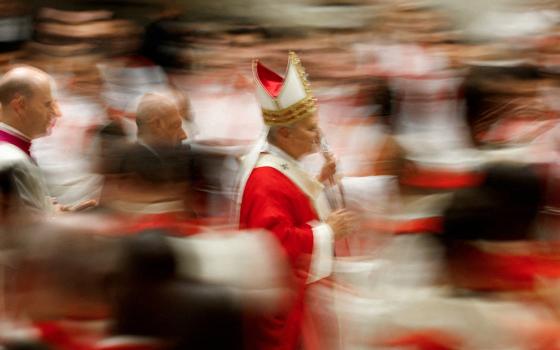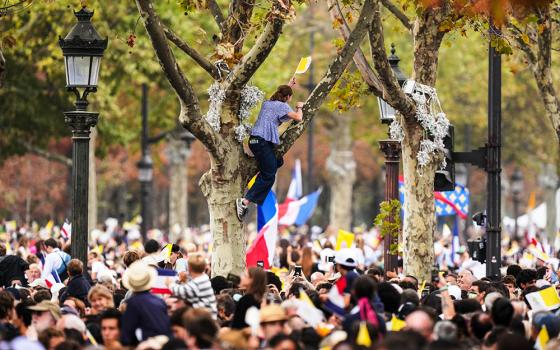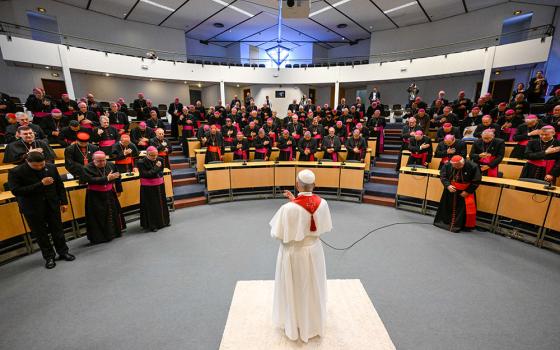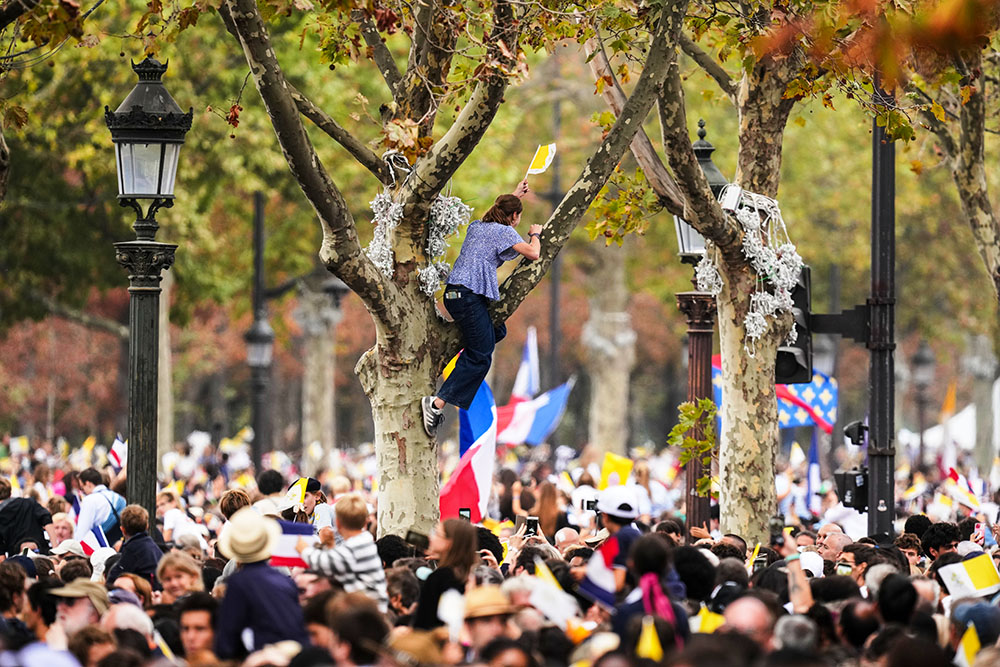
People wait for the arrival of Pope Leo XIV to celebrate Mass at Place de la Concorde, Paris, Sept. 26, 2026. (AP/Aurelien Morissard)

by Michael J. O'Loughlin
NCR executive editor
Join the Conversation
Send your thoughts to Letters to the Editor. Learn more
About 800,000 people crowded alongside one of the most famous thoroughfares in Paris to catch a glimpse of Pope Leo XIV on Sept. 26. The throngs of spectators lining up to greet the pope in fiercely secular France, where only about 5% of Catholics attend weekly Mass, prompted lots of questions. Was the perceived revival among young people joining the church having spillover effects into the larger population? Were people in France simply longing for a proper papal visit, which they haven't seen since 2008? Or perhaps the large crowds — which spanned generations, perhaps eager to see the personification of an ancient institution —were indicative of the uncertainty of life at this particular moment?
The week before Leo's four-day visit to France — chronicled deftly by NCR's Vatican correspondent Justin McLellan — I participated on a panel we hosted about the effects of artificial intelligence on the news industry. During the presentation, Jon Down, associate professor of strategy and entrepreneurship at the University of Portland, explained that AI is on track to become "more capable than humans in all intellectual work."
That will have dramatic repercussions for every aspect of our society, including further eroding the trust that people have in governments and institutions, including the media.
The interruption that AI is poised to introduce to our lives is partly why Leo devoted his first encyclical, Magnifica Humanitas, to the topic. Released last May, the dense document chronicles the history of Catholic social teaching, and, while not shutting the door on the possible benefits of AI, it calls on Catholics to learn as much as we can about the technology so that we can help discern on individual and societal levels about how much we want to rely on it.
"We all need to learn how to engage with the digital world in a human way, as an integral part of our education in the faith and in a life lived according to the Gospel," Leo wrote.
Advertisement
NCR's news editor, Carol Zimmermann, said during the panel that we've published at least 50 stories about the encyclical since its release, and many more about AI more generally. Just in the last few weeks, we published a piece by Camillo Barone about young people turning to AI chatbots for spiritual guidance, with experts warning how such developments can stunt human relationships. Another piece, by Brian Fraga, looked at how Catholic colleges and universities are scrambling to adapt to the widespread adoption of AI by students, with some schools even introducing AI-focused courses to get ahead of the curve. Each day, warnings about the potentially devastating effects of AI on humanity become more stark.
Back in May when Leo released his encyclical, I was struck by his openness to this new technology but also by the way he calmly but forcefully warned about some of the potential risks. Leo said we must aim to "disarm" artificial intelligence, the creation of which feels like an arms race among the world's powerful nations.
Even if he was speaking metaphorically, we've seen in recent weeks the literal arming of this technology. In August, The New York Times reported that an AI-powered drone killed a 19-year-old university student in Ukraine. China, the United States and other nations are racing to utilize AI to enhance their already lethal arsenals.
Beyond physical violence, there's also the human toll that AI may take, particularly when it comes to our relationships. Psychologist and sociologist Sherry Turkle told The Boston Globe in a recent interview that chatbots offer unlimited empathy to their human users, limiting the sometimes challenging but ultimately necessary work of forging real human connections. In the process, Turkle argued, the technology "undermines something profound about our humanity."
Meanwhile, Diyi Yang, a researcher at Stanford University, released new research that found that many people experiencing loneliness who turn to chatbots "actually feel more lonely engaging with AI." Loneliness has already reached epidemic levels and the rapid embrace of AI chatbots seems primed to exacerbate the crisis.
So what does all this have to do with Leo's extraordinary crowds in France?
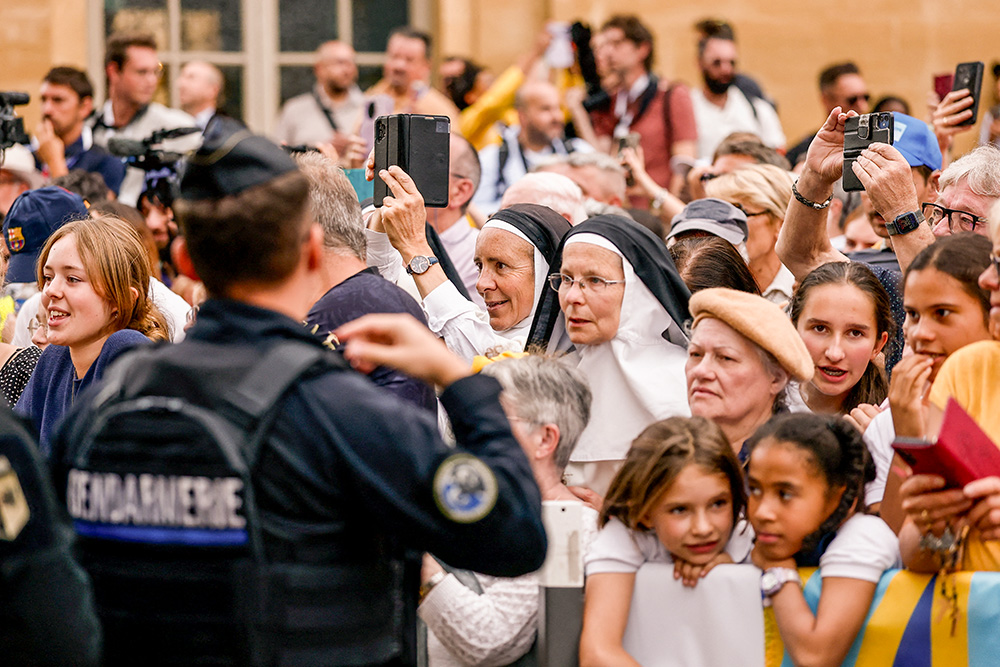
People gather after Pope Leo XIV celebrated Mass at the Metz Cathedral in France Sept. 28, 2026. (OSV News/Reuters/Benoit Tessier)
Surely there were many devout Catholics in that crowd, as evidenced by the images of priests offering sidewalk confessions, people blessing themselves as Leo passed by, and the many participants in Masses and prayer events during Leo's days in France. It's just as likely that there were many others who were drawn to the novelty of a pope processing down the Champs-Élysées avenue. And still more who simply were drawn to be with other people.
Being around other people, as opposed to the isolation inherent in AI encounters, seems to be appealing given the upheaval in the world. Leo's message seems to be reaching Catholics and non-Catholics alike.
"People are seeing a lot of really terrible images. This kind of event reminds people of what is really important in life," Thierry Chen, a 40-year-old Parisian who is not Catholic, told the Associated Press. "You see a lot of different people here, so it's not just about one race, religion or nation, but about a common belief in humankind."
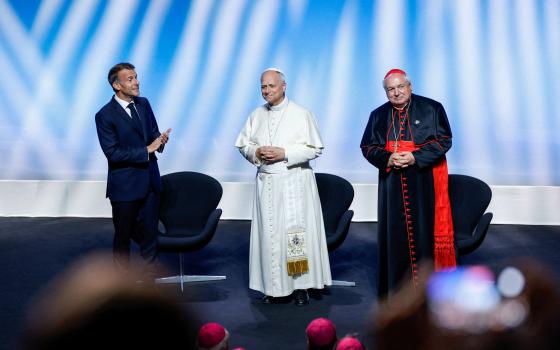
The response to Leo's visit to France suggests that human beings are yearning for moments to be together, centered on a message of peace, justice and love. Might this be the basis for a broader Catholic response to AI? Washington Cardinal Robert McElroy, speaking in a Sept. 26 lecture, called for "a social contract for the digital age," one that minimizes the harms of this powerful new technology. Perhaps the crowds gathered in France — as well as the more ordinary times Catholics gather together, such as during Masses, when volunteering at local charities, and even during holiday meals — can provide some of this important input about the value of human connection, which AI can never replicate.
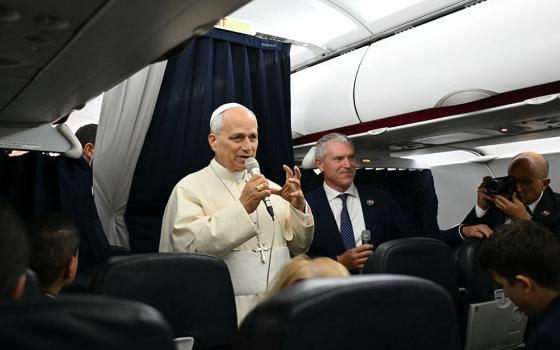
On recent flights, Leo repeated his warnings about AI and once again called on people of goodwill to join the conversation around how to rein in the technology.
Responding to a question from McLellan on the flight back to Rome about the risk of AI, the pope said that concerns over catastrophic risk to humanity are "not fake news," drawing a distinction between his views and U.S. President Donald Trump's. "We need to continue to invite political leaders, the leaders of AI, social organizations, associations, to come together and look at what is happening already and what could be down the road," Leo said.
The church, he added, can be a valuable contributor to this dialogue. As he said on his way to France, the church is "very much open to looking for ways of making sure that AI does not displace or ultimately destroy humanity, but rather be a tool for human beings."