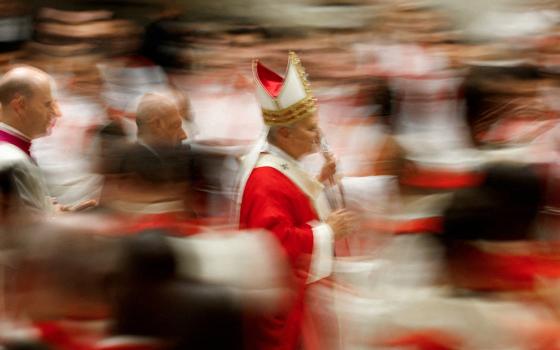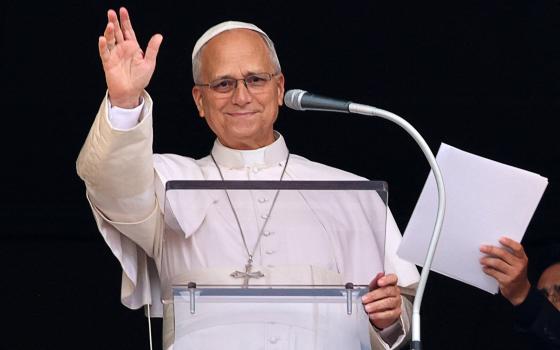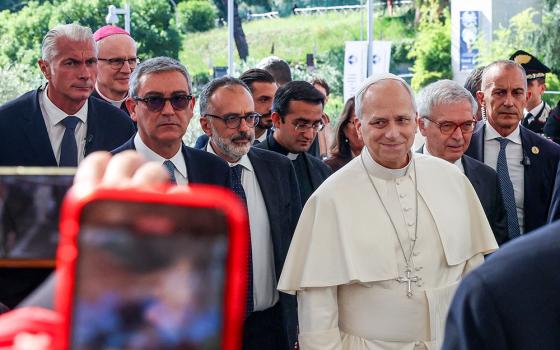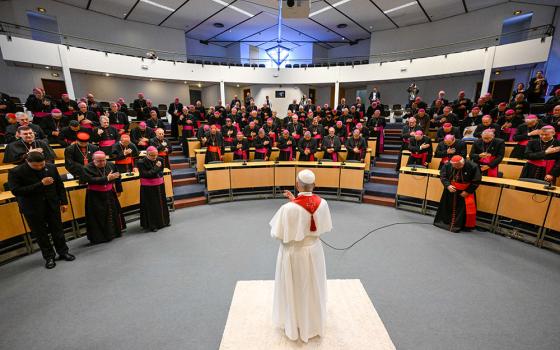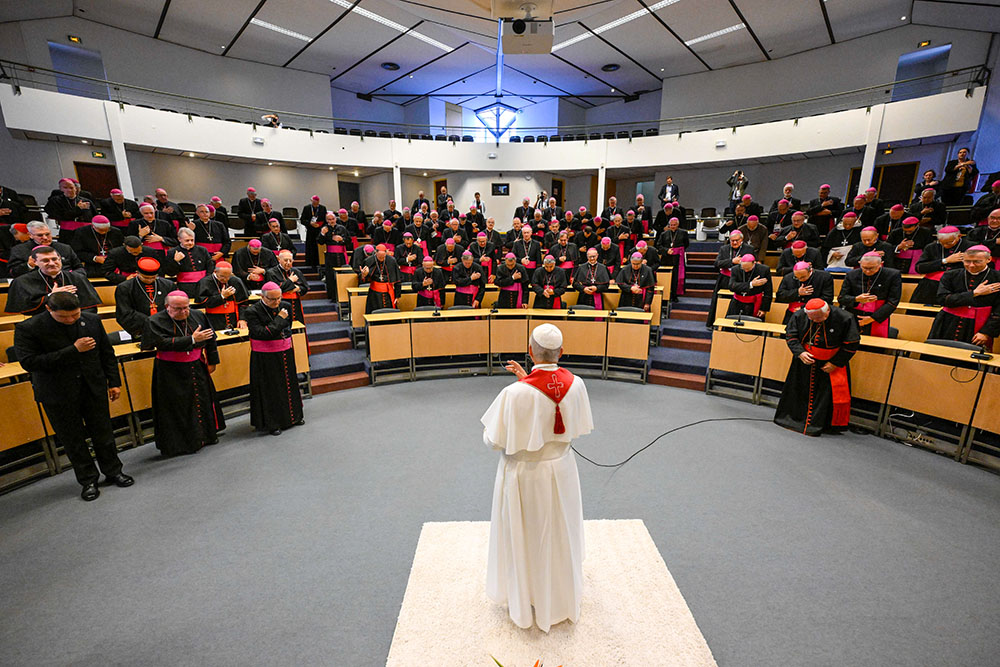
Pope Leo XIV meets with members of the French bishops' conference in the Sainte-Bernadette auditorium at the Shrine of Our Lady of Lourdes in Lourdes, France, Sept. 27, 2026. (CNS/Vatican Media)

Join the Conversation
Send your thoughts to Letters to the Editor. Learn more
When a pope makes an apostolic visit to a foreign land, he must give many speeches and sermons. As with any world leader, these texts are prepared by a team after much consultation with local officials and Vatican diplomats. No one outside the papal household knows who drafted which talk. Once the text comes out of the pope's mouth and is printed on the Vatican website, however, the words are his.
Of these many talks, it is the address to a nation's bishops that usually tends to reveal a pope's approach to the governance of the church most clearly. The bishops are his principal collaborators in that governance. After he goes back to the Vatican, they stay on to get the jobs done. The work of the bishops — and sometimes the scandals — constitute a large part of the briefings a pope gets from his senior staff every week, whether he is dealing with dicasteries for bishops or doctrine or clergy or evangelization.
This week, in France, the Holy Father spoke to the French bishops who had gathered, as they do for all their meetings, at Lourdes. And the themes Pope Leo XIV highlighted there are key to how he understands the priorities for the church in France.
The pope acknowledged the increased numbers of French young people entering the church and mentioned his meeting with the recently baptized the previous day.
"Show them [the young people] the way of the Gospel, the only sure path — even when it is demanding — which has already borne so much fruit in this land of France," the pope said "Yesterday, in Paris, we spoke of the encouraging sign of the catechumenate, which is now made up mostly of young adults. This is a grace and a joy for the whole people of God."
Leo emphasized the fact that this work, and all the church's works, is rooted in Christ: "To renew hope and give fresh impetus to the church's mission in France, which I earnestly desire, there is only one 'road map,' which is always the same: to make Jesus Christ known and loved, authentically, passionately, again and again."
The pope highlighted specific challenges, such as education, the "scourge of abuse committed against minors by members of the clergy," the decline in vocations, especially to consecrated life, and the need for unity within the church. The French bishops have been focusing on education recently, so leading with that certainly was intended to affirm them. The sex abuse crisis has taken a heavy toll on the French church, as has the drop in vocations, as they have affected the church in the U.S. Following the reforms initiated by Pope Francis, Leo insisted that ecclesial unity "is enriched through reciprocal dialogue, rooted in faith and expressed in the synodal style that we have been seeking to deepen in recent times."
Leo did not specifically mention his July decision to excommunicate the bishops and clergy of the reactionary Society of St. Pius X after the group consecrated four new bishops without a papal mandate. He did reaffirm papal authority, quoting from the Second Vatican Council's 1964 Dogmatic Constitution on the Church, saying, "This unity is not a flat uniformity, but rather allows every sensibility that is authentically Catholic to converge naturally in a common profession of faith, through obedience to the legitimate pastors and especially to the successor of Peter, who is the 'lasting and visible source and foundation of the unity both of faith and of communion.' " He added a line that might be seen as directed at some of those sympathetic to the Society of St. Pius X: "This is a dynamic unity, nourished by the tradition of the church — from the fathers to the Second Vatican Council — and by the post-conciliar magisterium." Leo is not about to negotiate the validity of Vatican II.
There were echoes of St. John Paul II in the section of the speech in which the pope encouraged the bishops to continue their public witness.
"The church has every right to be heard in the public square. By its nature, it possesses a prophetic authority. Even if it is not always understood, her voice is nonetheless needed," Leo said. "Even when her teaching is not followed, particularly on essential questions touching the foundations of civilization, it remains necessary. Do not doubt this. I know of your steadfastness and courage — as you showed clearly during the recent debates on end-of-life issues — and I encourage you to persevere, together with all people of goodwill who uphold the same values."
Advertisement
The pan-American pope is, like his Polish predecessor, bracing his brother bishops to the challenge of secularization.
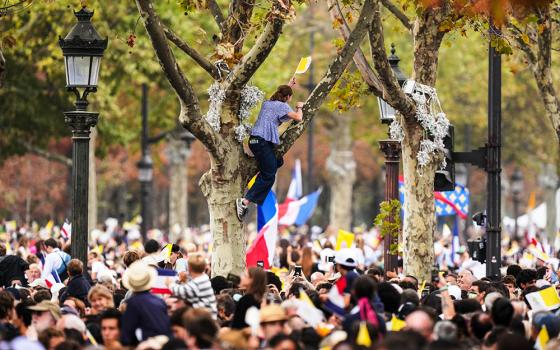
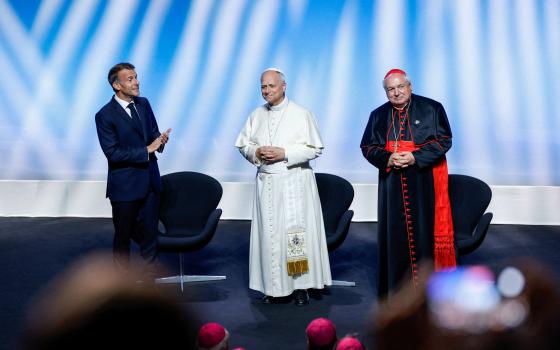
Commending the French bishops for their recent, albeit unsuccessful, fight against legalizing physician-assisted suicide was also noteworthy. He referred to it again later in the day when he met with the staff and the infirm of the community of L'Accueil Notre-Dame in Lourdes. And while not mentioning the issue specifically, he reiterated the church's commitment to the right to life and "to support frailty with loving care, to accompany every stage of life with respect and mutual trust," when he addressed civil authorities at the Elysée palace. He did not mention the issue even by inference when he delivered his sermon at the Mass in Paris in front of more than 700,000 people.
In one section of his remarks to the bishops, Leo began with a quote from Francis' letter on the occasion of the reopening of Notre Dame cathedral after the fire and restoration. "May the rebirth of this admirable church be a prophetic sign of the renewal of the church in France," Francis had written.
Then, however, Leo goes in a direction that is more reminiscent of Pope Benedict XVI, at once Christocentric, Augustinian and unafraid to name the pathologies of modernity, while cautioning against the demagogues of the time.
"I too believe that the time is ripe for many in our society who are waiting to hear the hope-filled message of the Gospel and see the light of the risen Christ shine before their eyes," Leo said. "The message of peace that has its source in Jesus is all the more needed when, in France as elsewhere in the West, we see a troubling polarization, a decline in fraternity, cordiality and the quality of social life, and a resurgence of violence, inequality and poverty. Faced with such challenges, the false promise of a world where God is absent, is relegated to the private sphere, and where the help of his grace is deemed unnecessary for 'building the City' has given way to disillusionment and disorientation. Yet Jesus clearly warned his disciples: 'Apart from me you can do nothing' " (John 15:5).
The overall message the pope delivered to the bishops was one of support for their work and continuity with his successors. Leo does not have Francis' gift for the striking metaphor, nor John Paul II's skills in the dramatic arts. He does not have the deep theological background of Benedict XVI. You might say, however, that he brings all their strengths together and makes them his own. His is a pontificate of synthesis and enacting reforms in the day-to-day processes of the church. He is to Francis what Paul VI was to John XXIII, the pope who institutionalizes the vision. Whether he succeeds or not will be the test of this pontificate.
Editor's note: You are reading a selection from Michael Sean Winters' weekly newsletter. To get the full edition — including the "In the News" link roundup — delivered 24 hours before it appears online, sign up here!