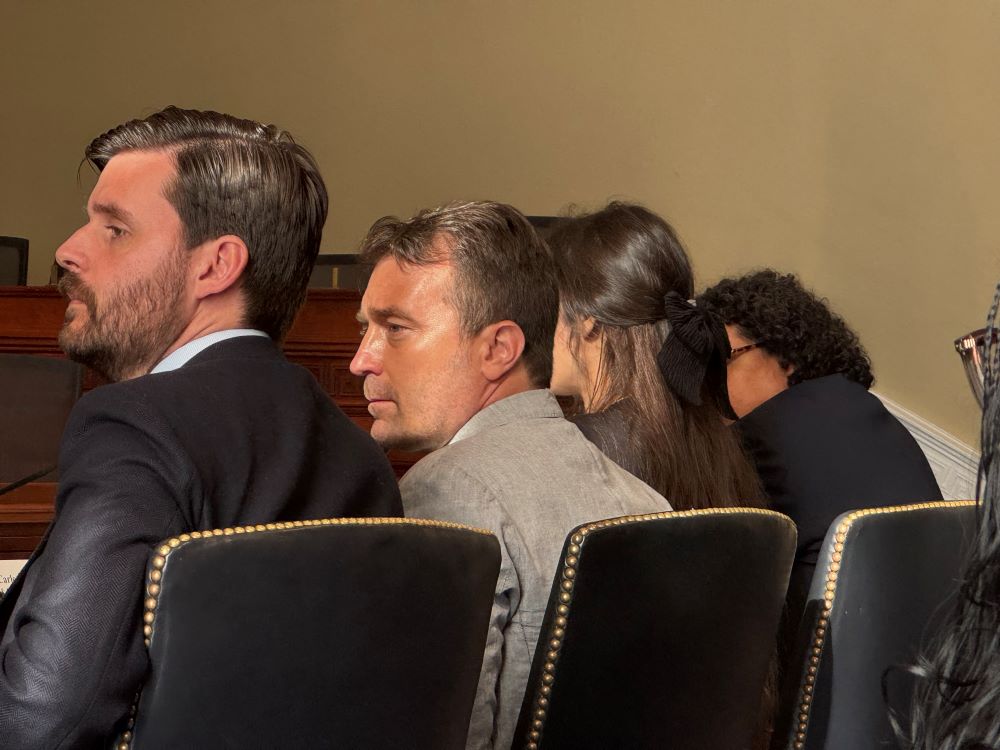
Witnesses listen to a question April 16, 2026, during a hearing of the Tom Lantos Commission in Washington focusing on human rights in El Salvador and U.S. policy. Two of the witnesses, a journalist and a human rights protector, left the country after threats. (NCR photo/Rhina Guidos)

by Rhina Guidos
Join the Conversation
Send your thoughts to Letters to the Editor. Learn more
A recent tense meeting in Congress showcased two very different narratives of El Salvador. In one, free of the scourge of gang violence, happy citizens applauded restored public order. The second painted an image of centralized power that has allowed security forces to spy on, threaten and imprison not only gang members, but also those who disagree with the first narrative.
"Just a few years ago, El Salvador was among the most violent countries in the world, with gangs exercising pervasive control over daily life, extorting families, recruiting children, and terrorizing entire communities," said U.S. Rep. Chris Smith, a Republican and a Catholic from New Jersey, one of the co-chairs of Congress' Tom Lantos Human Rights Commission. "Today, by all available measures, that reality has been changed profoundly and dramatically. Homicide rates have plummeted, extortion has declined, and ordinary Salvadorans are able to go about their daily lives with a degree of safety that was previously unimaginable," he said during the April 16 hearing
Smith's views concur with the Trump administration's narrative on El Salvador, which said in a 2024 State Department Report on human rights practices that "there were no credible reports of significant human rights abuses."
"This is a lie," said Rep. James McGovern — a Democrat and a Catholic from Massachusetts and the commission's other co-chair — about the report. "This is an insult to all those whose human rights have been violated. This is a cover-up. Previous annual reports documented human rights abuses by Salvadoran Security Forces and in Salvadoran prisons. It calls into question the integrity of the human rights report under Secretary [Marco] Rubio. It makes us wonder whether the administration is putting personal politics above human rights."
McGovern said he heard about abuses from Catholic Church members, from other victims he talked to the same year the report was released and from a variety of organizations detailing the violations. He last visited El Salvador in 2024 to participate in events honoring six priests and two Salvadoran women assassinated in 1989 on the campus of the Jesuit University of Central America.
He has been an ardent advocate against abuses in El Salvador funded by U.S. tax dollars, and fought for justice in the rape and killing of three U.S. nuns and a lay missionary in the country in 1980, even as some U.S. officials took the side of the Salvadoran government in blaming the women. Salvadoran soldiers following government orders were later convicted.
Smith, too, said he's traveled to El Salvador.
"Thankfully, I didn't get shot," he said, adding that keeping the gangs at bay, as the current government has done, is "amazing advancement," and citizens, by and large, are thankful.
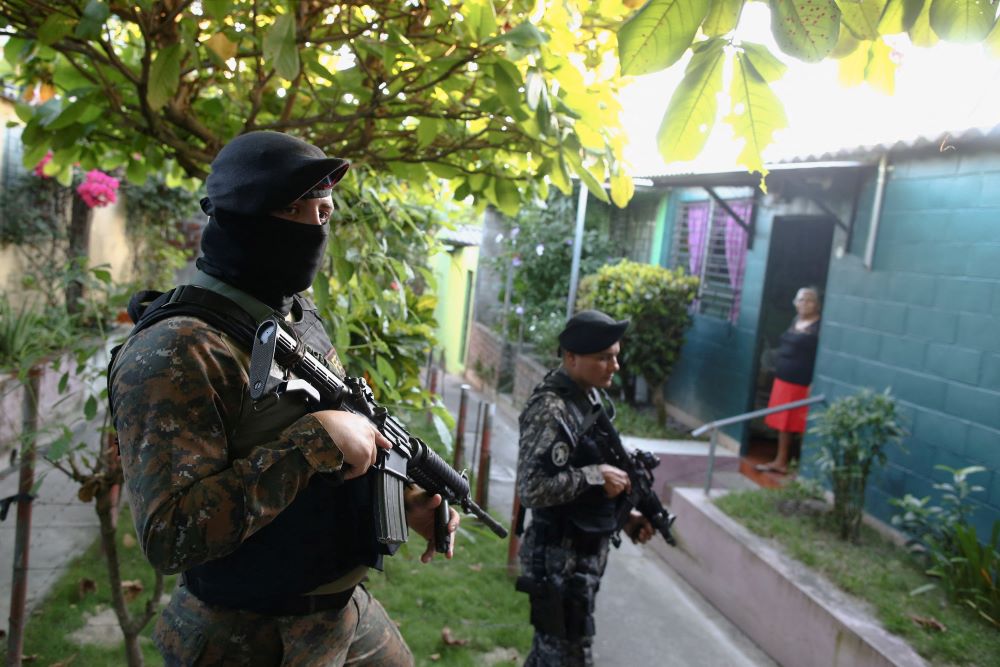
A woman stands in a doorway while armed Salvadoran troops patrol a residential area in Soyapango on Dec. 5, 2022. (CNS/Reuters/José Cabezas)
And he's not wrong. President Nayib Bukele, in independent polls, has approval ratings most politicians would envy, even as the same surveys show that the majority of Salvadorans fear speaking against him or the government.
Susana SáCouto, director of the War Crimes Research Office at American University's Washington College of Law, said the problem is not the result the government achieved, but how.
"Responding to acts of violence attributed to gangs is entirely legitimate. The impact of gang violence is real and devastating, and states, including El Salvador, have a duty to protect their populations and ensure public security in accordance with the law. That duty is not in dispute," she told the commission. "What is in dispute is the manner in which that duty is carried out. Security policies cannot be implemented at the cost of serious human rights violations. They must comply with the rule of law."
And there are reasonable grounds to believe that the Salvadoran government's response to gang violence "meets the elements of crimes against humanity under the Rome statute establishing the international criminal court," she said.
All but one of the witnesses who spoke to the commission said they'd heard of, documented and published some of the alleged abuses, which include sexual violations and torture, as well as extrajudicial killings inside El Salvador's prisons. Two witnesses, a human rights protector and a journalist, testified that their phones had been infected with Pegasus spyware, used for secret surveillance.
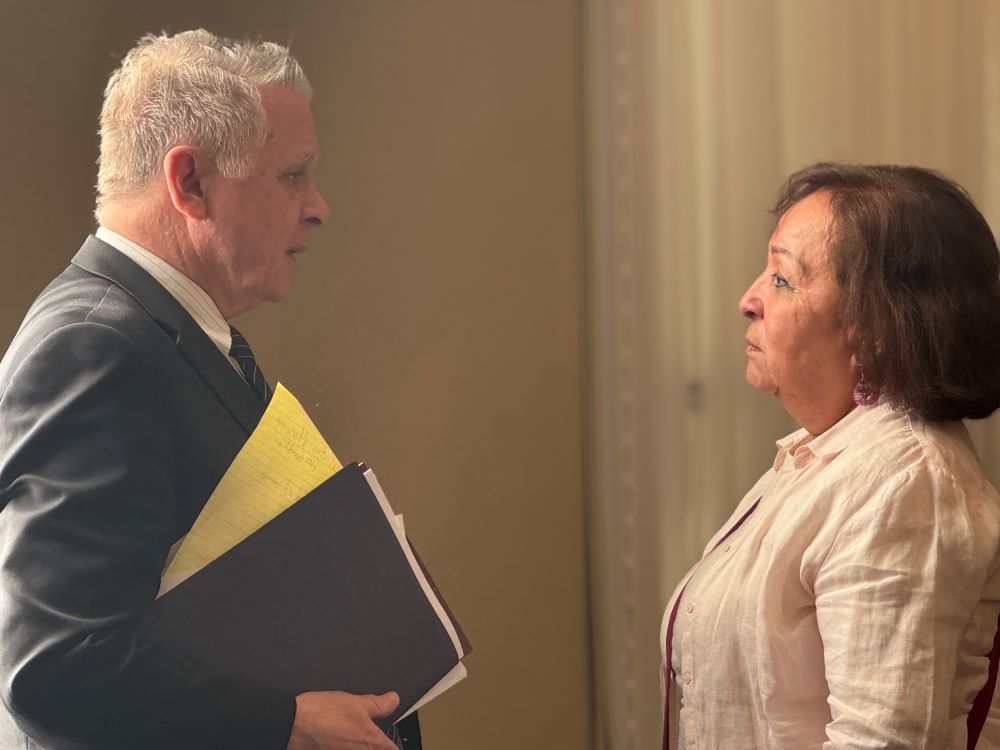
Consuelo Gómez, a Catholic mother from Maryland and head of MOVIR in the U.S., an organization for families of imprisoned Salvadorans who say they are innocent, talks to U.S. Rep. Chris Smith, also a Catholic from New Jersey, April 16, 2026, after a hearing at the Longworth House Office Building in Washington. (NCR photo/Rhina Guidos)
One of them was Noah Bullock, executive director of the faith-based human rights organization Cristosal. He left the country in 2025 after threats. The organization closed its El Salvador offices after the government imprisoned one of its outspoken lawyers in 2025, accusing her of embezzlement and tried her out of the public eye.
"The Bukele regime insists that anyone who questions their security model is defending the rights of criminals over the rights of victims. The regime is profoundly mistaken on this point," Bullock said. "Human rights organizations have advocated for the rights and provided assistance to victims of gang violence for years. We are in full agreement that the state has a responsibility to protect citizens from crime and violence. Our disagreement with the regime centers around the necessity to use policies that amount to crimes against humanity to achieve it."
Journalist Sergio Arauz, president of the Association of Journalists of El Salvador, said while it's true that there's a greater sense of safety in the country, "there's a dark side."
"There is no full freedom," he testified through an interpreter. "And that makes El Salvador the same as North Korea or Nicaragua. Beneath the surface, there is a great deal of fear … the [government] has not only imprisoned gang members, it has imprisoned farmers, community leaders, union members, journalists and human rights defenders. We have documented this, and we have been persecuted for commenting on it."
Granting unchecked power to a single person has bad consequences, he said.
Advertisement
But the Heritage Foundation's Andrés Martínez-Fernández, senior policy analyst for Latin America, said the primary violators of Salvadorans' human rights, the gang members, have been subdued and that was no easy task.
"By any fair assessment, El Salvador's human rights guarantees have been dramatically strengthened by the government's offensive against the narco-terrorist gang threat," he said.
While for many in the room the back-and-forth focused on U.S. policy, for Consuelo Gómez, a Catholic mother from Maryland, some of the arguments hit close to home: She has two sons, including one who voted for Bukele, taken to El Salvador's prisons after the zealous crackdown, she said. After the event, Gómez, who heads MOVIR in the U.S., an organization for families of imprisoned Salvadorans who say they are innocent, approached Smith and talked to him. He gave her his card.
"He told me to write down the story of my children," she told National Catholic Reporter. "He seemed interested."