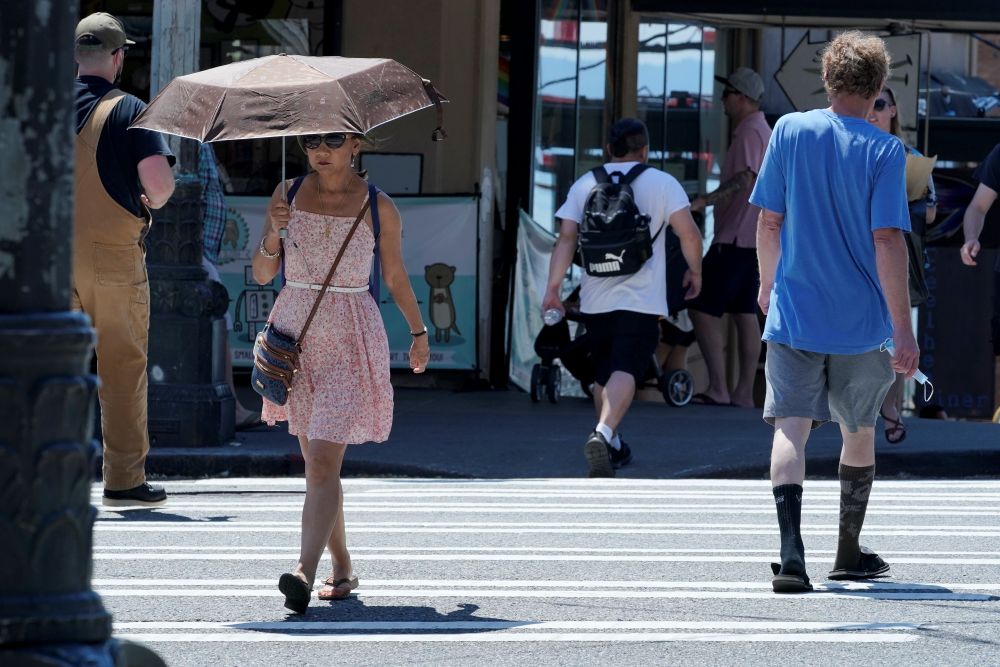
A person uses an umbrella for shade from the sun while walking near Pike Place Market June 29, 2021, in Seattle. The unprecedented heat dome that summer baked the Pacific Northwest for weeks in record-breaking extreme heat. More than 650 people died across the U.S. and Canada, including at least 19 in Spokane. (AP/Ted S. Warren)

Join the Conversation
Send your thoughts to Letters to the Editor. Learn more
Before wildfires in early August burned thousands of acres, evacuated 65,000 people and damaged hundreds of homes in Spokane, the city in eastern Washington was already dealing with high levels of heat.
Temperatures reached 90 degrees Fahrenheit for 13 days in July, part of the hottest month ever for the United States as a whole since recording-keeping began in the late 1800s. In Spokane, the heat wave reminded some of the fatal "heat dome" that befell the Pacific Northwest five years ago and contributed to hundreds of deaths.
Against that sweltering backdrop the Spokane City Council, with assistance from Gonzaga University, passed an ordinance July 29 establishing a new right for renters to have access to a cooling device in their residences. The effort is part of a growing trend in U.S. cities to set such standards in response to rising temperatures resulting from human-driven climate change.
"The fact is that our climate is rapidly changing, and so our laws need to catch up," said Brian G. Henning, director of the Institute for Climate, Water, and the Environment at Gonzaga. "It used to be that you could survive a summer without having any access to cooling. Now that's maybe no longer the case."
The institute at the Jesuit college played a central role in securing the "right to cooling" in Spokane, despite initial opposition from property managers, some housing advocates and even The Washington Post editorial board.
The new ordinance, now in effect, requires landlords and property owners to provide adequate cooling in at least one bedroom or living space. If they fail to do so, tenants can terminate leases or install their own device and deduct up to $500 from their rent. The ordinance also allows landlords to apply for extensions in cases where additional time is needed to install a permanent cooling system or make necessary electrical upgrades.
In recent years, right to cooling and similar laws have been adopted in cities across the U.S. including Dallas, Chicago, New Orleans and New York and Las Vegas. Houston adopted its own right to air conditioning ordinance Aug. 19. Oregon passed a state law in 2022.
Extreme heat is the leading weather-related cause of death in the U.S., and on average kills more people each year than hurricanes, floods, tornadoes and extreme cold combined. Heat can exacerbate underlying conditions, like cardiovascular disease, diabetes and asthma.
Each of the past 10 years ranks as the hottest years on record, as burning coal, oil and gas continues to heat the planet at dangerous and unprecedented rates.
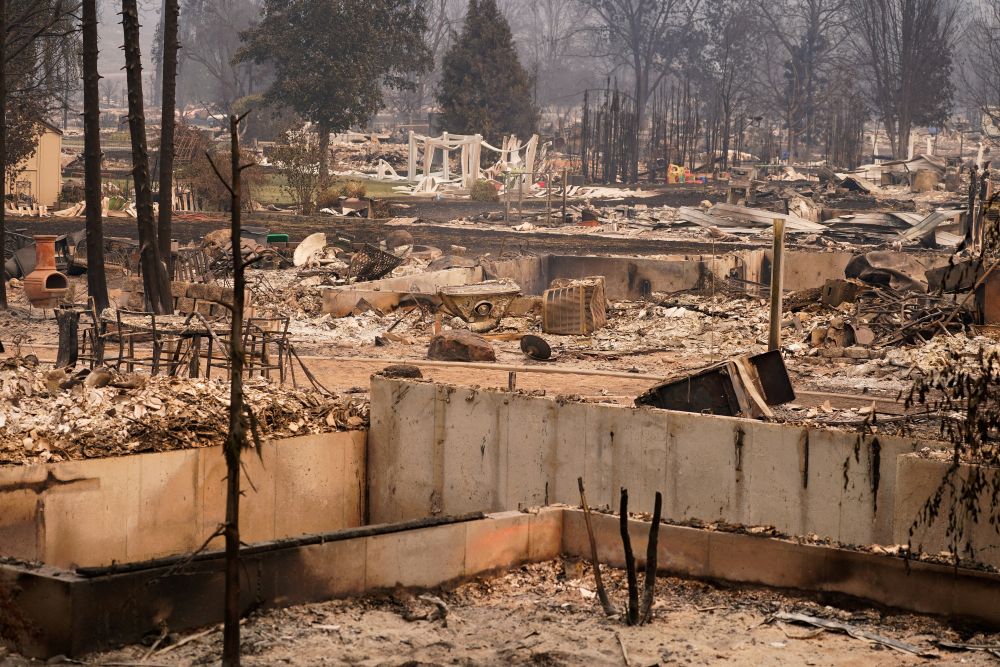
Destroyed homes are seen in a neighborhood in Spokane, Wash., Aug. 3, 2026, after a wildfire swept through the neighborhood. (OSV News/Reuters/David Ryder)
The new ordinance in Spokane builds off a prior one passed in 2024 that gave residents the right to install portable cooling devices, which the Washington Legislature made a state law in June.
The climate institute at Gonzaga assisted with the 2024 law, too, seeing it as a first step to ensure access to cooling. Motivating their work was the memory of the 2021 heat dome that baked the Pacific Northwest for weeks in record-breaking extreme heat, with the average daily max temperature nearly 30 degrees hotter than the summer average for the past decade.
More than 650 people died across the U.S. and Canada, including at least 19 in Spokane, and more than 300 people sought medical treatment for heat-related illnesses.
Climate change was one of the factors of the '21 heat dome, with future warming increasing the odds of heat domes becoming more frequent and intense.
In a way, it provided a wake-up call for the Spokane region, Henning said, to the need for cooling in summer as much as heat in winter.
"Over the last century or so, we've largely considered cooling a luxury that you could have if you could afford it," he said. "The Northwest heat dome in 2021 revealed that cooling should no longer be seen as a luxury that you get to have if you can afford it, that it needs to be seen as a necessity that, in fact, can be the difference between life and death."
Extreme heat has a disproportionate impact on low-income communities and people of color, who are more likely to rent and live in Spokane's lower-quality housing, according to research the institute conducted in its work on the ordinance. It also found 15% of residents lacked air conditioning and the vast majority of people tend to stay at home during periods of extreme heat rather than seek out community cooling shelters.
For council member Sarah Dixit, parts of her district, which includes Gonzaga, face the added strain from the urban heat island effect, where parts of cities with limited tree cover see higher temperatures than others.
"It had been an issue where we see a lot more heat in that area, and just tenants in general wanting to be able to have a respite from the heat," she said.
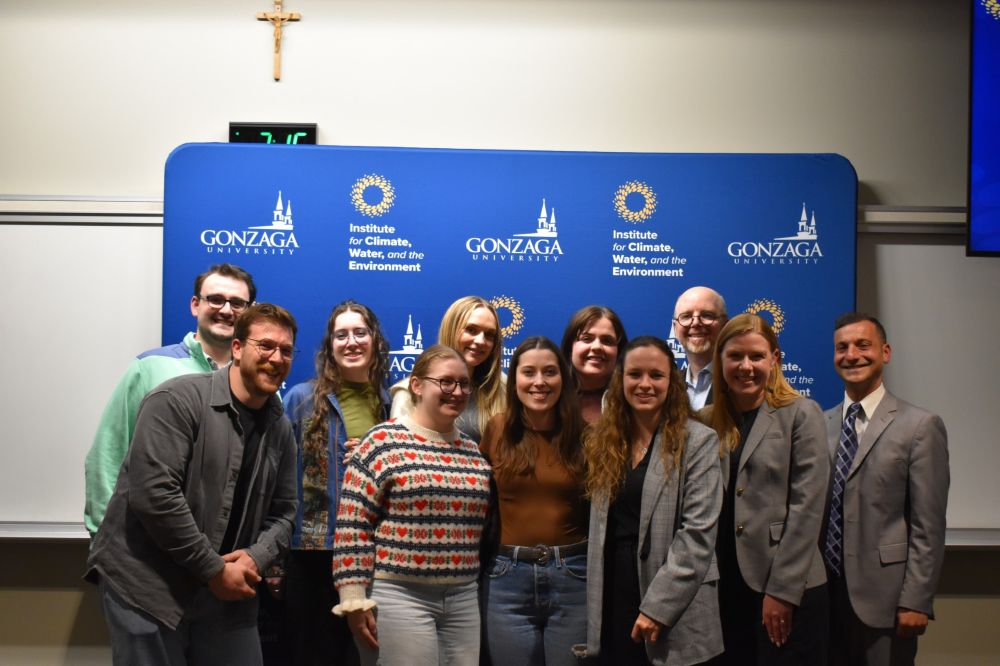
Members of the Gonzaga Environmental Law Clinic pose for a photo with Brian Henning (third from right), director of the Jesuit school's Institute for Climate, Water and the Environment. Hannah Hunter is to Henning's right. (Courtesy of Hannah Hunter)
During the spring 2026 semester, law students with Gonzaga's Environmental & Climate Law Clinic worked with the climate institute to draft a right to cooling proposal. They met with community groups and attended city council meetings. Hannah Hunter, one of the law school students and vice president of the environmental law society, heard support for the ordinance from fellow students, a sizable renting population in Spokane.
"I didn't realize how many people were just sweating it out miserable in Spokane because it is so common to just not have any air conditioning in the [rental] unit," Hunter said.
The ordinance originally required all bedrooms in a residence to have a cooling unit capable of keeping the room below 80 degrees. Those stipulations drew pushback from numerous landlords and property management organizations who worried it would raise costs, and with it tenants' rent.
While some of those objections were expected, it also raised concern from advocates for affordable housing, including the Spokane Low Income Housing Consortium. They also argued the costs of compliance in cooling all bedrooms could lead to a reduction in services and affordable housing if providers of low-income housing, who are restricted by law on rent fees, had to foot the bills alone.
Another concern was how low-income renters could afford energy bills associated with air conditioning, said Jonathan Mallahan, executive director of Catholic Housing Communities, a project of Catholic Charities of Eastern Washington that operates 1,500 housing units as the region's largest affordable housing provider.
"We support people being safe and cool in their homes, and we want to do it in a way that doesn't make it harder to build those homes for people in need," said Mallahan, who is also a board member with the low-income housing consortium.
The debate drew national attention when a Washington Post editorial called the proposal an example of "overregulation" threatening affordable housing.
In response to the objections, Henning and the Gonzaga climate institute convened council members and housing advocates to broker a compromise. Along with scrapping the temperature limit and cooling in every bedroom, council members agreed to introduce a trailer ordinance to free up financial resources for landlords in low-income areas to utilize for cooling units. They have also held discussions with the local utility about cost assistance.
Dixit, while still hoping to expand cooling requirements to all bedrooms, called the compromise "a step in the right direction."
"I think it's something that will help tenants right now," she said.
Advertisement
Mallahan also welcomed the agreement. While Catholic Charities already provides heating and cooling in its units, he said the need for cooling is only growing in Spokane, where the problem often is not a lack of air conditioning but outdated or insufficient systems.
"We need to know where people are struggling, and we need to be proactive and reaching out to people in multiple ways during extreme heat to meet those needs. And this is a positive step in the right direction," he said.
Policy work like the cooling ordinance was always a goal for the Gonzaga climate institute since it was founded in 2021, Henning said. Two years ago, the university was awarded a $20 million grant from the U.S. Environmental Protection Agency to address climate resilience in Spokane, including through greater access to cooling. But the grant was canceled by the Trump administration in 2025.
Henning said the institute and Gonzaga will continue to pursue other avenues for funding and ways to effect public policy on issues related to climate change and environmental justice, guided by Pope Francis' call to "hear both the cry of the earth and the cry of the poor" in his 2015 encyclical "Laudato Si', on Care for Our Common Home."
"We have a role to play in advocating for responsible policy changes that would help to keep vulnerable community members more safe in this rapidly changing climate," he said.