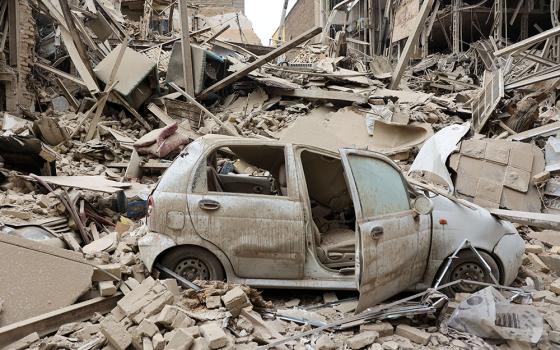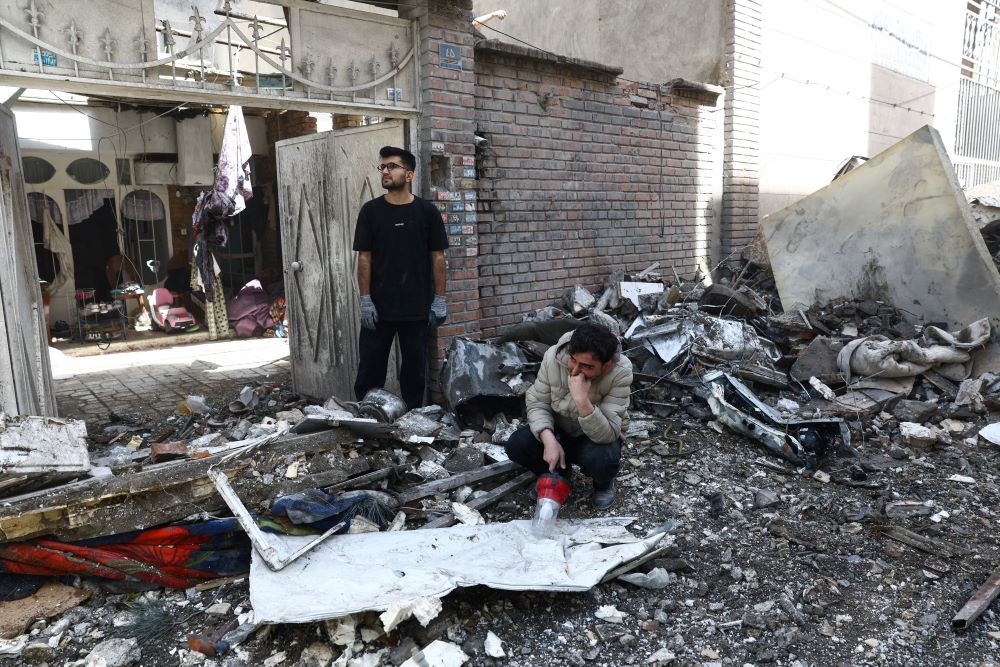
People react at the site of a residential building in Tehran, Iran, March 27, that was damaged by a strike amid the U.S.-Israeli war with Iran. (OSV News/Reuters/West Asia News Agency/Majid Asgaripour)

OSV News
Join the Conversation
Send your thoughts to Letters to the Editor. Learn more
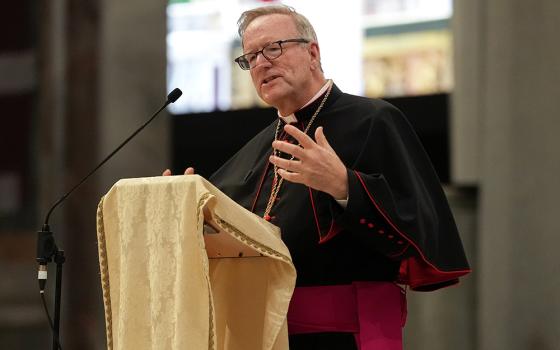
Archbishop Timothy Broglio of the U.S. Archdiocese for the Military Services questioned the legitimacy of America's war in Iran, arguing that the war is likely not justified under Catholic teaching on legitimate defense by military means, sometimes called just war theory.
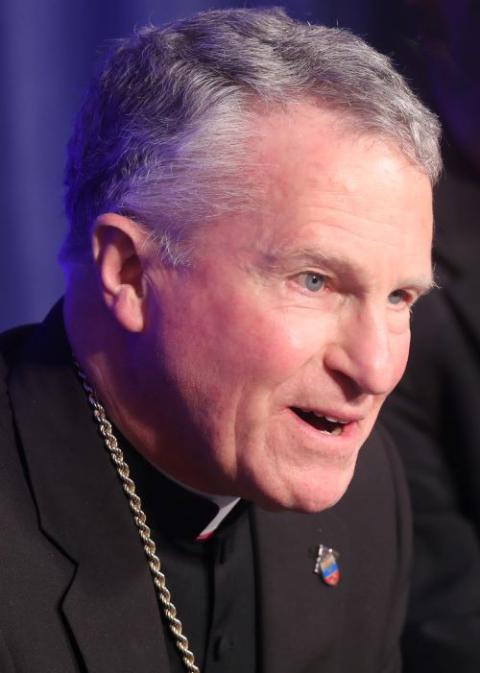
Archbishop Timothy Broglio of the U.S. Archdiocese for the Military Services (OSV News/Bob Roller)
In an interview with "Face the Nation" taped April 2 and scheduled to air on Easter, Broglio said that under the just war theory, he was concerned the U.S. military action in Iran was "compensating for a threat" before the threat "is actually realized."
"I would line myself up with Pope Leo, who has been urging for negotiation," he said. "I realize also that you could say, well, with whom are you going to negotiate? And that, that is ... a problem. But in the meantime, lives are being lost, both there and also among our, our troops. So it's ... a concern."
Broglio's remarks to "Face the Nation" are at least the third time in recent months he, the most recent past president of the U.S. Conference of Catholic Bishops, has publicly criticized U.S. foreign policy.
"I do think that it's hard to, to cast this war, you know, as ... something that would be sponsored by the Lord."
—Archbishop Timothy Broglio
Pope Leo XIV told journalists in March 31 comments at Castel Gandolfo that he hoped President Donald Trump was "looking for an off-ramp" to the conflict with Iran.
Leo has been a vocal critic of war in the Middle East and beyond. His comments March 31 followed his first Palm Sunday homily as pope, in which he proclaimed that Jesus, the King of Peace, embraces all suffering in human history and cries out from the cross against war.
God, Leo said during that homily, "does not listen to the prayers of those who wage war, but rejects them, saying: 'Even though you make many prayers, I will not listen: your hands are full of blood' (Isaiah 1:15)."
Trump discussed the U.S. military action in an April 1 address to the nation, "We are going to finish the job. And we're going to finish it very fast."
During that speech, Trump argued the combat operations against Iran Feb. 28 that killed Ayatollah Ali Khamenei and other key Iranian political and military officials were carried out in response to concern about grave threats, pointing to "the specter of nuclear blackmail."
In response to a question about Catholics in the military who may be concerned about participating in a war the church's leadership has described as unjust, Broglio called it a "a very good question." The ability of some service members to object may be very limited, creating a significant moral dilemma, he said. He advised that such individuals "would probably have to speak to his, you know, to his chaplain, to his chain of command."
"My counsel would be to do as little harm as you, as you can, and to try and preserve innocent lives," Borglio said.
Advertisement
The show's host, CBS News' Ed O'Keefe, asked the archbishop about rhetoric on the conflict from Secretary of Defense Pete Hegseth such as when he "invokes Jesus repeatedly when talking about the war with Iran." Hegseth uses the moniker "secretary of war" since Trump signed an executive order on Sept. 5 adding the "Department of War" as a secondary, ceremonial title for the Department of Defense.
Broglio said Hegseth's remark was "a little bit problematic in the sense that the Lord Jesus certainly brought ... a message of peace and also, I think war is always a last resort."
"Now, you know," Broglio added, "they may have information that led them to think that that was the only choice they had. I'm not making a judgment about that because I really don't know, but I do think that it's hard to, to cast this war, you know, as ... something that would be sponsored by the Lord," he said.
On Jan. 18, Broglio said that any U.S. invasion of Greenland would likely be morally unjust.
"Greenland is a territory of Denmark. Denmark is an ally," Broglio said in response to a question on BBC's "Sunday." "It's part of NATO. It does not seem really reasonable that the United States would attack and occupy a friendly nation."
In December, he said that an order to kill survivors of an attack by U.S. forces on a boat in the Caribbean would be wrong if they posed no immediate danger to those forces. To deliberately kill "survivors on a vessel who pose no immediate lethal threat to our armed forces," Broglio said Dec. 3, is "illegal and immoral."