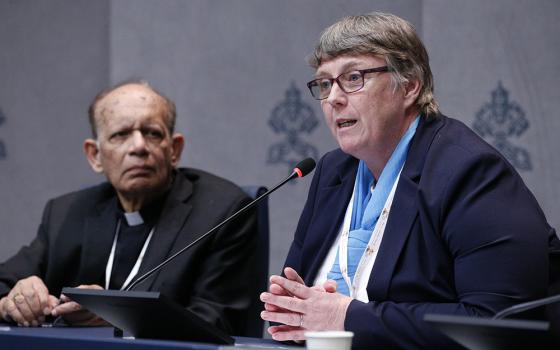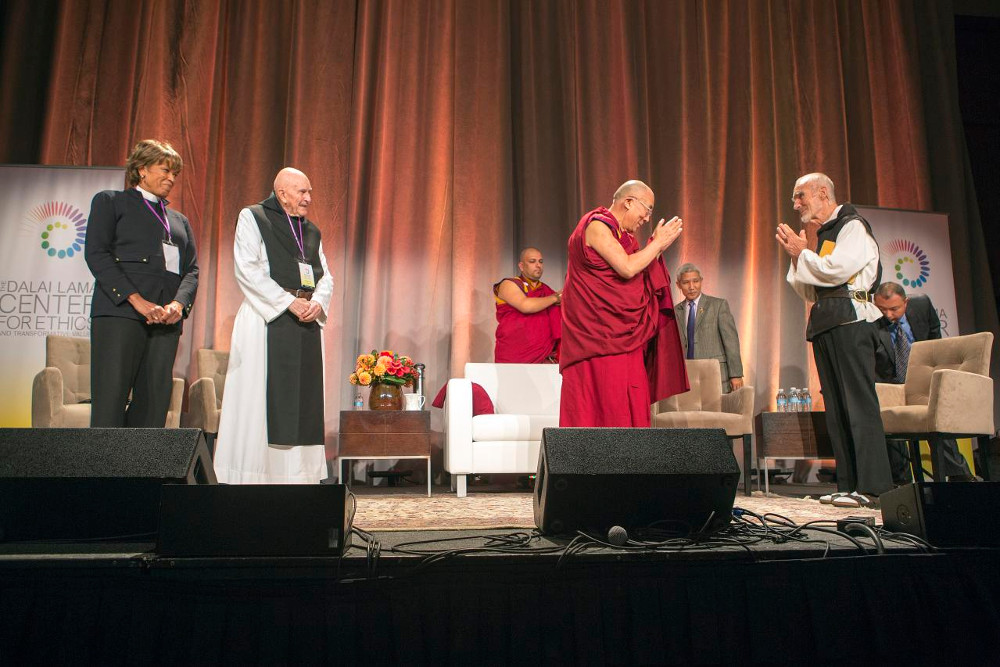
Benedictine Br. David Steindl-Rast, right, bows to the Dalai Lama at a talk on "Beyond Religion: Ethics, Values, and Wellbeing" in Boston, Oct. 14, 2012. (Flickr/Christopher Michel)
Join the Conversation
Send your thoughts to Letters to the Editor. Learn more
Arguably the most influential Catholic monk since Thomas Merton, Brother David Steindl-Rast has carried Benedictine spirituality into the modern world through interfaith dialogue, conversations between science and religion, and robust teaching on grateful living. This week, he turned 100 years old.
Known throughout the world as the "grandfather of gratitude," Brother David was born Franz Kuno Steindl-Rast on July 12, 1926, in Vienna, Austria, where Nazi occupation began when he was just 12 years old. In 1944 he was drafted into the German army but managed to escape after several months and lived underground, concealed by his mother, until the war's end.
It was the constant presence of bombs and the real specter of immediate death that led him to the practice of gratitude, of which he would one day become a globally recognized teacher. (His TED talk, "Want to be happy? Be grateful," has drawn over 3 million views.)
"Gratefulness itself is a real practice," he told me in a 2006 interview. "It's just as valid as … any other practice. It begins with a surprise. You may not even feel that you can be grateful, or you may feel that you are inadequately grateful, but stop and be surprised. Everybody can do that."
The early years
In 1952, at age 26, Steindl-Rast followed in the footsteps of his grandmother, mother and brothers and immigrated to the United States. He was uncertain of his future when a friend told him about Mount Savior Monastery, a new Benedictine community in Elmira, New York. Curious, he traveled to the monastery, where he found a home among the monks living earnest and intellectual lives there. In 1953, he officially joined their ranks.
During his time at the monastery, Catholic activist leaders like Jesuit Fr. Daniel Berrigan and Dorothy Day frequently visited. Inspired, Steindl-Rast soon began to speak out against the Vietnam War, U.S. poverty and other social injustices.
The mid-1960s brought fresh opportunities following the Second Vatican Council. Steindl-Rast was among the earliest Catholic figures to engage in interfaith dialogue, first with Buddhists, and later with Jews and Muslims. In 1967 he received Vatican approval to begin serious Buddhist-Christian dialogue, then unprecedented, which culminated in the publishing of The Ground We Share: Everyday Practice, Buddhist and Christian, which he co-authored with the American Zen teacher Robert Aitken.
Harnessing the council's fresh energy, he also began exploring theological interpretations that aligned Catholic teaching with modern science. He co-authored Belonging to the Universe: Explorations on the Frontiers of Science and Spirituality with physicist Fritjof Capra — whose work has explored the interactions among living organisms, social systems and ecosystems — and with Thomas Matus. The book won a 1992 American Book Award.
Steindl-Rast's spiritual thinking struck a deep chord, and he became a highly sought-after lecturer. For many years, he divided his time between living as a hermit in a monastery and traveling as an itinerant spiritual teacher.
Throughout his prolific career, Steindl-Rast has authored and co-authored more than a dozen books. Among his most popular are Gratefulness, the Heart of Prayer and The Ground We Share. In 2023, at age 96, he published the book You Are Here: Keywords for Life Explorers, which he described as his spiritual legacy.
The ministry continues
Indeed, old age has not made Brother David a quieter presence.
Now living at his monastery in Austria, devoted to writing and contemplation, he has continued to speak in a public voice without retreating from the world. Gratitude, for him, remains a discipline of attention that becomes a summons to action. In recent years, the writing he shares on his website, Grateful Living, has become more political. During the 2024 U.S. elections, he urged readers to assist those who needed help getting ballots or rides to the polls. In 2025, he called readers to plead for aid to Gaza.
Brother David's gratefulness has never meant passive contentment, but rather seeing the gift of life clearly enough to respond to it with peace, solidarity and responsibility.
In 2000, Steindl-Rast co-founded the nonprofit A Network for Grateful Living, whose mission is to "empower people to live meaningful lives through the transformative practice of living gratefully."
Twenty-six years later, the network's website has become a rich focal point for thought and practical guidance, offering videos, articles, podcasts and daily gratitude quotations. The work is guided by five principles: life is a gift; everything is a surprise; the ordinary is extraordinary; appreciation is generative; and love is transformative.
According to the Grateful Living website, "Br. David has been a source of inspiration and spiritual friendship to countless leaders and luminaries around the world including Desmond Tutu, the Dalai Lama, Thich Nhat Hanh, Thomas Merton, and more." Others include Benedictine Sr. Joan Chittister, Trappist Fr. Thomas Keating, Fr. Henri Nouwen and Ken Wilber.
Advertisement
Kristi Nelson, who served as the organization's executive director from 2014 to 2022, recounted the experience of hosting Brother David's 90th birthday celebration in San Francisco. Attendees came from all over the world. Steindl-Rast insisted on personally greeting and hugging each of the hundreds present.
"He was unfazed by the length of time it took," Nelson told NCR. "He held his conviction that it would be unfair for people to travel such distances and not have a one-on-one encounter with him."
Chuck Roppel, a board member of Grateful Living and a close friend since the 1960s, describes Steindl-Rast as energetic with a sense of humor. One fond memory is the time he got into his car after a visit and turned to wave goodbye, to be met with the sight of the tall, lean monk waving back, smiling brightly and wearing a large red clown nose. "So typical," Roppel laughed.
Throughout his life, Steindl-Rast has seen spirituality and mysticism as the inner fires of religion, the driving force of its continual rejuvenation. He likens spirituality to the fiery magma that flows from a volcano, gradually cooling and hardening into rock. Similarly, religious doctrines can become rigid unless we break through the crusted rock and reconnect it with the fire within.
As Brother David turns 100, countless spiritual seekers worldwide have him to thank for keeping the fire going.