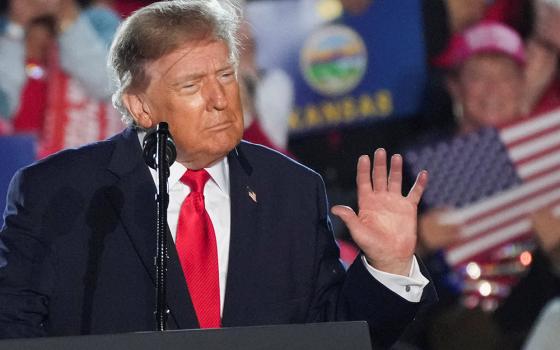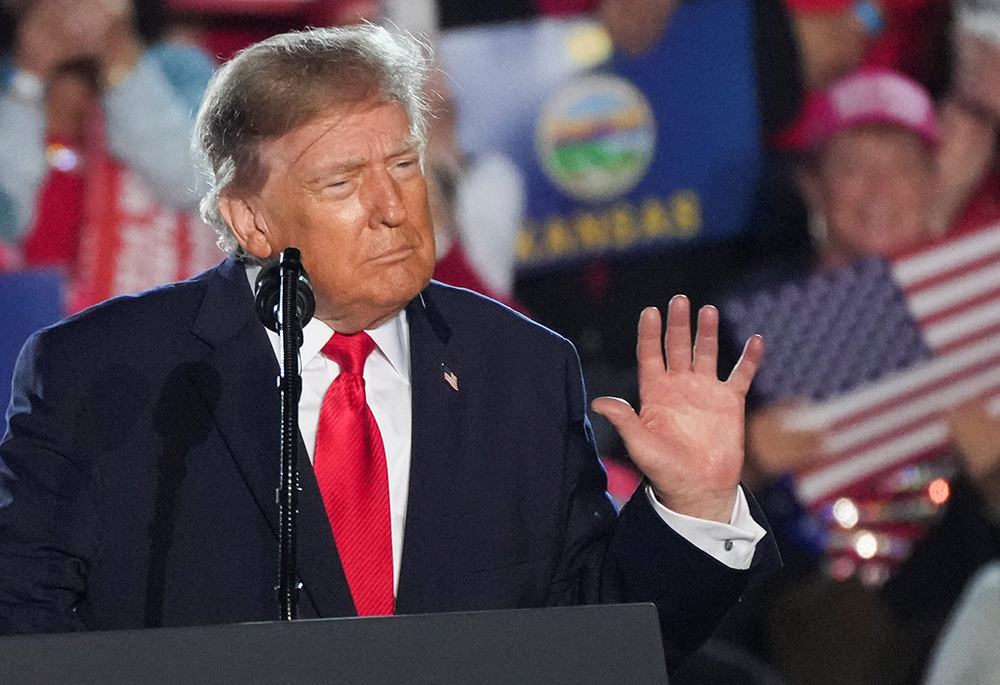
U.S. President Donald Trump gestures as he speaks during a midterm campaign rally at Salina Regional Airport in Salina, Kansas, Nov. 1, 2026. (OSV News/Reuters/Nathan Howard)

by Matthew N. Green
Join the Conversation
Send your thoughts to Letters to the Editor. Learn more
Midterm elections almost never result in wins for the president's party. The party usually loses seats in the U.S. Senate and almost always does so in the U.S. House of Representatives. Sometimes the party is defeated in state-level races too.
But in both the number of losses and the frequency of unexpected outcomes — size and surprise — this year's midterms were a true drubbing for the GOP.
Democrats will lead the House, which was widely expected, but by a larger margin than many predicted. Meanwhile, the Senate, which seemed all-but-unattainable for the minority party two years ago, will have a solid Democratic majority. Democrats have also won multiple governorships and hundreds of state legislative seats, while Republican candidates lost in states and districts that weren't on anyone's radar.
Losing parties invariably look for someone to blame. A strong case can be made that that person occupies the White House. In fact, President Trump arguably did more to hurt the GOP than any Democrat could have done.
Here are four of Trump's avoidable mistakes during his second term that made things much harder for his party in the midterm elections.
1. Backing bad candidates in primaries. Trump's power in his party's primaries is legion: when he endorses a specific candidate, that candidate almost always wins their primary election, even against Republican incumbents.
Unfortunately for the GOP, Trump used that power in this election cycle to recruit or endorse Senate candidates that were incredibly weak when facing Democratic opponents. These included Darline Graham in South Carolina, Ken Paxton in Texas, and Michael Whatley in North Carolina. All three lost despite running in purple-to-deep red states.
Relatedly, one could also blame Trump for putting Ohio — a state that has been trending Republican for years — in play when he chose Ohio Sen. JD Vance to be his vice presidential nominee. That left a vacancy that the state's governor filled by appointing the lieutenant governor, Jon Husted. Appointed senators tend to do worse in elections, however, and he lost to Sherrod Brown despite Trump repeatedly praising Husted's hindquarters.
2. Pushing for mid-decade redistricting. Last year President Trump urged Texas Republicans to redraw their congressional map to squeeze more GOP House districts out of the Lone Star State. It set off a redistricting war in which over a half dozen states gerrymandered their district lines to help one party over the other. While this ultimately benefited Democrats in California (the only Democratic state that implemented it successfully), it backfired badly in Republican states like Texas and North Carolina, where Democrats actually gained congressional seats. As a result, Democrats will have an even bigger majority in the House than they might otherwise have had.
3. Fueling a narrative of corruption and self-dealing. Trump has repeatedly positioned himself as an outsider who would "drain the swamp" of Washington, D.C. But two years of headlines about corrupt schemes and inappropriate behavior by cabinet officials, White House staff, and even an ambassador belied that claim. Trump did not help matters when he accepted lavish gifts and tried to build vanity projects in the nation's capital.
Because most people are cynical about politicians, news stories about political corruption often fail to take hold. Not this time. A mid-October poll revealed that the most common issue that mattered to voters (mentioned by 36% of respondents) was "government corruption." That proved deadly to the incumbent party.
4. Pursing policies that hurt the economy. Political scientists have long known that economic concerns are a major predictor of vote choice in U.S. elections. It's why folks who try to forecast election results usually include at least one variable in their models that measures the state of the economy.
When he was elected in 2024, Trump inherited an economy that was growing modestly but had suffered multiple years of high inflation. There are ways to reduce inflation; raising tariffs and starting a war that disrupts the international supply of oil are definitely not among them. Yet the president did both.
Advertisement
In the aforementioned October poll, "cost of food and groceries" was a close second among voters' biggest concerns (34%), and the price of gas came in fourth (23%). People who sour on the economy will punish the incumbent party. However, since Trump's inflationary actions made it easy for voters to draw a direct connection between the president and high prices, that punishment was especially severe.
What does this mean for the future of the Republican Party? I would not go so far as those who see the midterms as an electoral "collapse" or "armageddon" for the party (both quotes taken from conservative outlets, BTW). Political parties can bounce back quickly, even from big election losses like the ones suffered this week.
This is especially true in our era of electoral whiplash. In fact, over the past two decades, control of Congress has flipped several times, and neither political party has had a majority in the House or Senate for more than eight consecutive years.
In the short run, the party's future will depend on what President Trump chooses to do with his remaining time in the White House. If he intervenes more judiciously in primaries and redistricting (or stops intervening in them altogether), ends corrupt insider dealings in the executive branch, and finds ways to reduce the cost of living for Americans, he could do a great deal to restore the GOP brand. If not, 2028 could be another tough election year for the Republican Party.