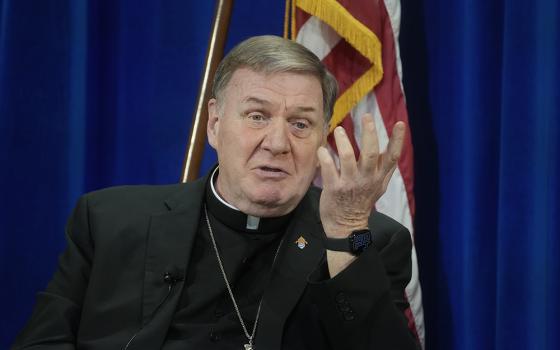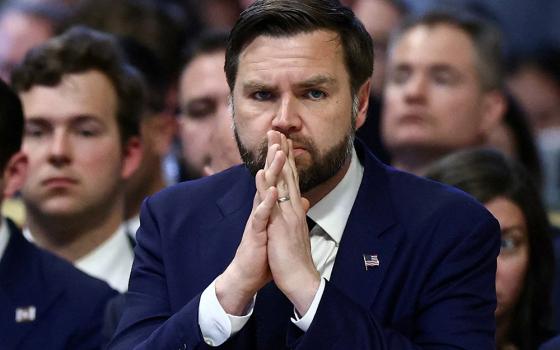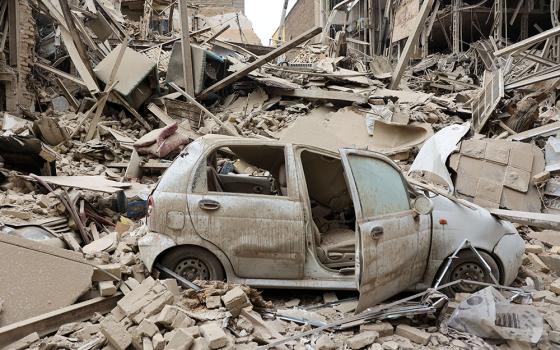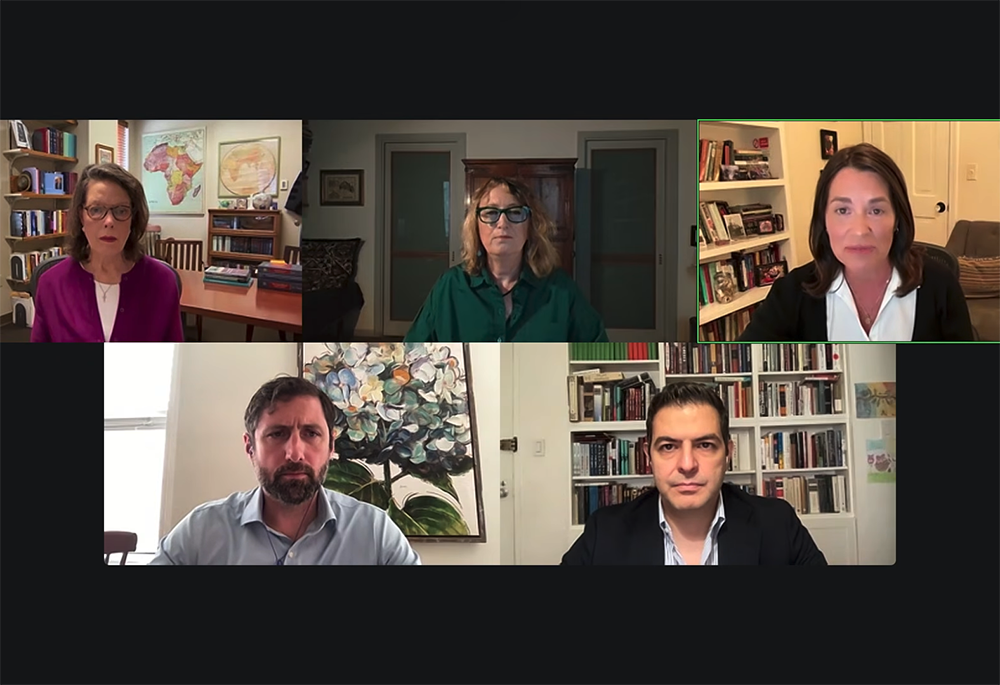
Panelists participate in an April 13 dialogue hosted by the Georgetown University Initiative on Catholic Social Thought and Public Life. From left, top row, are Mary Ellen O’Connell; Elisabetta Piqué; and Kim Daniels; from left, bottom row, are Phil Klay and Sohrab Ahmari. (Courtesy of Georgetown University)

by Brian Fraga
Staff Reporter
Join the Conversation
Send your thoughts to Letters to the Editor. Learn more
Pope Leo XIV is speaking from a "very well-established tradition," in terms of just war theory, said a panelist in a recent Georgetown University discussion where participants were asked to examine what it means to choose peace, as Pope Leo has been advocating since the start of the U.S. and Israeli-led bombing campaign in Iran.
Kim Daniels, moderator at the April 13 event, asked: "What does Catholic teaching actually ask of us today, of our leaders and of our country?"
"I'm looking at a war where Catholic thought tells you you need to have both a clear just cause, a clear and achievable just objective, and the strategy needs to be developed around that. We have never had either of those articulated," said Phil Klay, an author and veteran of the United States Marine Corps, referring to the leadership of the Trump administration
Daniels, the director of the Georgetown University Initiative on Catholic Social Thought and Public Life, which hosted the April 13 online discussion, noted the concerns over Iran obtaining a nuclear weapon and sponsoring terrorism in the region.
"But the conduct of this war raises profound moral questions that can't be answered simply by pointing to the threat that Iran poses," said Daniels, who added that more than 1,400 Iranian civilians had been killed in the first month of operations since the U.S. and Israel began bombing Iran on Feb. 28.
"Pope Leo has been a persistent voice for peace throughout this war, his words growing more urgent with each passing week," Daniels said during the panel titled: " 'War is Back in Vogue': Iran and Catholic Teachings on a Moral Foreign Policy."
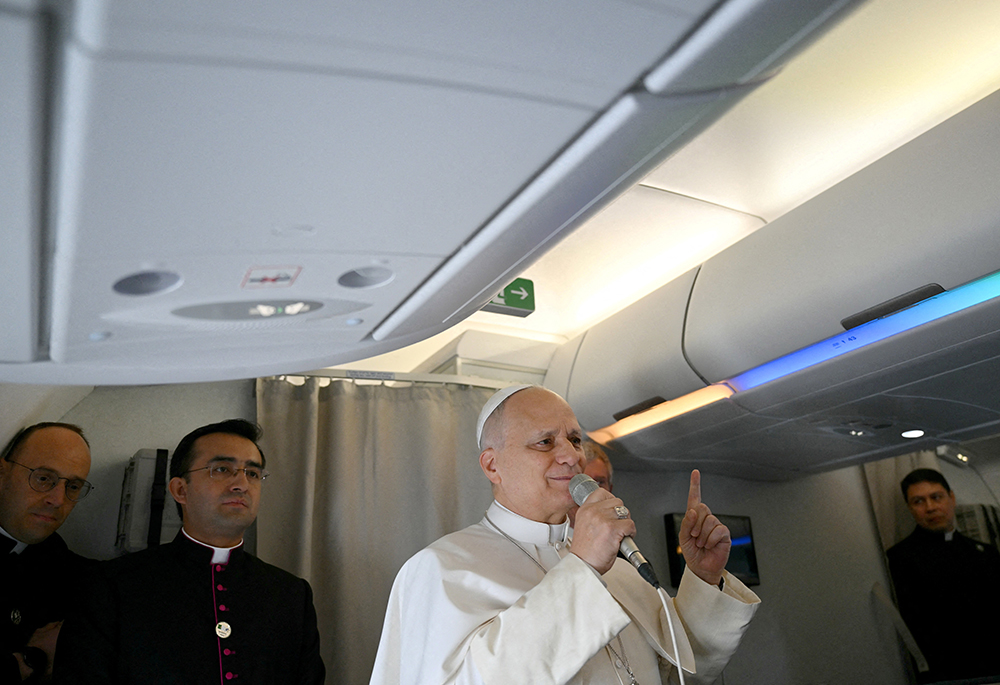
Pope Leo XIV addresses journalists during the flight heading to Algiers on April 13, 2026. U.S.-born Leo pushed back that day on President Donald Trump's broadside against him over the U.S.-Israel war in Iran, telling reporters that the Vatican's appeals for peace and reconciliation are rooted in the Gospel, and that he doesn't fear the Trump administration. (OSV News/Alberto Pizzoli, pool via Reuters)
Sohrab Ahmari, the U.S. editor of UnHerd who writes regularly about Iran, said the Trump administration had not heeded Leo's calls for peace. Ahmari added that he believes there is no military solution to the conflict.
"Ultimately, this is a futile war that has led to the president being cornered," Ahmari said. "You cannot bomb a country into submission."
Daniels noted that the discussion was also being held during "an extraordinary moment" as the president of the United States attacked the pope on social media for his statements opposing the war in Iran.
President Donald Trump's words, Daniels said, were intended "to undermine [Leo's] moral authority, to silence his pleas for peace and for the church's diplomatic efforts, and it should alarm not just Catholics but anyone who cares about religious freedom and all people of good will as well."
Ahmari said Trump's attacks were unprecedented since he was disparaging the pontiff as if he were a fellow politician. Ahmari said Trump was lashing out amid his frustrations with how the war in Iran has unfolded.
"And it's the pope who has the upper hand, I believe," Ahmari said.
On April 12, Trump posted on his Truth Social platform that the first U.S.-born pope was "terrible on Foreign Policy." The following day, the pontiff told reporters aboard the papal plane that he did not fear the Trump administration and would continue to call for peace in the region.
During the Georgetown panel, Notre Dame University law and international peace studies professor Mary Ellen O'Connell said that the pope had spoken "with calm, with diplomacy, with consideration for the human dignity that all people should enjoy, including President Trump."
Advertisement
"Pope Leo has an absolute duty to correct moral falsehoods when they are uttered, especially moral falsehoods of the level of invading a country without legal right to do so, of threatening to wipe out an entire people, that is to commit genocide, to have no concern about the killing of civilians and cutting off their very basic needs for survival, including water and food," O'Connell said.
Leo was among those who criticized Trump's threat on April 7 to destroy Iranian civilization unless the Islamic Republic's regime reopened the Strait of Homuz. The pope said the threat was "truly unacceptable," and he urged Americans and others to contact their political leaders to work for peace.
O'Connell said that Pope Leo's words affirmed international law, which she suggested the Trump administration has increasingly disassociated itself from since the president told The New York Times in January that he doesn't need international law.
"The words [Leo] uses, the bases on which he is speaking these moral truths, in contrast to the falsehoods that he's countering, are all based on international law," said O'Connell, who added that the pope has been "speaking truth to power, but a very strange kind of power, power not based on the consensus of the world."
Elisabetta Piqué, a war correspondent and Vatican reporter for La Nación, Argentina's main newspaper, told the panel that Trump's attacks on Leo appeared to be a sign of desperation, adding that the pope has not been intimidated.
Klay said the Catholic Church is still "troubling the powerful."
"The church's role is not to win a news cycle or a social media slapfight, but to calmly articulate timeless truths which should inform our approach to war and to politics but can never be reduced to our politics," Klay said. "I think that's what Pope Leo is doing, and I think we should listen and pray."