Activists participate in a demonstration to end the use of fossil fuels at the COP30 U.N. Climate Summit, Nov. 20, 2025, in Belém, Brazil. (AP photo/Andre Penner)

Join the Conversation
Send your thoughts to Letters to the Editor. Learn more
The federations of Catholic bishops for Latin America, Asia and Africa have endorsed an international initiative to develop a global treaty to transition the world away from fossil fuels.
The bishops' moral call comes as the global oil market has been rattled by the U.S.-Israel war on Iran and ahead of a major conference next month in Colombia where countries will gather to begin mapping a potential path to a full phaseout of coal, oil and gas.
"Guided by the preferential option for the poor and the care of creation described in the Catholic Social Teaching, we declare our unwavering support for a just transition and strongly call on the governments of the world to adopt a treaty to stop proliferation and abandon fossil fuels as a moral and political imperative," Catholic bishops of the Global South stated in a manifesto released March 16, which also included a commitment to consider divesting their dioceses from fossil fuel investments.
The bishops specifically endorsed the Fossil Fuel Treaty, a grassroots initiative that seeks a legally binding international framework that would immediately end all new exploration and production of coal, oil and gas; an equitable phaseout of current production; and a just transition to renewable energy that would support workers, communities and countries historically reliant on fossil fuels.
The treaty will be the focus of a gathering April 24-29 in Santa Marta, Colombia, convened by Colombia and the Netherlands. The Catholic leaders urged government leaders to attend the meeting and to join the two dozen nations who have lent support to a fossil fuel phaseout. Numerous Catholic organizations are expected to attend, as well.
The manifesto was issued jointly by the Latin American and Caribbean Episcopal Council (CELAM), the Symposium of Episcopal Conferences of Africa and Madagascar (SECAM) and the Federation of Asian Bishops' Conferences (FABC). Together, the three continental bishops' conferences represent more than 820 million Catholics.
The manifesto was signed by the cardinals who lead each conference: Cardinal Jaime Spengler of Brazil; Cardinal Fridolin Ambongo Besungu of the Democratic Republic of the Congo; and Cardinal Filipe Neri Ferrão of India. In addition, representatives for the Council of Bishops' Conferences of Europe and Federation of Catholic Bishops' Conferences of Oceania lent support to the Global South manifesto.
"We are living in a time that urgently demands a fossil fuel treaty," Neri said at a webinar Monday (March 16) introducing the manifesto.
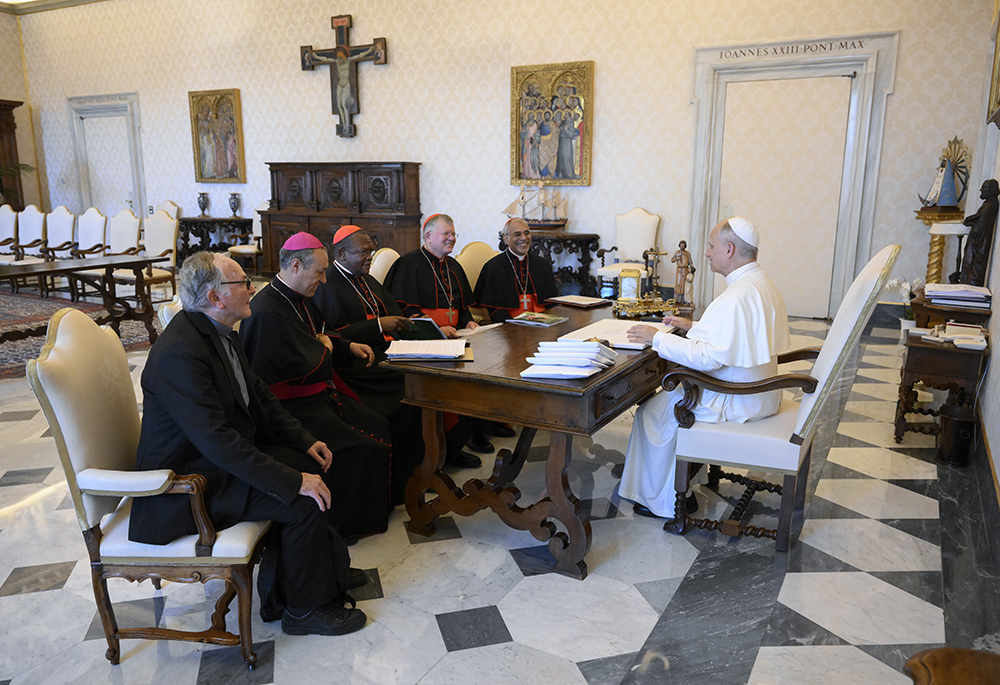
Pope Leo XIV meets with the heads of several bishops' conferences July 1, 2025, at the Vatican. From left are Indian Cardinal Filipe Neri Ferrão, president of the Federation of Asian bishops' conferences; Brazilian Cardinal Jaime Spengler of Porto Alegre, president of the Latin American bishops' council, known as CELAM; and Congolese Cardinal Fridolin Ambongo Besungu of Kinshasa, president of the Symposium of Episcopal Conferences of Africa and Madagascar, or SECAM; and other prelates. (OSV News/Vatican Media/Mario Tomassetti)
Each of the past 11 years have been the hottest on record, fueled by rising levels of greenhouse gas emissions that trap heat in the atmosphere and are released primarily from the burning of coal, oil and gas. Fossil fuel emissions are the main driver of climate change that has contributed to more extreme storms, heatwaves, droughts, flooding and sea rise around the globe.
Average temperature rise is expected to reach 2.3 to 2.8 degrees Celsius by the end of the century, well over the 1.5 C limit nations committed to pursue under the 2015 Paris Agreement. Countries and climate scientists have acknowledged the likelihood temperatures will exceed 1.5 C, even if temporarily, within the next decade.
"The planet is approaching critical thresholds that compromise the stability of ecosystems, socioeconomic systems, and governance structures, exacerbating the suffering of the most vulnerable, even in countries of the Global North," wrote the Catholic bishops, describing climate change as not only an environmental crisis but "a social, cultural, and spiritual crisis that threatens human dignity and peace."
At the same time, global production of fossil fuels continues to increase. Projections for fossil fuel production in 2030 are more than double levels aligned with the 1.5 C goal. And while nations under the Paris Agreement have committed to reducing emissions, that accord does not mention fossil fuels, and past U.N. climate summits have only once acknowledged the need to shift from fossil fuels in final documents.
That omission has led many environmental groups and numerous faith-based organizations, including the Global South bishops, to view a fossil fuel treaty as a necessary complement to the Paris Agreement.
"We need a clear plan," the bishops wrote. "We believe that the Fossil Fuel Treaty (FFT) can be the specific tool."
The United States, the largest source of historical emissions and global leader in oil and gas production and consumption, has withdrawn a second time from the Paris accord under the Trump administration, which has aggressively cut back climate policies while working to expand fossil fuel production, including through military actions this year in Venezuela and the Middle East.
Advertisement
"The return to policies of 'energy dominance,' that is, the aggressive expansion of oil and gas, environmental deregulation, and the use of force to secure resources, continues to fuel conflicts and forms of petro-imperialism," the Catholic bishops wrote, without naming any specific country or geopolitical event.
"When energy security takes precedence over international law, the sovereignty of peoples, and commitments to creation, cooperation between nations is weakened, and a just transition becomes more difficult. Moving beyond fossil fuels is not only an ecological imperative: it is a condition for peace, fraternity, justice, and the protection of those who suffer most."
The manifesto is the second major joint appeal from the bishops' conferences representing the Global South, building off a similar call last year — their first-ever joint appeal on any topic — demanding an end to the use of fossil fuels and rejection of false "green" solutions that exploit people and ecosystems.
In a statement to EarthBeat, Alex Rafalowicz, executive director of the Fossil Fuel Treaty initiative, said the bishops' support of the treaty and upcoming Colombia conference "sends a critical signal of the urgency to act in solidarity and with courage to forge a global pathway toward a more just, safe, and peaceful future for all."
"As communities from Africa to Latin America face rising floods, droughts, and displacement, continued fossil fuel expansion is not just an environmental failure — it is a moral crisis, an assault on human dignity and God’s creation," Rafalowicz said. "The case for a Fossil Fuel Treaty is clear, and growing support from faith communities affirms it as a moral imperative grounded in faith, peace, and justice."
Efforts around the treaty, formerly known as the Fossil Fuel Non-Proliferation Treaty, trace back to a proposal from Pacific island nations in 2015 for binding international mechanisms to phase out fossil fuels. In 2020, the initiative formally launched.
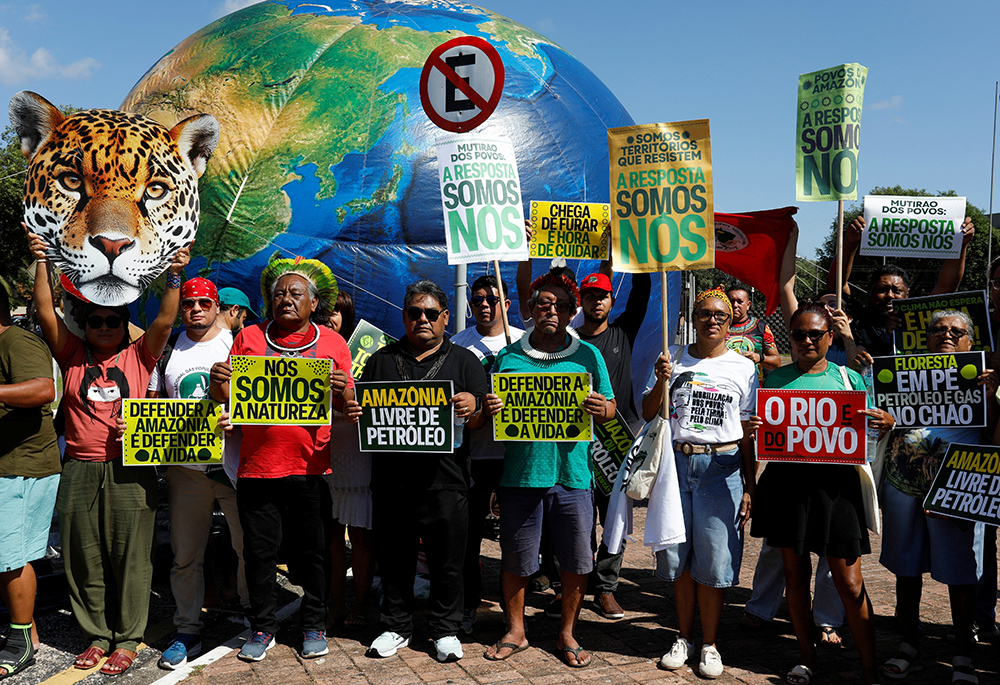
People attend a protest in Belém, Brazil, July 23, 2025, advocating for climate justice months ahead of U.N. Climate Change Conference, COP30, that Belém hosted in November. (OSV News/Reuters/Wagner Santana)
It gained momentum last year at COP30 in Belém, Brazil, when Brazilian President Luiz Inácio Lula da Silva urged diplomats gathered in the Amazon-adjacent city to develop roadmaps aimed at phasing out fossil fuels and ending deforestation. While neither roadmap materialized — Brazilian ministers have committed to developing them before COP31 in Turkey — 25 countries at COP30 issued the Belém Declaration committing to accelerate the global phase out of fossil fuels. So far, 18 nations have directly supported the Fossil Fuel Treaty.
Within the Catholic Church, the Laudato Si' Movement, Caritas Internationalis and religious orders have championed the treaty since its introduction and sought to mobilize support. Catholic leaders met with officials with the treaty during the Raising Hope for Climate Justice conference in October marking the 10-year anniversary of Pope Francis' encyclical "Laudato Si', on Care for Our Common Home." Kumi Naidoo, president of the Fossil Fuel Treaty initiative, gave the concluding keynote. Among those in attendance at the Raising Hope conference was Spengler.
During the webinar Monday, the Brazilian cardinal said the bishops' manifesto calls the church in Latin America "to embody the preferential option for the poor" through public advocacy, pastoral accompaniment and concrete matters. The bishops pledged in the document to review their own practices in promoting a just energy transition, including consideration of divesting from fossil fuels.
"We hope that the manifesto will promote ecclesial divestment from fossil fuels, the formation of communities around local energy alternatives, and coordination with social movements that demand climate justice," Spengler said.
The Vatican has not taken an official position on the proposed Fossil Fuel Treaty. Cardinal Michael Czerny, head of the Dicastery for Promoting Integral Human Development, said in 2022 such a treaty "holds great promise" as a complement to the Paris Agreement. Pope Francis spoke forcefully of the need to transition rapidly from fossil fuels, a message he reiterated in 2023 when he called it "madness to permit continued exploration and expansion of fossil fuel infrastructure."
In their manifesto, the Catholic leaders referenced teachings from both Francis and Pope Leo XIV and outlined principles they see as key to a fossil fuel treaty and a just transition to renewable energy. They stressed the need to address energy poverty, especially in Africa, and for rich nations to reduce "voracious consumption." They repeated their call from last year that it is imperative a transition to clean energy rejects "false solutions" like carbon markets and in pursuing critical minerals not to repeat the fossil fuel extractive practices that exploit the Global South and create new "sacrifice zones."
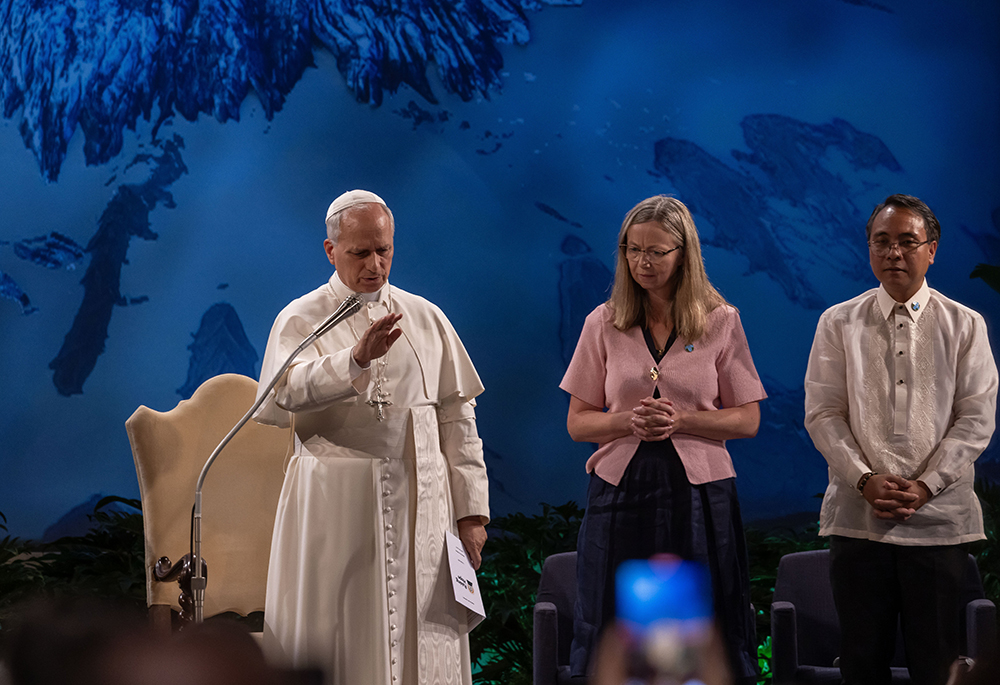
Pope Leo XIV offers a blessing during the opening session of an international conference celebrating the 10th anniversary of Pope Francis' encyclical "Laudato Si', on Care for Our Common Home," at the Mariapolis Center in Castel Gandolfo, Italy, Oct. 1, 2025. To the right of the pope are Lorna Gold, executive director of the Laudato Si' Movement, and Yeb Saño, chair of the board of directors of the Laudato Si' Movement, which organized the conference. (CNS/Pablo Esparza)
They added that rich nations must repay their ecological debt to the Global South by leading in phasing out fossil fuels and providing financial and technological assistance to developing countries. The bishops also suggested addressing climate change alongside developing countries' debt crisis, and emphasized the need to include all voices — Indigenous communities, fossil fuel workers, and impoverished people in particular — in a just transition to clean energy.
"We hope that the manifesto will promote inclusive public policies that reduce dependence on coal, encourage investment in renewable energy, and guarantee job retraining and social protection programs, especially for groups dependent on the fossil fuel industry," Neri said.
Along with the manifesto, the webinar presented a Catholic theological reflection on the proposed fossil fuel treaty. Lorna Gold, Laudato Si' Movement executive director, called the transition from fossil fuels a question of justice, one informed by Catholic teachings on the common good and Pope Francis' call in Laudato Si' to hear both the cry of the earth and the cry of the poor.
"When we bring these principles together, something becomes very clear: Continuing to expand fossil fuel extraction, when we know it is driving catastrophic climate disruption and conflicts, is incompatible with our vision of faith," Gold said.