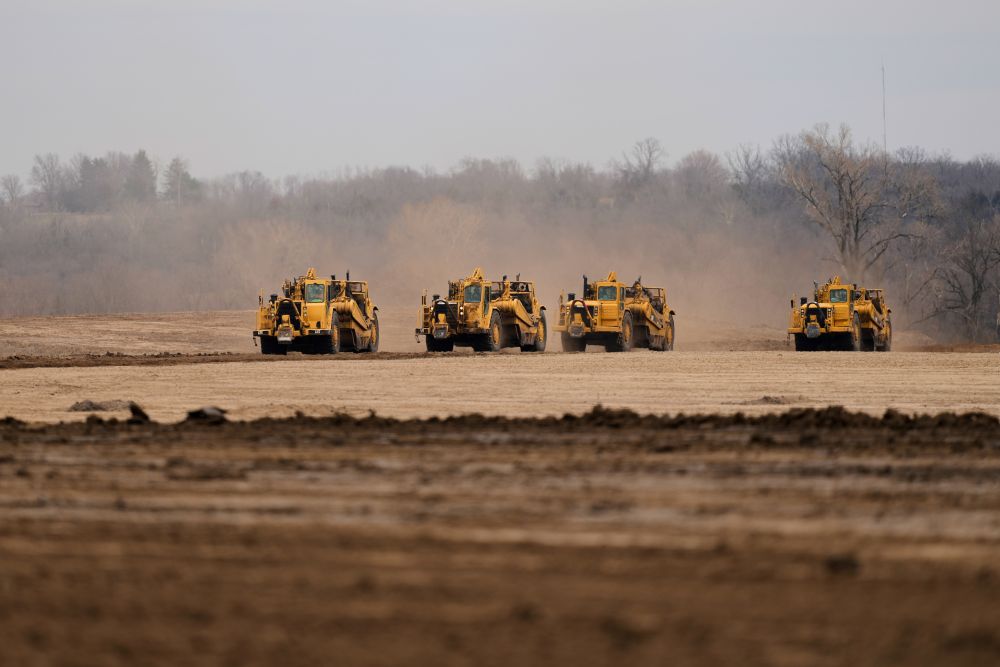
Earth movers prepare a site for a 2.5 million square foot AI data center March 24, 2026, in Independence, Mo. Globally, data centers rank behind all but 10 countries in electricity use, according to a new U.N. report. (AP/Charlie Riedel, file)

Join the Conversation
Send your thoughts to Letters to the Editor. Learn more
For decades, a tourism slogan has declared Virginia is for lovers. These days, the commonwealth is also for data centers, the critical infrastructure powering and training highly advanced artificial intelligence models.
Northern Virginia specifically has been called the world capital of data centers, with nearly 400 in operation or in development. The state currently houses 609 data centers, according to the research group Data Center Map, the most in the United States where more than 4,300 of these facilities are planned or already operating.
In many communities, citizens have mobilized to express worry and outrage about the hypersonic expansion of data centers, in both urban and rural areas, in their towns and fields. A main focus has been the extensive amounts of energy and water required to power and cool these centers, which threaten to both deplete resources and increase utility bills.
Efforts to raise alarm and pump the brakes on data centers' accelerating growth received some support from Pope Leo XIV. In his first encyclical, Magnifica Humanitas, addressed energy concerns as part of his widespread warnings about AI's breakneck development and incursion into people's daily lives.
'As the Pope writes, technology well designed can be used to 'heal, connect, educate and protect our common home.' AI can help do that, but only if we take the costs and risks seriously.'
—Evan Tachovsky
"It's extremely important and encouraging to hear and read a world leader acknowledging that we need better protection for our common home when we look at the incredible scale and pace of expansion of AI data center infrastructure and everything that is required to report to support it," said Amanda Garcia, a senior attorney who leads data center advocacy for the Southern Environmental Law Center.
AI's intensive energy, water demands
In Magnifica Humanitas, the pope spoke directly about data centers in a section where he warned the rapid and uncritical adoption of AI "exposes us to a range of risks, including the tendency to overlook the environmental impact."
"Current AI systems require enormous amounts of energy and water, significantly influencing carbon dioxide emissions, and place heavy demands on natural resources," Leo wrote in paragraph 101.
"As their complexity increases, especially in the case of large language models, the need for computing power and storage capacity grows too, which requires an extensive network of machines, cables, data centers and energy-intensive infrastructure," he said. "For this reason, it is essential to develop more sustainable technological solutions that reduce environmental impact and help protect our common home."
A typical AI data center uses the same amount of power as 100,000 houses, according to the International Energy Agency. Data centers comprised 4% of total U.S. energy consumption in 2023 (a year after OpenAI debuted ChatGPT) and their collective load capacity is estimated to roughly double to 150 gigawatts within three years, according to a report by Bloom Energy.
Globally, data centers rank behind all but 10 countries in electricity use and its greenhouse gas emissions on par with Argentina's, according to a United Nations University report issued June 3. It also projected that by 2030 data centers' energy use, primarily driven by AI, would rank sixth among countries and energy-related water use would equal that of 1.3 billion people in sub-Saharan Africa.
The extreme power demands trace to the extraordinary number of calculations needed to train generative AI models, with hundreds of thousands of graphics processing units computing together for months at a time, said Benjamin Lee, an electrical and systems engineering professor at the University of Pennsylvania specializing in sustainable computing and a consulting scientist with Google's Global Infrastructure Group.
"The number of calculations required to train a model is vastly larger than anything else we have tried to compute for earlier," Lee said, referencing server facilities that for decades have powered the internet. As more people use AI models as software, data centers' energy use will only climb higher, he added, as will the costs of powering them.
While tech giants like Google and Microsoft made sustainable computing pledges in the early 2020s, including setting net-zero carbon emissions computing, the explosion of AI and its requisite data centers have made such goals far more difficult to achieve through wind and solar energy and battery storage alone. That has led some companies to turn to nuclear energy or natural gas, the latter also increasing greenhouse gas emissions that are driving climate change.
"If they ever want to make money on the technology, they're going to have to reduce those energy costs," said Lee, who took part in a 2024 conference at Santa Clara University on AI and the environment.
Researchers at Santa Clara — within Silicon Valley and home to 50-plus data centers — have also begun to study AI's impact on water supplies, especially in California and other parts of the West where arid conditions and extended droughts worsened by climate change have made water an even more depleted resource.
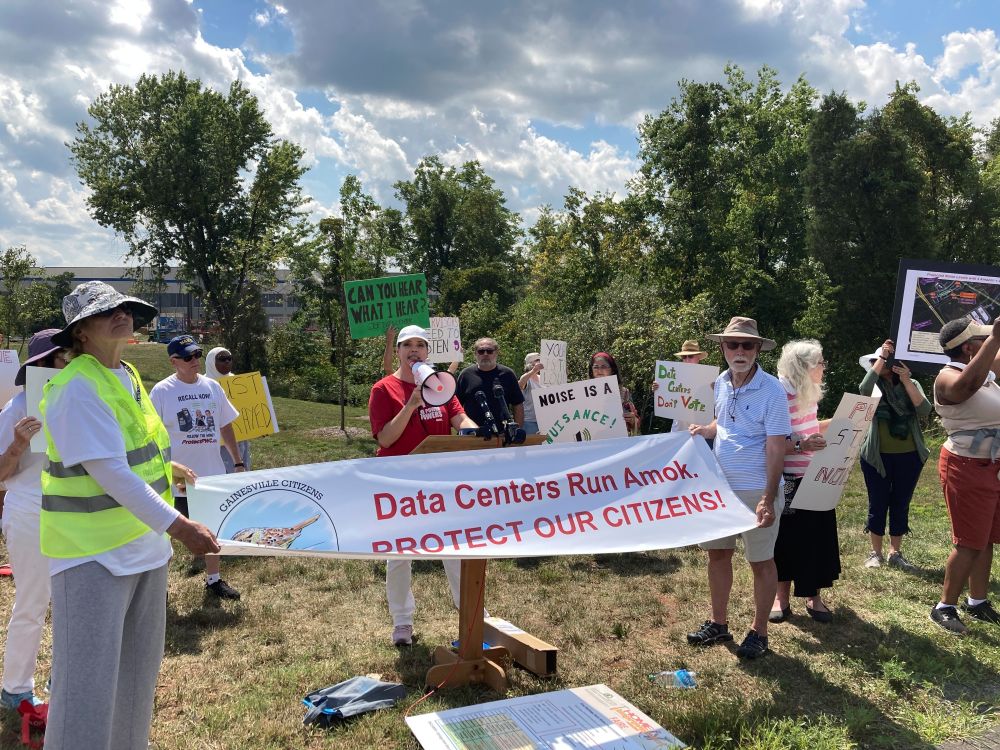
Spencer Snakard, president of Protect Fauquier, speaks Aug. 29, 2022, at a rally near Manassas, Va., protesting a newly built data center for Amazon Web Services. Virginia currently houses 609 data centers, the most in the United States. (AP/Matthew Barakat, file)
"We have the technology boom in Silicon Valley, but just an hour away [in the Central Valley's agricultural basin], people are drawing drinking water from shallow, polluted wells," Iris Stewart-Frey, a hydrologist at Santa Clara and co-coordinator of the Jesuit school's Environmental Justice and the Common Good Initiative, told the university magazine in August.
Traditionally, water has been used to cool the constantly running servers at AI data centers, though their footprint extends to electricity generation and microchip production. Studies have estimated data centers use upwards of 100 million gallons of water annually, with larger centers using as much as 5 million gallons a day, though others have concluded more transparency is needed. In 2023, a Google data center in Council Bluffs, Iowa, used roughly 980 million gallons of water, or 21% of the city's total water use.
The energy and water demands of AI have a cascading effect on residents' utility bills, as the strains on grids and already near-capacity water supplies drive up costs for all.
Defending AI's energy use, OpenAI CEO Sam Altman drew backlash in February when he said "It also takes a lot of energy to train a human. It takes about 20 years of life — and all the food you consume during that time — before you become smart."
Local impacts on water, air
Beyond Virginia, data centers have expanded across the South in recent years, with more than 1,200 operational and 754 more planned.
Garcia with the Southern Environmental Law Center, which works in six states, has heard concerns from locals about air pollution from AI data centers, as well as depleted drinking wells and the decline in birds and wildlife. Noise pollution is also a frequent complaint.
Over the past two years, the center and local advocates have fought air pollution issues from xAI data centers in Memphis, Tennessee, and South Haven, Mississippi, predominantly Black communities already facing disproportionate pollution. In both cities, Elon Musk's xAI sought to power the data centers with turbines using methane, a potent greenhouse gas and pollutant.
Recent polling has found 7 in 10 Americans oppose building AI data centers in their local area — with half strongly opposed in a March Gallup survey. Nearly half (46%) worried a great deal about their environmental impact.
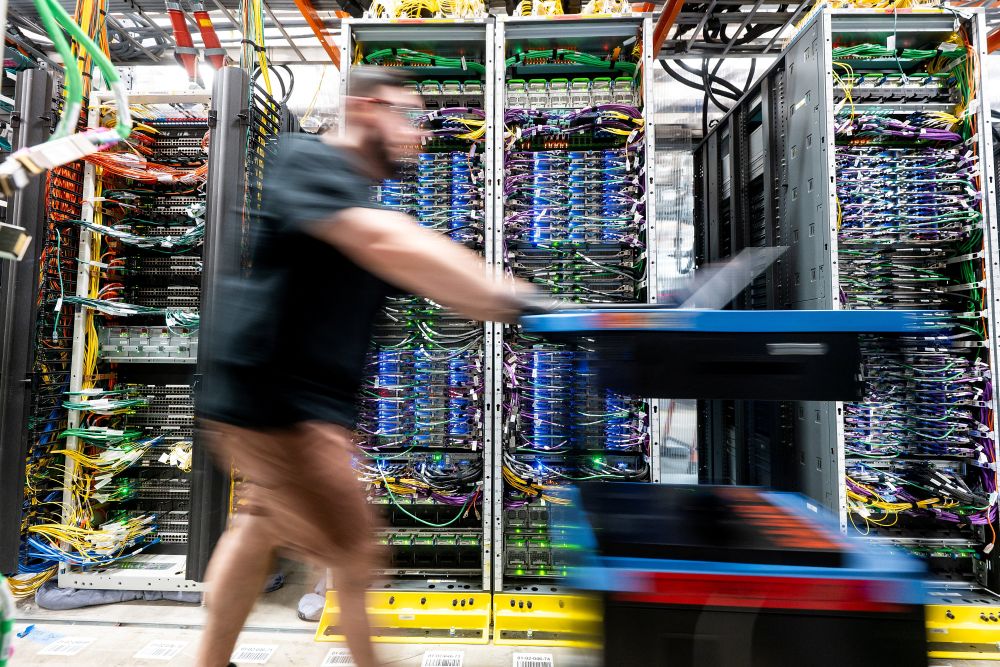
A technician works at an Amazon Web Services data center in Hermiston, Ore., May 9, 2025. The explosion of massive data centers to handle the increasing generative demands of artificial intelligence have placed high demands on both power and the water used in cooling systems. Low-income communities have typically endured the brunt of the air pollution they create. (OSV News/Reuters/Noah Berger for AWS)
SELC has worked with communities to press for local ordinances requiring disclosure of environmental impacts and the amount of water and energy data centers will use. It has also pressed for codified protections and filed lawsuits over zoning and air permit violations.
Garcia said she sees the pursuit of commonsense protections for communities in alignment with what the pope proposed in Magnifica Humanitas, as resources are turned over to develop AI models at the expense of living conditions for people and the environment.
"We're not anti-development, but what we're seeing on the ground is not sustainable for the people or the places that we love and inhabit in the South," she told EarthBeat.
One challenge, she said, is most Southern states lack laws requiring environmental reviews for projects outside the permitting process, which takes place typically after the decision to build a data center has already been made. Some data center deals have been made without public notice or input.
Already, data centers and rising utility bills have emerged as a key voter issue ahead of the 2026 midterm elections. Some communities have sought to recall or replace officials who have inked deals.
Advertisement
Lee, the computing engineer at the University of Pennsylvania, said there are technical ways to improve data centers' energy use to alleviate grid strain, as well as its water use, both of which require trade-offs. But a wider conversation about data center risks is needed, he added, especially concerning where they're located. He said the pope rightly raised important environmental concerns with AI, but expressed skepticism the tech industry will pause its development amid fierce competition, both nationally and globally.
"In my view the best case is that the pope's message gets out and helps shape thinking about safeguards and the resources that could go into reducing the impact of AI, rather than maybe pausing or stopping data centers and AI," Lee said.
Evan Tachovsky, chief data and AI officer for the World Resources Institute, said that AI's potential for addressing, rather than raising, environmental problems is already seen in accelerated weather forecasting, electric grid optimization and deforestation tracking and prevention. But those advances can't overlook the real risks posed on local communities by surging resource demands and air quality issues.
"As the Pope writes, technology well designed can be used to 'heal, connect, educate and protect our common home.' AI can help do that, but only if we take the costs and risks seriously," Tachovsky said in an email.