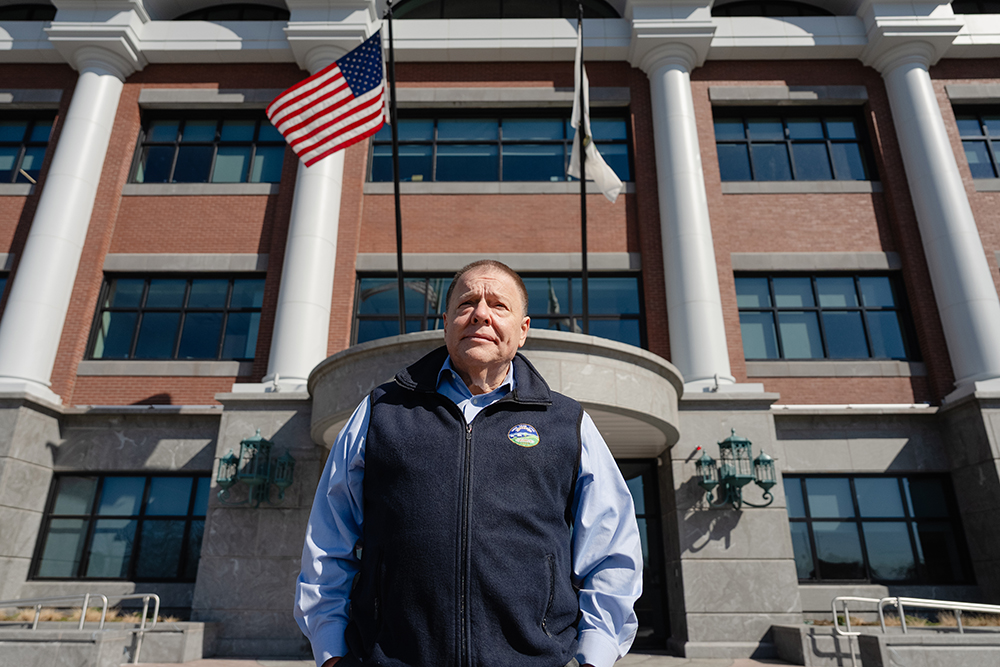
Thomas Koch, mayor of Quincy, Mass., stands in front of the city's new public safety headquarters building where he wants to place two saint statues. (Courtesy of Becket Fund)

by Brian Fraga
Staff Reporter
Join the Conversation
Send your thoughts to Letters to the Editor. Learn more
Massachusetts' highest court has ruled that the city of Quincy likely violated the state's constitutional guarantee of neutrality toward religions when it commissioned two10-foot-tall bronze saint statues for the front of its new public safety building.
In a 34-page ruling, the Massachusetts Supreme Judicial Court unanimously agreed with a lower court ruling that prohibited city officials from displaying the statues of St. Michael the Archangel and St. Florian outside a police and fire complex while a lawsuit proceeds in court.
Contrary to city officials' arguments that the patron saints of police and firefighters transcend Catholicism, the high court said in its Aug. 20 decision that the statues "have a greater potential to be perceived as government endorsement of a particular religion, and subordination of other religions."
Supreme Judicial Court Associate Justice Scott Kafker also wrote that it was likely that Quincy had "violated important constitutional rights and has spent, and plans to continue to spend, taxpayer dollars in violation of those rights that will not be recoverable."
Kafker added that the statues "are not part of a larger collection of statues and monuments that includes nonreligious ones, or statues of figures of particular importance to other religions." Rather, they "stand tall and alone, adorned with Catholic iconography."
The ruling is not the final word on the statues; the case will now proceed in a lower state court that is hearing arguments in the lawsuit brought in 2025 by the American Civil Liberties Union and Americans United for Separation of Church and State. The high court opined that the statues' opponents are likely to succeed in their lawsuit.
"Here in Massachusetts, our state constitution is clear: the government must remain neutral in matters of religion and must not elevate one faith above others," Jessie Rossman, legal director at the ACLU of Massachusetts, said in a press release.
Rossman said the high court's ruling affirmed those principles, which he said "are the essential foundation of a pluralistic society where people of all faiths and no faith can flourish."
Claire Fitzmaurice, a Quincy resident who grew up Catholic but now attends a Unitarian Universalist church, said in a prepared statement that she was "thrilled" with the ruling. She is one of 15 city residents challenging the statues.
"I believe that Quincy should be a place where we welcome people from all faiths and backgrounds," Fitzmaurice said. "To have these imposing religious statues looming over the entrance of the public safety building would fly in the face of that pluralistic ideal — especially as our city continues to grow more diverse. I look forward to our next day in court."
Quincy Mayor Thomas Koch, a conservative Catholic who has been pushing to install the statues, called the decision "disappointing," but said it is "preliminary." He said the city "will continue to fight for the ability to commemorate our first responders as the law permits."
Joe Davis, senior counsel at the Becket Fund, a Washington, D.C., law firm that has been representing Quincy, also called the high court's ruling disappointing and preliminary. He said Quincy chose these statues to honor the courage and sacrifice of its firefighters and police.
"The City should not have to hide public art simply because some people may think of religion when they see it," Davis said in a press release. "As the Court noted, this is not the final word for these statues, and we will continue defending Quincy's right to honor its heroes."
Advertisement