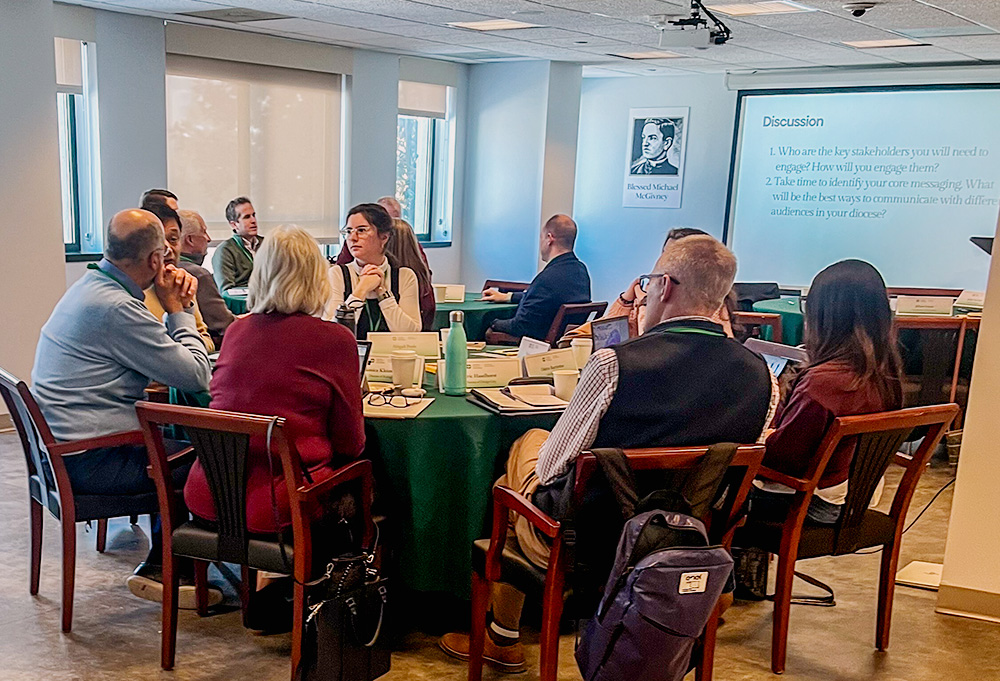
Staff members from 19 U.S. dioceses take part in a workshop on developing Laudato Si' action plans at the headquarters of the U.S. Conference of Catholic Bishops in Washington D.C. in January 2026. (Joshua van Cleef)

Join the Conversation
Send your thoughts to Letters to the Editor. Learn more
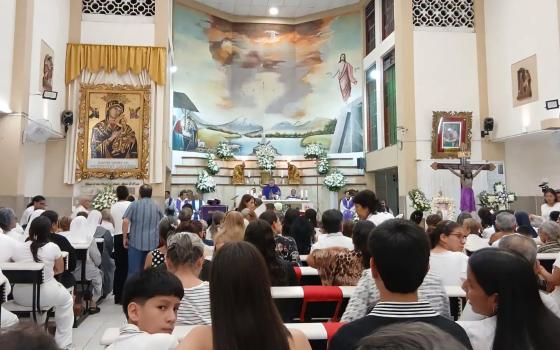
On a recent sweltering Saturday typical of April in Arizona, around 100 people from across the state gathered at the pastoral center of the Phoenix Diocese for a day of prayer and contemplation on the environment.
The diocese's second Creation Summit opened with a reflection by Phoenix Auxiliary Bishop Peter Bui, with the rest of the day divided around three topics: migration and creation; local steps to address poverty and creation; and action planning, where Catholic parishioners and people of other faiths worked to develop localized blueprints for environmental initiatives.
"[We] brought them together to be in community and to journey together for the day and then they were all sent out having an opportunity to form an action plan with their communities," said Abigail Poole, the diocese's Catholic social teaching coordinator.
The Phoenix Diocese too is developing a plan of its own, as one of 19 dioceses taking part in an inaugural national training program to compose ecological action plans inspired by Pope Francis' 2015 social encyclical, "Laudato Si', on Care for Our Common Home."
The Laudato Si' Leadership Training program is a collaboration between the U.S. Conference of Catholic Bishops and the Diocese of Lexington, Kentucky. Despite its size and limited resources, the Lexington Diocese has emerged as a leader in transforming church teachings on the environment into ambitious actions to address climate change and other socio-ecological issues in the region.
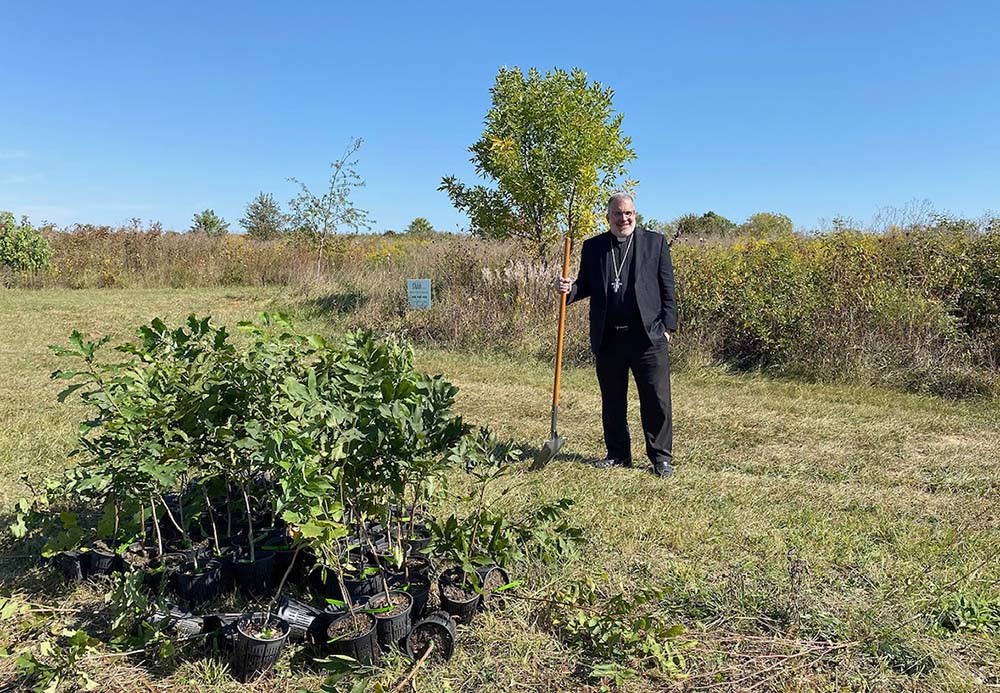
Bishop John Stowe of Lexington, Kentucky, stands beside a newly planted tree in Hisle Park. In September 2023, the diocese partnered with Green Forest Work on a tree planting day to celebrate the Season of Creation, with 300 new saplings placed in the ground. (Kevin Steele)
"We want to give people the tools, because we really believe that every diocese can make a plan with the right support and the right process," said Joshua van Cleef, director of the Lexington Diocese's Peace and Justice Office. "Hopefully it shows that through this program, and then other dioceses can step in and realize that they can do this, too."
A decade after Francis issued Laudato Si', there has been a substantial upsurge of Catholic engagement and activity around environmental concerns, as the teaching has taken root and the impacts of climate change have struck nearly every part of the globe. While parts of the U.S. church — notably religious orders and schools — have moved to the vanguard on creation care, some Catholics continue to see bishops, dioceses and clergy lagging behind.
Those involved with the Laudato Si' training program hope their efforts will change that perception. With two more cohorts planned in the coming years, the result could be nearly half of U.S. dioceses with Laudato Si' action plans underway.
"It would send a signal that this is a priority for the Catholic Church in the United States, as much as immigration, pro-life issues, all the rest," said Dan Misleh, executive director of the Catholic Climate Covenant. "I think this would certainly send that signal that the bishops have made this a top priority with this program."
Advertisement
'A ground-breaking initiative'
Discussions around the Laudato Si' training program began last summer as the church marked the 10-year anniversary of Francis' encyclical in the months after his death.
The Catholic Extension Society, which provides funding and resources to isolated and financially underserved U.S. Catholic communities, reached out to the Lexington Diocese with a proposal to train mission dioceses on how to develop multiyear plans to put church teachings on creation into practice.
At the start of 2025, Lexington had unveiled its own Laudato Si' plan, which included a bold vision for the eastern Kentucky diocese to reach net-zero emissions by 2030. As part of the diocesan effort, Lexington Bishop John Stowe had directed all parishes to put together their own plans, based on their own capabilities and resources.
Van Cleef, who has overseen that initiative, suggested to Catholic Extension that the training program be offered to any diocese. To that end, they brought in the U.S. bishops' conference, and by winter the first group of 19 dioceses was selected.
The plans they're developing are tied to the Vatican's Laudato Si' Action Platform, which each of the dioceses joined as part of the program. According to Msgr. Robert Vitillo, a senior adviser with the Vatican Dicastery for Promoting Integral Human Development, more than 11,000 Catholic institutions and individuals have enrolled in the global initiative, including at least 38 U.S. dioceses.
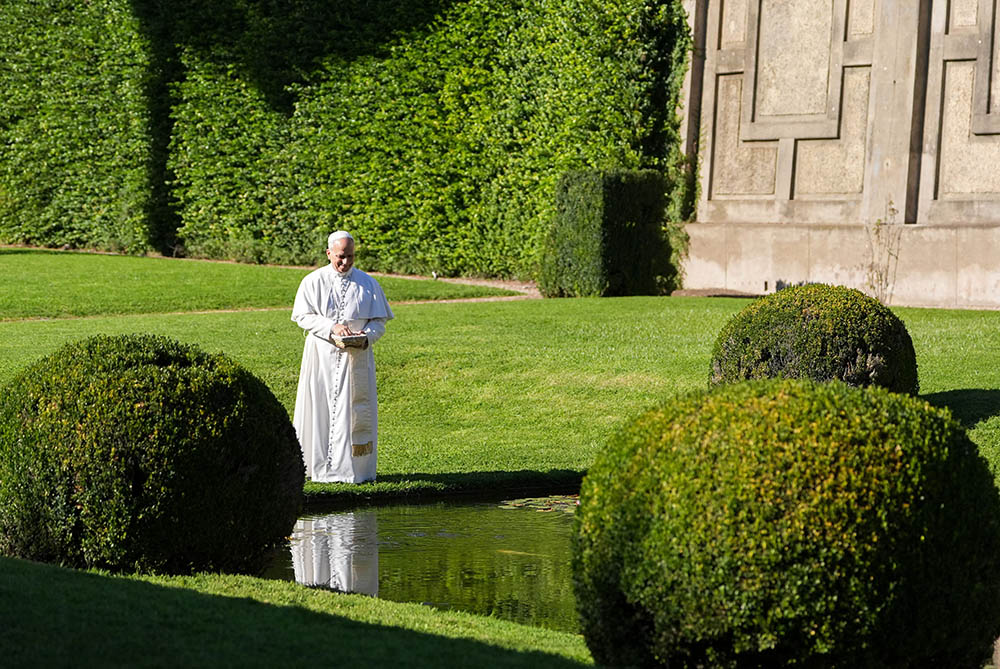
Pope Leo XIV feeds fish at a pond in the Pontifical Gardens of Castel Gandolfo, Italy, Sept. 5, 2025. The pope inaugurated Borgo Laudato Si’ the same day, opening the historic papal residence as a center dedicated to the principles of care for creation and human dignity outlined in Pope Francis’ encyclical Laudato Si’. (CNS/Lola Gomez)
Along with offering the church a road map, the Vatican has sought to lead by example. It has submitted a greenhouse gas emissions reduction plan under the Paris Agreement and developed a massive solar farm capable of powering the entire city-state. Ecological projects like Borgo Laudato Si', a new Mass for creation and annual pontifical messages on creation and climate change have further ingrained ecology into Catholic life.
"We must shift from collecting data to caring; and from environmental discourse to an ecological conversion that transforms both personal and communal lifestyles," Pope Leo XIV, the first U.S.-born pontiff, said in October at a conference outside Rome marking a decade of Laudato Si'.
Vitillo, who serves as the Dicastery for Promoting Integral Human Development's point person for the action platform, called the U.S. diocesan training program "a ground-breaking initiative" in an email to EarthBeat.
While dioceses and national and regional episcopal conferences in other parts of the world, like Australia, Colombia and East Africa, have devised programs to engage the local church around Laudato Si', Vitillo suggested the new U.S. approach could serve as a model for other regions.
'Absolutely yes, sign me up'
Each diocese in the Laudato Si' Leadership Training program is represented by a staff member appointed by the bishop to undergo training and lead the development of the diocese's Laudato Si' plan. They attend monthly training sessions and work with a mentor with experience in creation ministries and sustainability to help guide their work.
In Phoenix, Poole was the appointed staffer. During her two years with the diocese, the nation's second-largest with more than 2 million Catholics and nearly 100 parishes, she has overseen several environmental initiatives, like the Creation Summits and a hike last year through Sedona to the Chapel of the Holy Cross — built into the region's famous red rocks — as part of the Pilgrimages of Hope for Creation organized to celebrate the Jubilee Year of Hope.
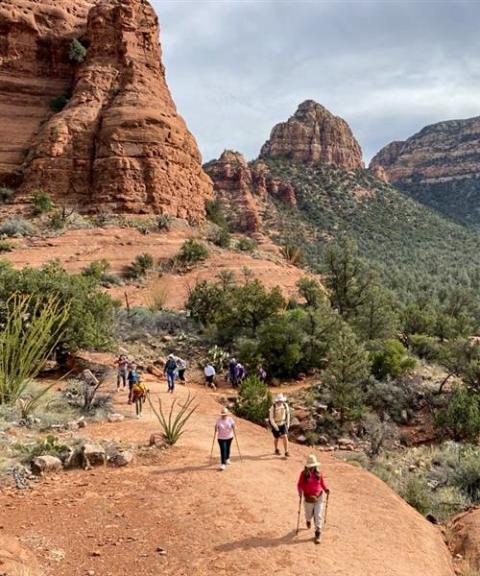
Hikers walk along the desert landscape and red rock formations of Sedona, Arizona, as part of a Pilgrimage of Hope for Creation in November 2025 organized by the Phoenix Diocese to celebrate the Jubilee Year of Hope. (Courtesy of Phoenix Diocese)
"That was really a spiritual journey," Poole said.
Joining the Laudato Si' training program offered a chance to greatly expand the diocese's work on creation care, she said, a sentiment she said is shared by Phoenix Bishop John Dolan, who was also glad the U.S. bishops were taking on the initiative.
Amber Henning, the in-house counsel and properties manager for the Great Falls-Billings Diocese in Montana, became involved in the training program after Bishop Jeffrey Fleming learned of it after attending, alongside 100 fellow bishops, a workshop on Laudato Si' at the annual bishops' assembly in November.
"He came back to me, as I deal with properties for the diocese, and said, 'Is this something that you would be interested in doing?' And I said, 'Absolutely yes, sign me up,' " she told EarthBeat. She added it was unlikely a diocesan Laudato Si' plan would have happened without the training program.
"I just felt that call to do something for our diocese," said Henning, who reread Laudato Si' after her enrollment. "Montana is so blessed with beautiful land, mountains, wonderful people, and it is just something that I want to help protect through my faith and then through our other civic means as well."
Organizers with the training program were pleased with the level of interest from dioceses. Emily Schumacher-Novak, an associate director in the Secretariat for Peace and Justice for the U.S. bishops, credited that to the renewed focus on Laudato Si' at its 10-year anniversary, including at the November workshop and from Leo's own attention to issues of climate change and other environmental crises.
"There's this building momentum," Schumacher-Novak said, "and there is just so much richness in how we can care for our common home. But it is so much deeper than just thinking about how we live in a sustainable way, though that is very important."
"We are gifted with so much in this world, and so it is really a great spiritual practice for us to think about how is it that we let the call that Pope Francis beautifully gave to us in Laudato Si', and that we just know as part of our faith tradition, to infuse into the very many ways that we live out our faith."
'How can we mobilize parishes?'
In January, participants in the Laudato Si' leadership training met for three days amid frigid wintry conditions at the U.S. bishops' conference headquarters in Washington, D.C., for the first workshop.
Sessions offered resources and a chance to meet other participants alongside veterans in the Catholic ecological space. Vitillo, the Vatican official overseeing the Laudato Si' Action Platform, also attended.
"It was wonderful to talk to other people [from] all around the country and ask: What does your diocese do? How do you do this?" Henning said.
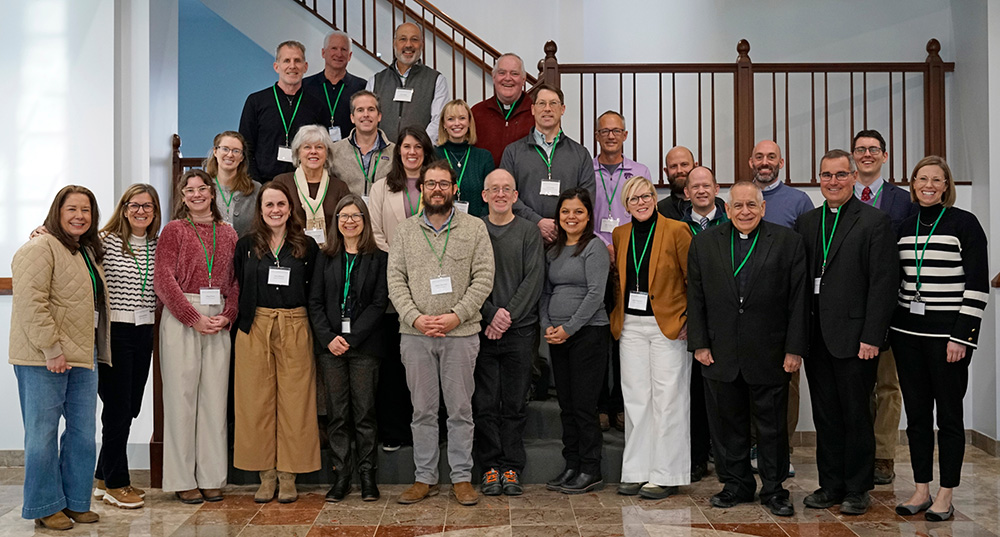
Participants in a workshop on Laudato Si' pose for a photo at the headquarters of the U.S. Conference of Catholic Bishops in Washington D.C. in January 2026. (Courtesy of USCCB)
For James Jahnz, secretary for Catholic Charities and social ministry for the Diocese of Providence, Rhode Island, joining the first cohort presented a chance to elevate creation ministry to the next level. "One of the things that I wanted to learn about and be able to promote a little better is integrating Laudato Si' into our parish life," he said.
Along with opportunities, discussions at the first workshop addressed challenges staff likely will face in the intensive work of devising a Catholic sustainability plan.
Often, that begins with making creation care a priority at all, and from there finding the capacity to undertake what can often be large, long-term projects, whether installing solar panels or launching an education program in parishes on church teachings on creation.
"To make an effective plan for your diocese, you need to collaborate with your finance office, buildings and grounds office, with your communications office, faith formation office, liturgy office," van Cleef said.
Engaging parishes presents its own obstacles, he said, whether through the diocesan plan or in developing their own.
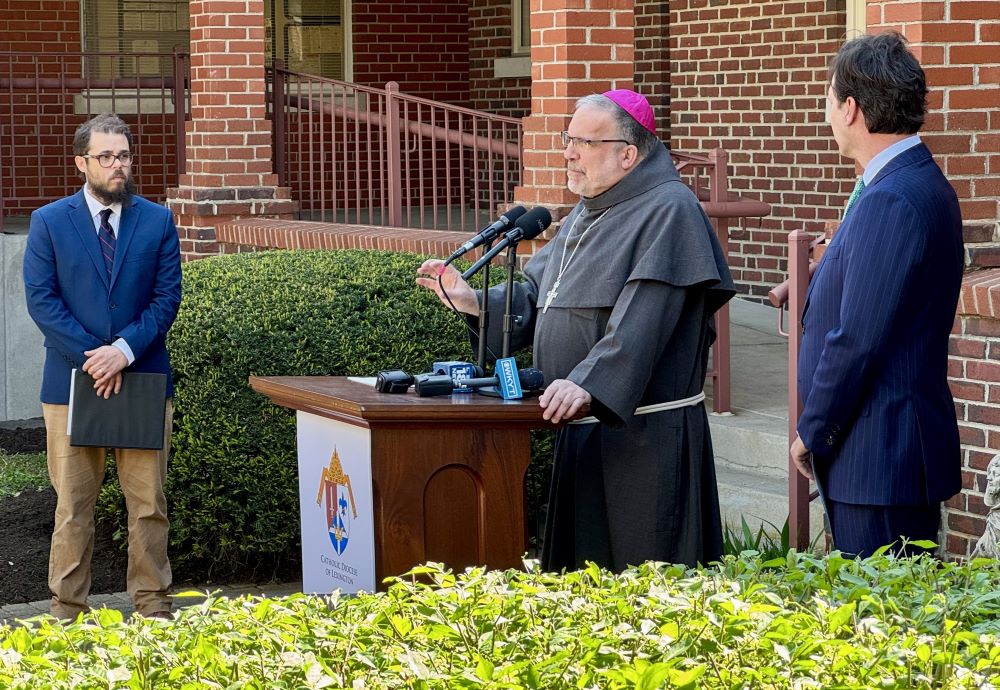
Bishop John Stowe of Lexington, Kentucky, announces a net-zero initiative, pledging to reach net-zero emissions across its 59 parishes as well as schools and other institutions in the next six years. With him at a press conference April 23, 2024, are Adam Edelen (right), founder and CEO of Edelen Renewables, and Joshua Van Cleef (left), director of the diocese's peace and justice office. (Courtesy of Diocese of Lexington)
"The experience of church for most people is their parish. So part of the challenge for a diocese is how can we mobilize parishes? How can we encourage parishes to make their own plans that fit their context?" van Cleef said.
There are local challenges, too.
In Montana, where mining and ranching are major economic and cultural drivers, how ecological matters are framed is critical. For instance, emphasizing a shared love of the land, over the science of climate change, is likely to bear more fruit, Henning said.
"We do call Montana the last best place," she said. "And so I think coming at it from that ... how do we protect it? How do we honor the gift that God has given us?"
Poole said she left the D.C. workshop with a sense of how to begin a plan and, just as important, find resources and connections to complete it. Hearing stories and examples from other dioceses, including Lexington, was especially helpful.
"The summit really set us up for success, to come back to our diocese with a way to move forward and to not have to move forward alone," Poole said.
By October, dioceses are set to finish drafting their Laudato Si' plans, with bishop approval. From there, the hard work of actually implementing the plans will begin, while another 20 dioceses in the next cohort begin devising their own blueprints.
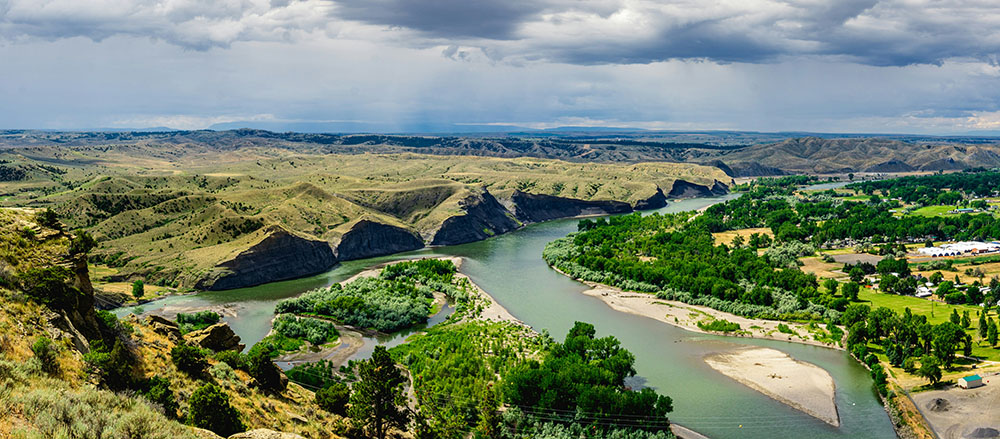
The Yellowstone River flows past Billings, Montana. "How do we honor the gift that God has given us?" asks Amber Henning of the Great Falls-Billings Diocese. (Unsplash/Trevor Vannoy)
The training program has funding from Catholic Extension and Crimsonbridge Foundation for three rounds, meaning the program could produce 60 new U.S. dioceses with Laudato Si' plans. Combined with the dioceses already enrolled in the Laudato Si' Action Platform, that would mean roughly 90 of the 195 U.S. dioceses would have active long-term strategies to ingrain Francis' encyclical into Catholic life.
Like others in the first class, Henning is working away at the plan for her eastern Montana diocese. She has framed it around education, reflection and action and has already explored energy audits for diocesan buildings and opportunities for renewable energy. The process of installing solar on some church buildings has already begun. But she sees education, specifically on how such actions are spiritually motivated, as the key to building Laudato Si' momentum in Montana.
All that starts with a plan.
"I'm hoping for that ecological conversion, and whether that is one person, five people, that's a win for me. Because one can turn into 20, 20 can turn into 40, and it really is that spark that I'm looking to ignite in our diocese."