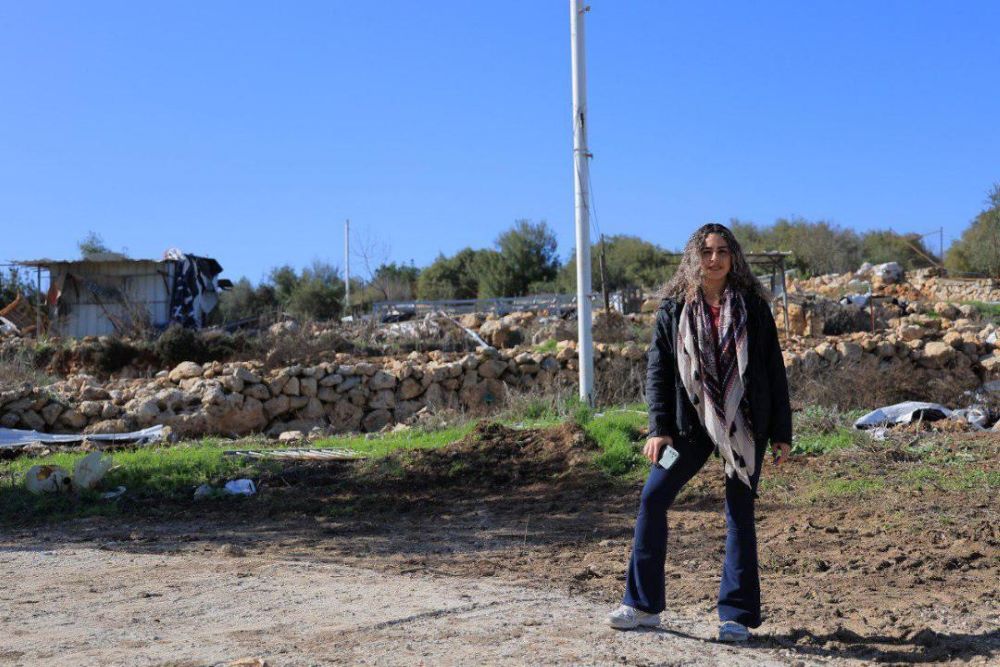
Alice Kisiya stands on her family farm in Palestine in December 2025 after the Israeli Supreme Court returned the family's land. The Kisiyas are among a minority of Christians who have lived in the Al-Makhrour valley for thousands of years and make up about 1% of the West Bank's population. (Courtesy of Alice Kisiya)

by Ryan Byrnes
Join the Conversation
Send your thoughts to Letters to the Editor. Learn more
For one Palestinian Christian family, the end of 2025 ushered in a rare victory: getting their land returned by the Israeli Supreme Court. After years of struggle, fearless activism and global outcry, the Kisiya family has finally returned to their farm.
The struggle gained global awareness in June 2019, when 25-year-old Alice Kisiya learned her house would be demolished. Her family owned a 1-acre farm in the Al-Makhrour valley outside Bethlehem, in Area C of the West Bank. Under international law, this area is part of Palestine, though it is currently occupied by the Israeli government, which places extreme restrictions on new housing developments for Palestinians.
When Alice was 8, her father, Ramzi, built a small café on their farm, even setting up solar panels for electricity, she said. Here, the Kisiya family sold salads to visiting tourists and hosted holiday celebrations for local Christians and Muslims. When she was 18, her father built a house adjacent to the café.
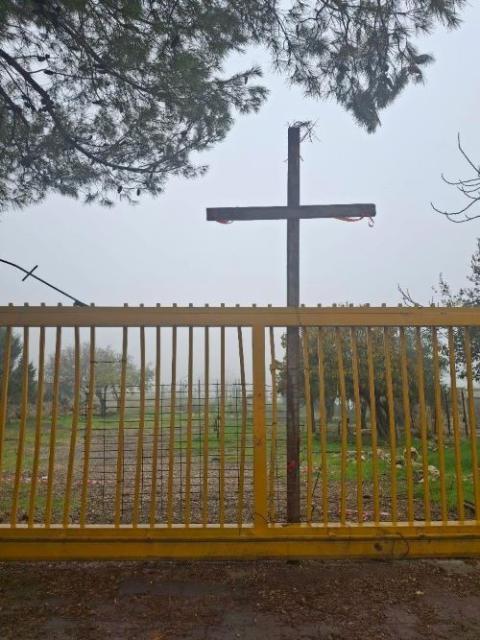
A cross is displayed on the Kisiya family farm in Palestine in a December 2025 photo. The community helps to support the nearby Church of the Nativity and the Church of the Holy Sepulchre. (Courtesy of Alice Kisiya)
Throughout Alice's life, she said, the Israeli government targeted her family for not having the proper building permits. For Palestinians, the process of obtaining a building permit is made so difficult as to be impossible, and as a result the government rejected the family's applications. Failure to receive a building permit often results in demolition. Alice is no stranger to this labyrinth of red tape; when she was 6 years old the Israeli Civil Administration demolished her home for the first time, she said. Again, the government demolished the family's café in 2012, 2013 and 2015. The family rebuilt it every time.
The conflict came to a head in 2019, when the Civil Administration issued yet another warning. Alice said soldiers pulled up to their house wearing armored vests and riot visors and carrying long rifles. A yellow excavator, with its great hydraulic arm, crushed through the roof until the house collapsed into itself, erupting in a plume of dust.
Although the excavator destroyed their house, the family managed to save the large cross they had proudly mounted on their roof for passersby. As Alice explains, the Kisiyas come from a minority of Christians who have lived in the Al-Makhrour valley for thousands of years and make up about 1% of the West Bank's population. This community helps to support the nearby Church of the Nativity as well as the Church of the Holy Sepulchre, the places of Jesus Christ's birth and death, which millions of pilgrims visit every year.
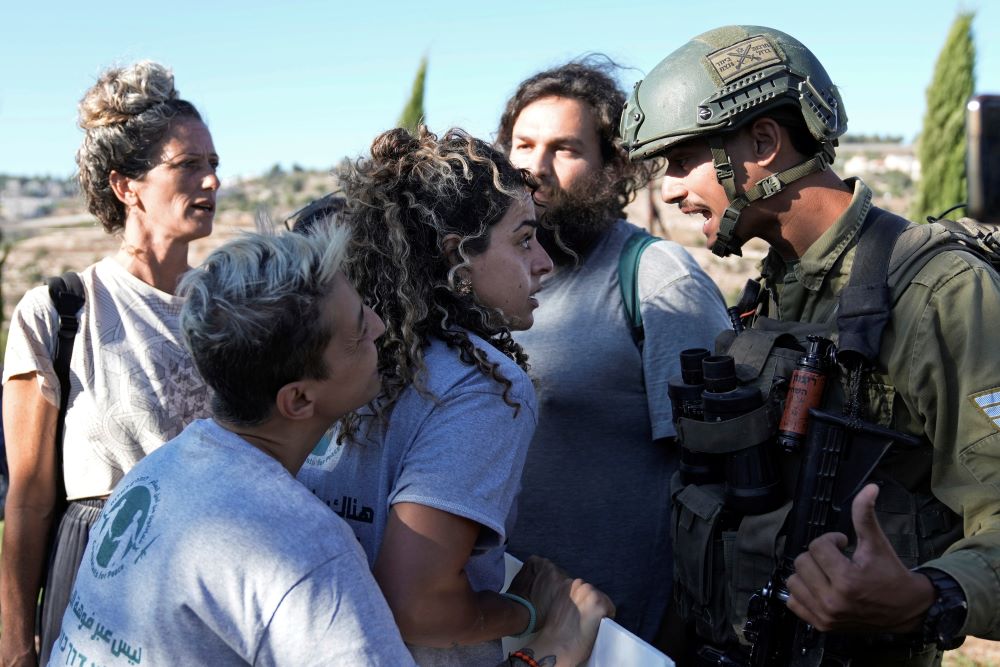
Israeli activists surround Alice Kisiya, center, as they try to enter her family's land, after the Palestinian family was forcefully evicted by Israeli settlers backed by soldiers who declared it a closed military area, in the West Bank town of Beit Jala Aug. 2, 2024. (AP/Mahmoud Illean)
Despite the valley's beauty, a dark cloud hangs over it. An informal group known as the Hilltop Youth set up illegal outposts in the valley, mostly consisting of trailers or small wooden huts. As Alice explains, the Hilltop Youth mainly consist of radicalized Jewish teenagers who exhibit gang-like behaviors. Believing the Israeli government hasn't gone far enough, they take it upon themselves to harass Palestinians, in some instances committing arson and murder. Despite the destruction of her home, Alice explains, "We were still on our land, and that was what mattered. Nobody could make us leave." The family set up a tent on their property. At night, teenagers from the Hilltop Youth often climbed over their fence and attacked them with knives. For five years they lived this way.
"They destroyed our tent 17 times," Alice told the National Catholic Reporter.
On July 31, 2024, representatives of the Civil Administration forcefully evicted the Kisiyas from their farm. This period marked a turning point in Alice's life, when she formalized a strategy for winning back her land. Alice said that in the past, her parents dealt with the Civil Administration through lawyers, never through activism. But after losing her land, Alice organized a sit-in with Combatants for Peace, a group of Israelis and Palestinians who aim to bring peace through nonviolent activism and dialogue.
Advertisement
In late September 2024, Alice and her supporters constructed an interfaith chapel, which they called the Church of Nations, a short distance from the Kisiya farm. Here, they were joined by the World Council of Churches, Rabbis for Human Rights, Palestinian pastor Munther Isaac and countless attendees on a video call. The nearby Hilltop Youth squatting on her farm heard the Jewish shofar call and approached the gathering out of curiosity, where Alice welcomed the teenagers and offered them food. The next day, the Israeli military demolished the tent.
The Kisiyas filed a lawsuit in November 2024 against the Civil Administration at the Israeli Supreme Court. The judges sought documentation proving that an Israeli real estate company bought the land in 1969. The Civil Administration was unable to provide documentation, and in June 2025, the Israeli Supreme Court stated definitively that the Kisiyas were the legal owners of their farm. The government evicted the squatters and allowed her to return.
Finally, on Dec. 23, 2025, Alice stepped foot on her farm again. Her community, as it has for generations, celebrated Christmas in nearby Bethlehem, marking the spot of Christ's birth.