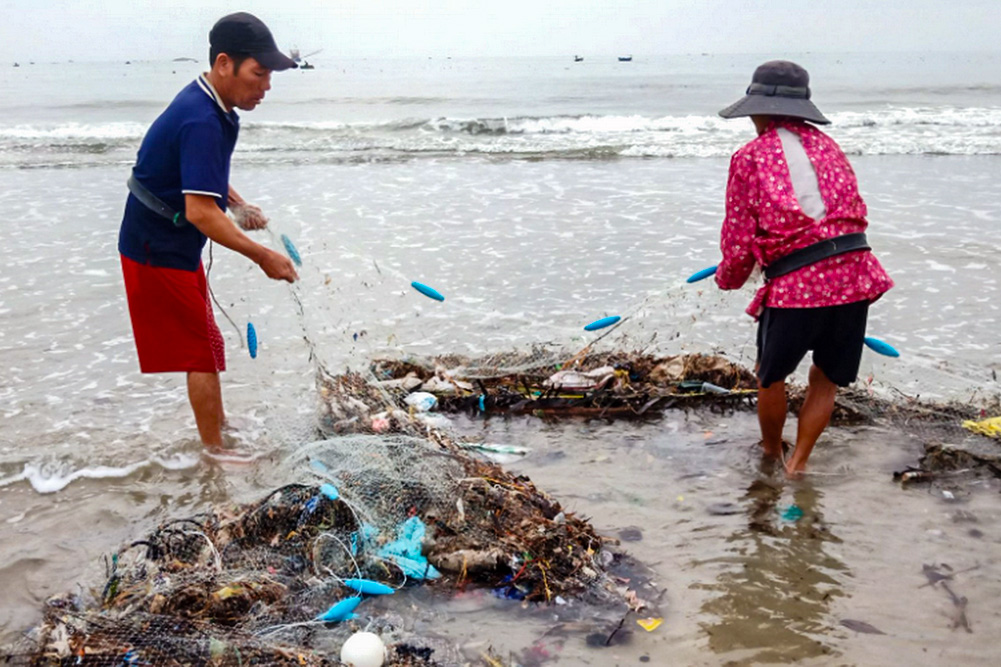
Workers remove trash from a clam-farming area in Vinh An, Vietnam, on June 17, 2026. Farmers say plastic waste and other flood-borne debris have contributed to declining harvests. (Joachim Pham)
When fisherman Huynh Ba Oa was a boy, his father taught him a simple lesson: "The sea feeds us, so we must protect the sea."
For generations, Oa's family has lived by the waters of Lang Co Bay on Vietnam's central coast. Today, he still heads out to sea with eight crew members, spending 21 days at a time fishing for mackerel, herring and crabs.
But the sea that sustained his family is changing.
"Now when I pull up my nets, sometimes there is more plastic than fish," Oa said.
Vietnam, with more than 3,200 km (2,000 miles) of coastline, faces one of the world's worst plastic pollution crises. According to the Vietnamese government, the country generates about 1.8 million tons of plastic waste annually, with up to 730,000 tons leaking into the ocean each year, placing Vietnam among the five largest contributors to marine plastic pollution globally.
A March 2026 report from the Global Plastic Action Partnership, in collaboration with the Viet Nam National Plastic Action Partnership, estimated that more than 1,500 tons of plastic waste leak into Vietnam's environment every day. Microplastics have been detected in rivers, mangrove forests, coral reefs and coastal sediments — and in shellfish, shrimp and fish consumed by people.
For fishing communities, the consequences are becoming impossible to ignore. Every trip brings encounters with floating debris.
"We regularly pull up plastic bottles, sandals, buckets, milk cartons, beer cans and abandoned fishing gear," Oa said. "Sometimes it takes two or three hours just to remove the trash from our nets."
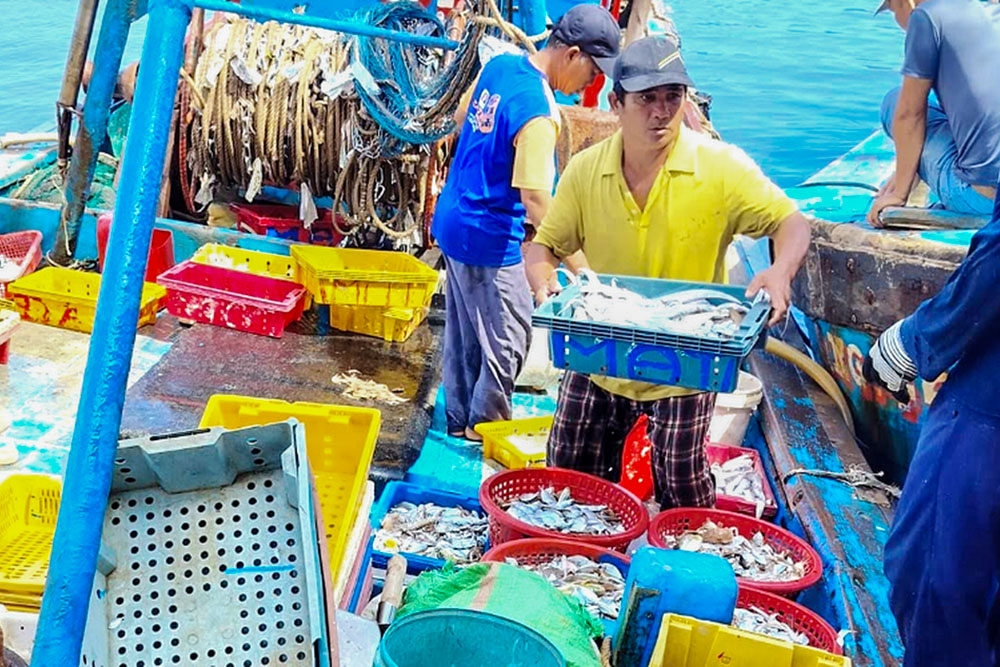
Huynh Ba Oa (in yellow) unloads fish from his catch aboard in Lang Co Bay, Vietnam, on June 16, 2026. Oa says plastic waste and abandoned fishing gear increasingly fill his nets. (Joachim Pham)
Ghost nets — abandoned fishing gear that continues trapping marine life — have become a particular menace.
In 2024, Oa's net snagged an abandoned anchor, tearing away more than 15 meters of netting and forcing him to spend a week making repairs. On other occasions, he hauled up hundreds of dead tuna and mackerel trapped in discarded nets.
Meanwhile, fish catches continue to fall.
"Today, we catch about 1,500 kilograms of fish on a trip," he said. "Ten years ago we would catch 5,000 to 6,000 kilograms."
A study published in Communications Earth & Environment journal in June 2026 found that fishing households lose an average of US$3,400 per boat annually because of plastic pollution — roughly 12% of yearly vessel revenue.
For Oa, the damage goes beyond economics.
"The hardest thing is going out every day and watching the sea die," he said. "One day it's worse than before. Then the next day it's worse again."
Oa is unusual among local fishermen because he brings trash back to shore rather than throwing it overboard.
"When I was the only one carrying garbage back from the sea, people called me crazy," he recalled.
Yet he believes behavior can change. If programs existed to pay fishermen for bringing plastic waste ashore, he said, many would participate.
Not far away, another victim of the crisis is giving up her livelihood altogether.
Advertisement
Pham Thi Hai began farming clams in Cau Hai Lagoon in 2021, harvesting more than three tons annually from a 5,000-square-meter plot. By 2025, production had collapsed.
"I don't understand why the clams are dying," Hai said. "Normally, the rainy season is when clams reproduce strongly."
She had never heard the term microplastics, but she suspects worsening pollution plays a role. After floods, huge amounts of trash and plastic wash downstream into the lagoon.
A major flood last October swept debris through her farm, destroying nets and fencing. Cleanup and repairs cost 10 million dong. In May polluted water killed about 500 kilograms of clams worth more than 17 million dong (US$650).
"I have no choice but to quit clam farming and switch to making fish sauce," she said. "It's very sad."
Hai is one of 14 local clam-farming households that have abandoned the occupation.
As fishing and aquaculture communities struggle, faith groups across central Vietnam are increasingly stepping into the fight against pollution.
At An Bang Parish in Hue, where dozens of families depend on fishing, environmental stewardship has become part of parish life.
In 2015, Fr. Peter Nguyen Huu Giai of the parish established an environmental protection group. What began with 60 volunteers has grown to 112 members.
Every Saturday, they collect trash along the coast, bury it in pits and plant flowers on them.
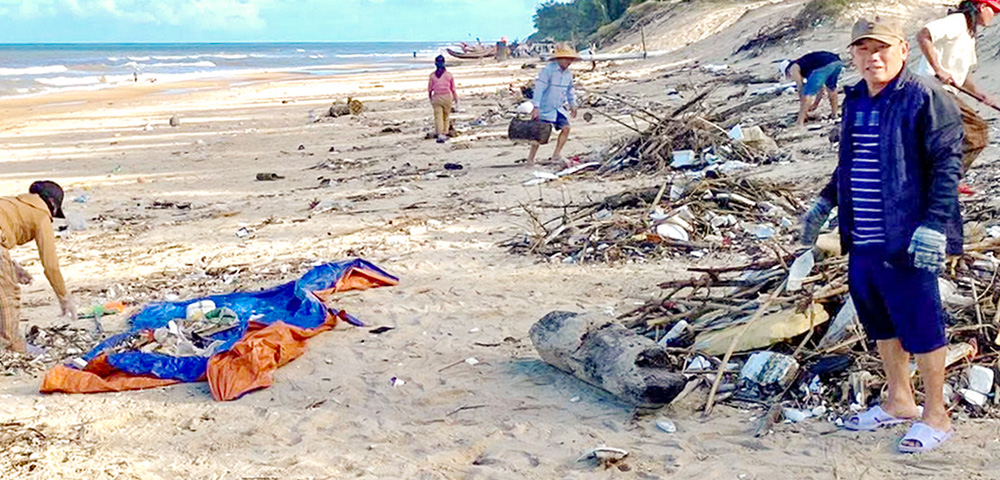
John Truong Dinh Bang, right, and parishioners collect trash along a beach in Hue, Vietnam, on June 20, 2026 as part of a parish environmental initiative. (Joachim Pham)
"The lesson we learned is that environmental protection requires participation from everyone," said John Truong Dinh Bang, who coordinates the effort.
The initiative gradually persuaded even skeptical households who raise pigs and produce rice wine to improve waste disposal and wastewater treatment practices.
Across the Hue Archdiocese, the environmental ministry has expanded through Caritas Hue; 46 parishes and subparishes now operate environmental cleanup teams.
Caritas has distributed more than 100 waste collection bins to coastal parishes, organized waste-management training and incorporated the themes of Pope Francis' Laudato Si' into marriage preparation courses, catechism classes and parish groups.
For staff member Lucia Nguyen Ha Van, the fishing crisis is also a family crisis.
"When local people lose their fish farms, family problems follow," she said. "Children cannot finish school. Husbands talk about leaving for city jobs. The plastic reaches into everything."
She sees a direct connection to Francis' teaching that "the cry of the Earth and the cry of the poor" are one.
"Here in Hue, we need to listen to the women who used to sell clams and now sell fish sauce instead," she said.
Catholics are not alone.
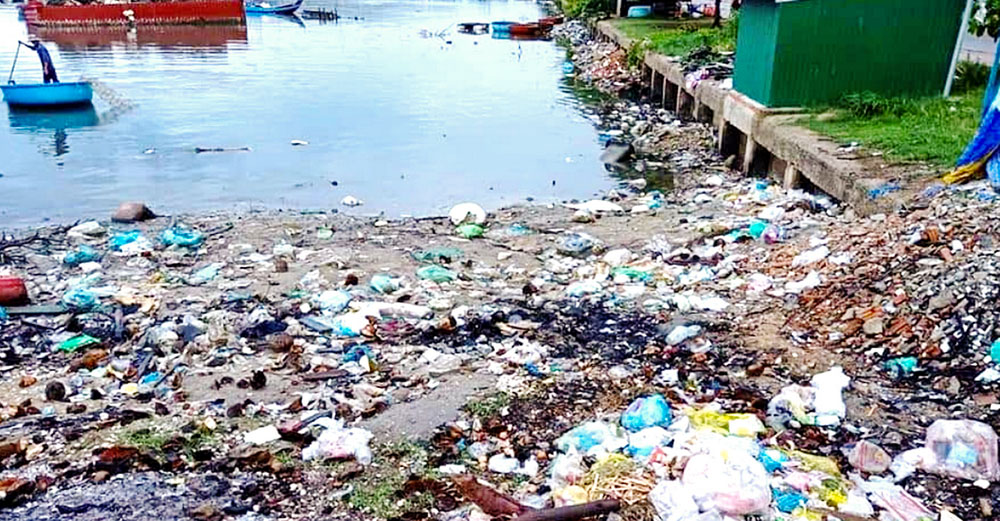
Plastic waste and other debris are discarded at Tam Giang Lagoon in Hue, Vietnam, on June 25, 2026. Seasonal floods often carry the trash into the sea. (Joachim Pham)
Buddhist volunteer Nguyen Hai Yen has led a 35-member group in environmental campaigns to reduce plastic waste and protect waterways for the past decade.
"Our message is that beauty should flow from the temple into the villages," Yen said. "A peaceful life requires a healthy environment."
Seven local Buddhist temples now maintain environmental cleanup teams.
Members of the Indigenous faith Cao Dai have also joined the movement. Le Van Ky said a group of 30 young volunteers has been cleaning parks, lakes and ponds since 2020. Women in the community weave bamboo baskets as alternatives to plastic bags and organize tree-planting campaigns.
Ky said environmental cooperation has become increasingly interfaith. Catholics, Buddhists and Cao Dai followers attend workshops together and collaborate in environmental protection and disaster relief efforts.
"We must protect the environment," he said. "Otherwise floods will worsen, land will become polluted and future generations will suffer."
Back in Lang Co Bay, Oa still heads to sea.
The father of four knows he may eventually have to abandon fishing. If that happens, he says, he will find work as a dock laborer.
For now, however, he keeps fishing — and keeps bringing plastic back to shore.
"The sea gave us life," he said. "We have to protect it. If we don't, there will be nothing left for our children."