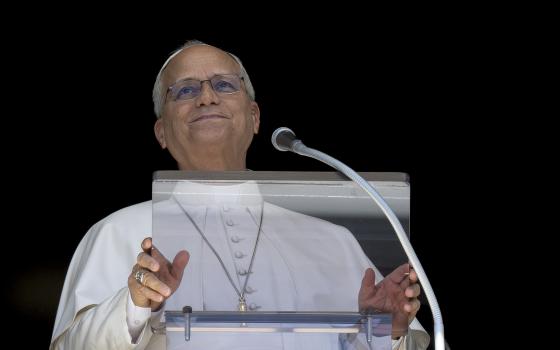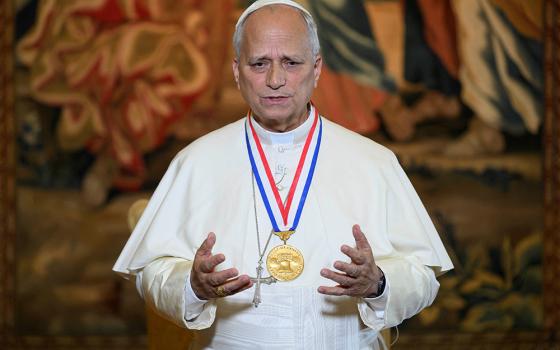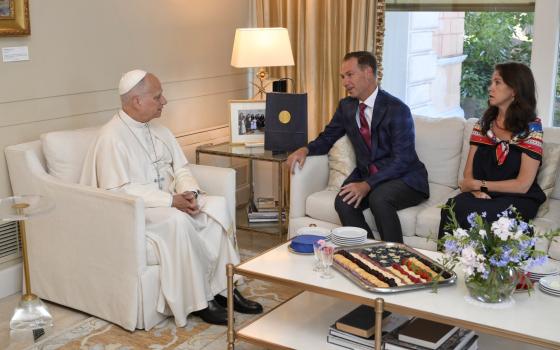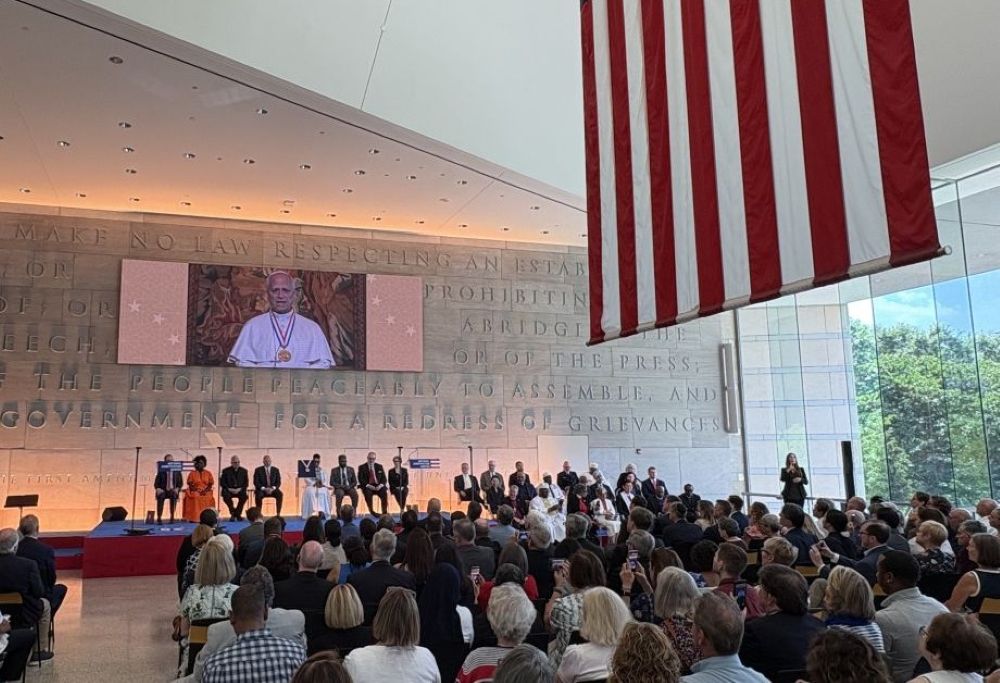
Pope Leo XIV appears via livestream from the Vatican during the Liberty Medal ceremony from the National Constitution Center in Philadelphia July 3, 2026. About people attended, including civic leaders, religious representatives from more than 30 faith traditions, Catholic leaders and many of the pope's longtime Augustinian friends. (NCR photo/Camillo Barone)

Join the Conversation
Send your thoughts to Letters to the Editor. Learn more
Pope Leo XIV urged Americans July 3 to renew their commitment to the nation's founding ideals of human dignity, religious freedom and the common good. He called on the country to continue striving toward the promise of liberty and justice for all, while acknowledging that the American experiment remains "a work in progress."
Acknowledging the Liberty Medal from the National Constitution Center in Philadelphia, the first U.S.-born pope reflected on the nation's founding ideals and encouraged Americans to protect human dignity, defend freedom of conscience and pursue unity, justice and peace.
"As a son of this great country, founded by courageous men and women who dreamed of liberty and of a better life for themselves and for their children," he said via livestream. "I join you in asking God's blessings upon America's future, that the lofty ideals enshrined at the beginning of the Declaration of Independence may continue to guide the flourishing of the nation in unity, justice and peace," Leo said.
Wearing the Liberty Medal around his neck as he appeared live from the Vatican, Leo formally accepted the award July 3, before rising to his feet as also the audience gathered 4,300 miles away inside Philadelphia's National Constitution Center stood in a 60-second ovation. Leo had received the medal in person April 30 at a smaller Vatican ceremony.
At the center of the stage in the Kenneth C. Griffin Great Hall at the Constitution Center, a second Liberty Medal rested on a pedestal, symbolically linking the Vatican and the birthplace of American democracy on the eve of the nation's 250th anniversary.
The 38th annual Liberty Medal ceremony, traditionally held outdoors on Independence Mall but moved inside because of extreme heat, brought together about 500 guests. In attendance were civic leaders, representatives from more than 30 faith traditions, Catholic leaders and many of the pope's longtime Augustinian friends. Philadelphia Mayor Cherelle Parker, Pennsylvania Gov. Josh Shapiro and Philadelphia Archbishop Nelson Pérez joined the gathering just steps from Independence Hall, where the Declaration of Independence and the Constitution were signed.
Minutes before 11 a.m., a replica of the Liberty Bell, provided by the National Liberty Museum, rang through the hall, setting the tone for a ceremony focused on religious liberty, freedom of conscience, peace and dialogue. After remarks by civic leaders and five religious leaders, including Pérez, the giant screen at the front of the hall came alive with the image of Leo speaking live from the Vatican. Behind the audience stood the flags of all 50 states, arranged in the order in which they entered the Union.
The pope rooted the American experiment in what he described as the intrinsic dignity of every human person.
"It is indeed here that we discover the basis of human dignity; dignity which precedes the establishment of any state, and whose custody constitutes its very purpose," he said.
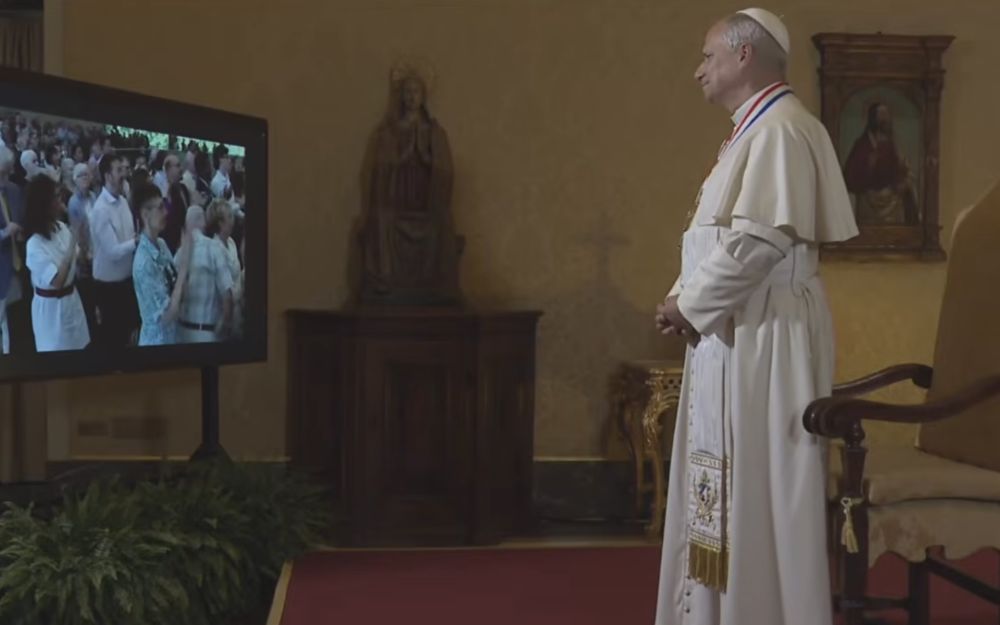
Pope Leo XIV is seen in this screen grab accepting the Philadelphia-based National Constitution Center’s 2026 Liberty Medal virtually from the Vatican, July 3, 2026. (OSV News/National Constitution Center, YouTube screenshot
Leo acknowledged that the American promise remains unfinished.
"As every American knows, however, the path to building a society that would embody those high ideals of liberty and justice for all was not always easy and, in many respects, is still a work in progress," he said. "Indeed, the effort to realize this vision is one that must be taken up anew in each generation and in the face of ever new challenges."
The pope devoted much of his remarks to the relationship among the right to life, authentic freedom and freedom of conscience. He said that liberty extends beyond individual choice and is rooted in the search for truth and the common good.
He also praised the nation's tradition of interfaith cooperation, expressing hope "that this tradition will continue to bear fruit in a public discourse marked by moderation, respect for the views of others and an ongoing effort to find common ground in promoting the cause of peace and reconciliation, at home and abroad."
Concluding his remarks, Leo called on Americans to recommit themselves to the principles that have shaped the country for two and a half centuries.
In an interview with the National Catholic Reporter before the ceremony, Philadelphia's Archbishop Pérez said the award recognized both the pope's global leadership and the universal values he has consistently defended.
"The reason he's being given this award, as a world leader, but also a priest, a bishop and now the universal shepherd of the church, is that he's championed world peace, he's championed religious freedom, he's championed the gift of liberty for all peoples, a gift that is inherent in our human dignity and our human rights that are given to us by God," Pérez said.
Looking toward the nation's 250th anniversary on July 4, the Philadelphia archbishop reflected on the immigrant story that has defined the United States.
"Unless you're an American Indian, all of us here came from someplace else," he said. "Our families were all searching for freedom. That's a gift that brought us here, keeps us here and will keep us here going into the future. The gift that was given to us is a gift that we have to then pay forward."
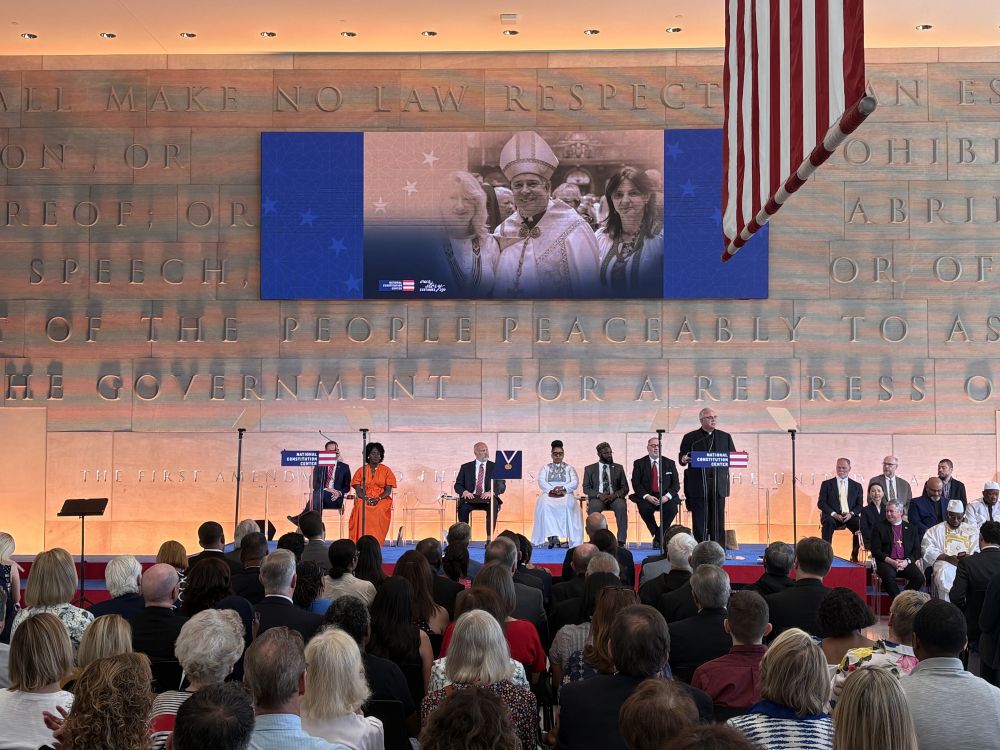
Philadelphia Archbishop Nelson Pérez gives a speech at a ceremony honoring Pope Leo XIV for receiving the Liberty Medal from the National Constitution Center in Philadelphia July 3. (NCR photo/Camillo Barone)
Advertisement
For Augustinian Fr. Arthur Purcaro, who has known Leo for four decades and who was sitting at the ceremony with other Augustinian friends, the event carried a deeply personal meaning.
"I'd say, as an Augustinian, as a friend, I'm very proud," Purcaro said before the pope's speech. "Here's a man who is obviously touched by the Holy Spirit. He's been a man who's committed to Christian values, and he deeply believes. He's a man of prayer, a person who listens."
Purcaro also pointed to one of the pope's recurring themes.
"One of the things that Leo has said and emphasized, particularly now and tomorrow when he'll be in Lampedusa, is that the litmus test of our social justice commitment is how we treat migrants. And we as Catholic people, as human beings, will believe and promote human dignity," he said.
Julie Silverbrook, chief content and learning officer at the National Constitution Center, said the ceremony was intended to invite Americans of every faith — and of none — to reflect on the enduring place of religious liberty in the nation's civic life.
Silverbrook said she hoped visitors would remember "the ways in which religious liberty and freedom of conscience have been an integral part of our civic life," from the American Revolution to the abolitionist movement and the Civil Rights Movement.
She added that "having a country where you can exercise any faith or no faith at all and live according to the dictates of your own conscience is, I think, one of the greatest contributions that we've made to the world."