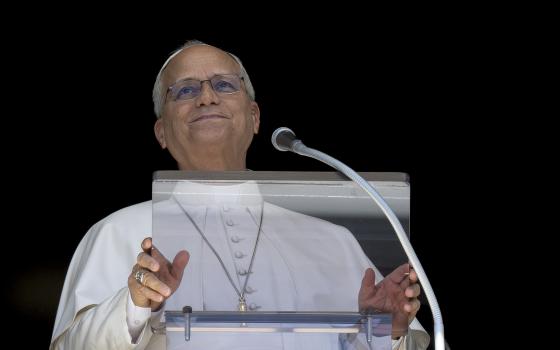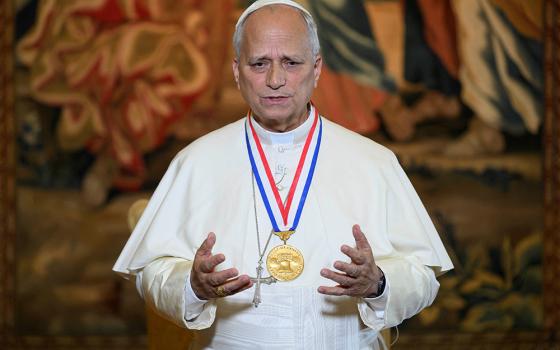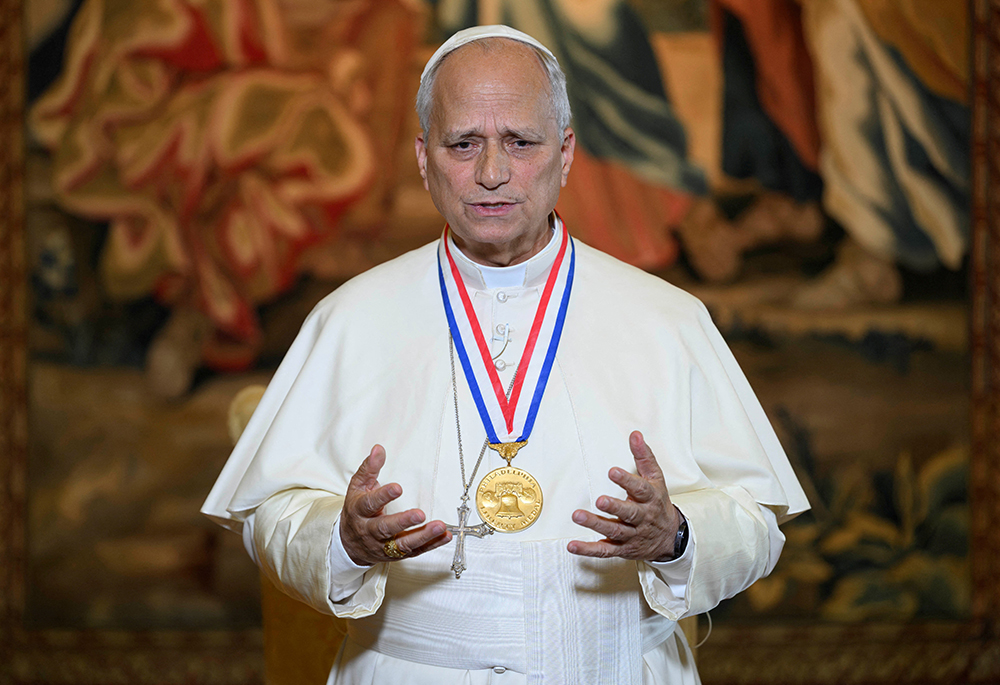
Pope Leo XIV gestures at the Vatican, July 3, 2026, after addressing the National Constitution Center in Philadelphia via video link after receiving the Liberty Medal. (OSV News/Vatican Media/Simone Risoluti)

by Cathleen Kaveny
Join the Conversation
Send your thoughts to Letters to the Editor. Learn more
What was the purpose of the Founding Fathers in uniting 13 North Atlantic colonies into an independent nation in 1776? What is the purpose of the United States of America today? Over the July Fourth weekend, Pope Leo XIV modeled a two-pronged approach to these questions. His approach issues a challenge: Can we make the "eloquence of those words" of the Declaration of Independence a living reality, so that the "lofty ideals enshrined at the beginning of the Declaration of Independence may continue to guide the flourishing of the nation in unity, justice and peace"?
The test of those eloquent ideals lies in not in the glamour of ceremony, but rather in the grit of our commitment to flesh-and-blood human beings, particularly the "tired," the "poor," and the "huddled masses yearning to breathe free," to quote Emma Lazarus.
On July 3, Pope Leo XIV gave a livestream address to the National Constitution Center in Philadelphia which awarded him its annual Liberty Medal. Here he pondered the "nation's founding principles," meditating on the declaration's "resounding appeal to the law of nature and to nature's God as the basis of their assertion that all men and women are created equal and endowed by their Creator with certain inalienable rights, including the right to life, liberty and the pursuit of happiness."
The import of Leo's analysis is that the health of the American polity will always depend on the appropriate interpretation of each of these rights. The right to life must be understood with reference to — and reverence for — "the dignity endowed upon every human person by virtue of their very existence." The right to liberty is not grounded in the capacity to "act as one would like," but instead is "founded upon the human person's capacity to know the truth and adhere to what is good, even at great cost." Leo's entire speech tacitly contended that the proper pursuit of happiness is not to be found in the egocentric chase of money and power, but through a united commitment to the protection of the weakest. As Leo said, "The moral greatness of a nation is manifested, above all, in its capacity to support, protect and cherish the lives of all, especially the most vulnerable and those whose worth is questioned."
Beautiful as the ideals of "life, liberty and the pursuit of happiness" are, they are merely ideas. As Pope Francis taught us, however, "realities are more important than ideas." Pope Leo underscored that lesson on July 4, in his visit to Lampedusa, the gateway to Europe and the hope of safety for countless refugees. But the hope of many who set sail for Lampedusa was dashed by the winds and waves of the Mediterranean — a fact that Leo marked by placing flowers at their graves. The reality of indifference to human vulnerability is death.
In his letter to his fellow countrymen on the 250th anniversary of the nation's Declaration of Independence, the first American pope proclaimed the nation's flourishing is tied to the way we treat people who are or may be dependent — including migrants: "In every generation, those who have arrived seeking freedom, opportunity and a place to belong have helped to shape the nation's character." Leo said. "To receive them with compassion and generosity is not only an act of charity, but also a recognition of the dignity that belongs to every human person."
How do we make the lofty words of the Declaration of Independence real in American life? One important way is by using them as a lodestar in the interpretation of our basic governing document, the Constitution, as well as the laws designed to bring to life the polity described in the Constitution. It was, after all, the American Constitution Center that awarded Leo the Liberty Medal, in the City of Brotherly Love. The Constitution is the nation's charter, and like any charter, it cannot be properly interpreted without reference to its purpose. That purpose is articulated most compactly in the Declaration of Independence, as Leo recognizes.
How do we make the lofty words of the Declaration of Independence real in American life? One important way is by using them as a lodestar in the interpretation of our basic governing document, the Constitution, as well as the laws designed to bring to life the polity described in the Constitution.
But Leo is not the first one to have this insight. The most famous example of interpreting the Constitution in light of the declaration is Martin Luther King Jr.'s "I Have a Dream" speech, delivered Aug. 28, 1963, at the March on Washington. King honors the "architects of our Republic" as issuing a "promissory note to which every American was to fall heir," no matter what their race. But he laments that the declaration's promises of "the unalienable rights of life, liberty, and the pursuit of happiness" have failed African Americans. The guarantees set forth in the declaration were undermined by decades of constitutional interpretation justifying the brutal indignities of racism and Jim Crow continuing long after the Civil War ended slavery.
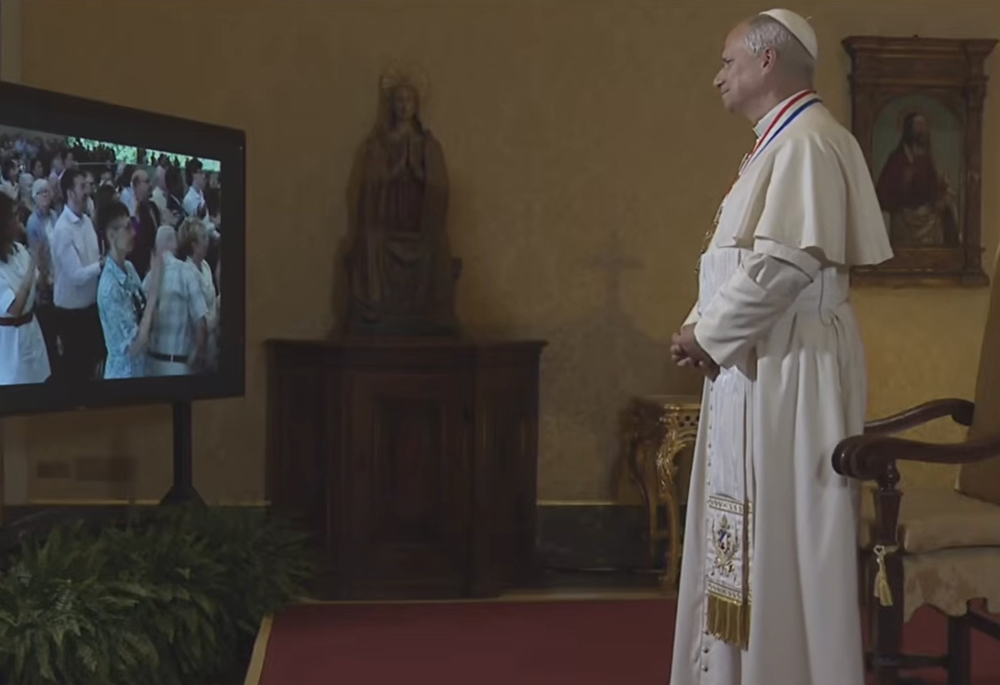
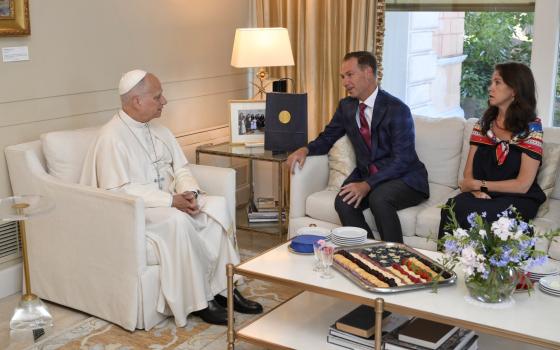
Pope Leo XIV is seen in this screenshot accepting the Philadelphia-based National Constitution Center’s 2026 Liberty Medal virtually from the Vatican, July 3, 2026. (OSV News/National Constitution Center, YouTube screenshot)
As both King and Leo recognize, interpreting the Constitution correctly requires interpreting it in light of its overarching purpose of promoting equal human dignity. But the current conservative majority on the Supreme Court doesn't seem to agree. In Mullin v. Doe, a 6-3 decision handed down in June 2026, the Supreme Court allowed the Trump administration abruptly to end temporary protected status (TPS) for migrants fleeing violence and natural disaster in Syria and Haiti, leaving them vulnerable to immediate deportation.
The majority opinion held that the review process mandated by the statute before removing a country from the program was not subject to judicial review. Moreover, while recognizing that it would have jurisdiction over the migrants' constitutionally based equal protection claims, the court declined to say that the president's repeated racial slurs against Haitians supported those claims. In the majority's view, Trump was not ending the TPS program for prohibited, race-based reasons.
Let me be clear: The TPS statute leaves no doubt that the executive branch has the power to terminate TPS with respect to migrants from any given country, and that this "determination" of termination is not subject to judicial review. The question is whether the courts can and should assess whether the administration followed the process set forth in the statute before terminating a country from the program. The majority opinion says no — the word "determination" is broad enough to prohibit judicial review of the process, not only the outcome.
But that reading of the statute is not inevitable — indeed, it is counterintuitive, as the dissent points out. For example, the fact that the department chair cannot review my grades doesn't mean they can't raise an eyebrow if I throw the exams down the stairs, giving the highest grades to those that land on the lowest steps. But for the sake of argument, let's say that the interpretation of "determination" is an open question. Why not resolve it by considering the purpose of the TPS statute to safeguard vulnerable migrants from nearly certain ruination? Why not interpret the scope of appropriate judicial protection in light of America's broader moral and jurisprudential commitments?
Advertisement
Unfortunately, consideration of broader legislative and constitutional purposes plays almost no role in the majority's reasoning. But it should. At bottom, the migrants are asking for respect for due process. Not merely a component of the rule of law, due process is intrinsically bound up with respect for human dignity. It is one thing to say that the administration can end TPS for people fleeing a particular country without judicial review. It is another thing entirely to say that it can do so without considering the situation on the ground in that country, as the statute specifies, or by treating some people as less worthy of protection because of their race. As human beings dealing with human beings, our leaders must be accountable to that basic level of consideration.
But what about the objection that this is judicial activism? No. To recognize that the purpose of the law, and the broader purposes of our nation under law, must affect legal interpretation is not to wrongly legislate from the bench. It is to recognize that law must serve the nation's common good, as articulated in its founding documents.
We can't allow the words of the Declaration of Independence to devolve into impotent platitudes. Following the example of Leo, we must incarnate its commitment to dignity, equality and flourishing in our actions and in our laws — and especially now, in our respect for due process and human dignity.