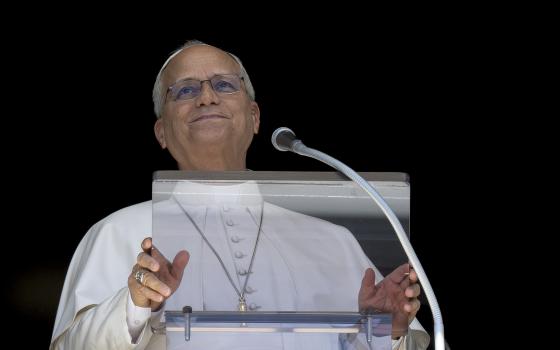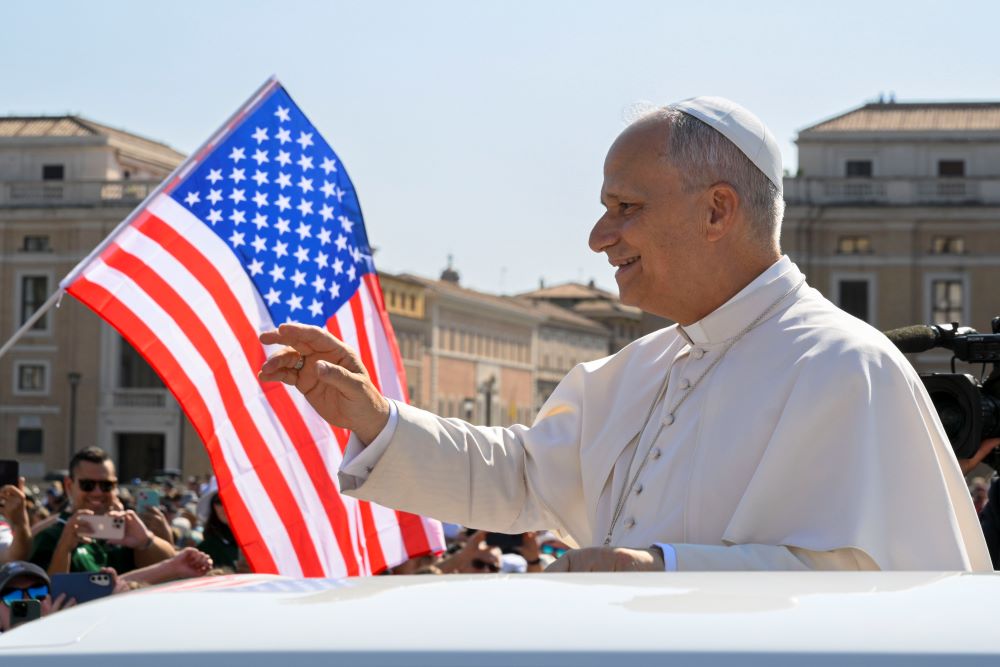
With a U.S. flag in the background, Pope Leo XIV waves to the crowd from the popemobile as he rides around St. Peter's Square at the Vatican before his weekly general audience Aug. 6, 2025. (CNS/Vatican Media)

Join the Conversation
Send your thoughts to Letters to the Editor. Learn more
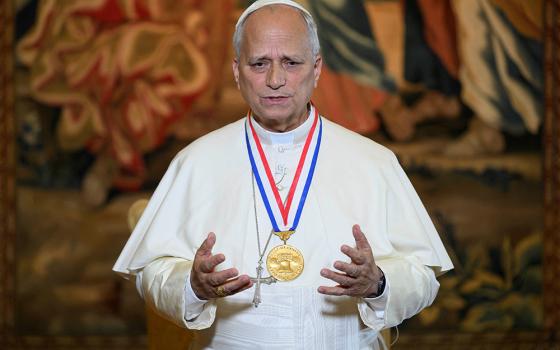
On the eve of the United States' 250th anniversary, the National Constitution Center in Philadelphia will award its 38th annual Liberty Medal to the first U.S-born pope, Pope Leo XIV, in a ceremony designed to reflect on the meaning of liberty across generations and borders.
The July 3 event, held outside the National Constitution Center on Independence Mall, will bring civic leaders, faith representatives and members of the public together at a symbolic location: the historic district where the U.S. Constitution and the Declaration of Independence were drafted and signed.
Leo will accept the award virtually from the Vatican in remarks broadcast live to the audience gathered in Philadelphia. The medal recognizes what organizers described as the pontiff's lifelong advocacy for religious liberty and freedom of conscience — principles embedded in the Constitution's First Amendment.
"It's our 250th anniversary, or the semiquincentennial, and at the National Constitution Center, we felt as though that moment required a recipient who was equally as important in telling our our story," said Vince Stango, interim president and CEO of the Constitution Center.
"And so as we were thinking about those founding principles, it just occurred to us that to honor the first American pope, who himself has been a long advocate of freedom of religion and the American tradition of pluralism," Stango said. "He really was the number one choice to receive this year's Liberty Medal."
The selection marks the first time a pope has received the Liberty Medal, an award established in 1988 to commemorate the bicentennial of the Constitution and given annually to individuals who advance freedom and human dignity worldwide.
Previous recipients include Ukrainian president Volodymyr Zelenskyy, Hong Kong activist Jimmy Lai, Sen. John McCain, Rep. John Lewis, Justice Ruth Bader Ginsburg, the Dalai Lama, former Secretary of State Hillary Clinton and former President George W. Bush.
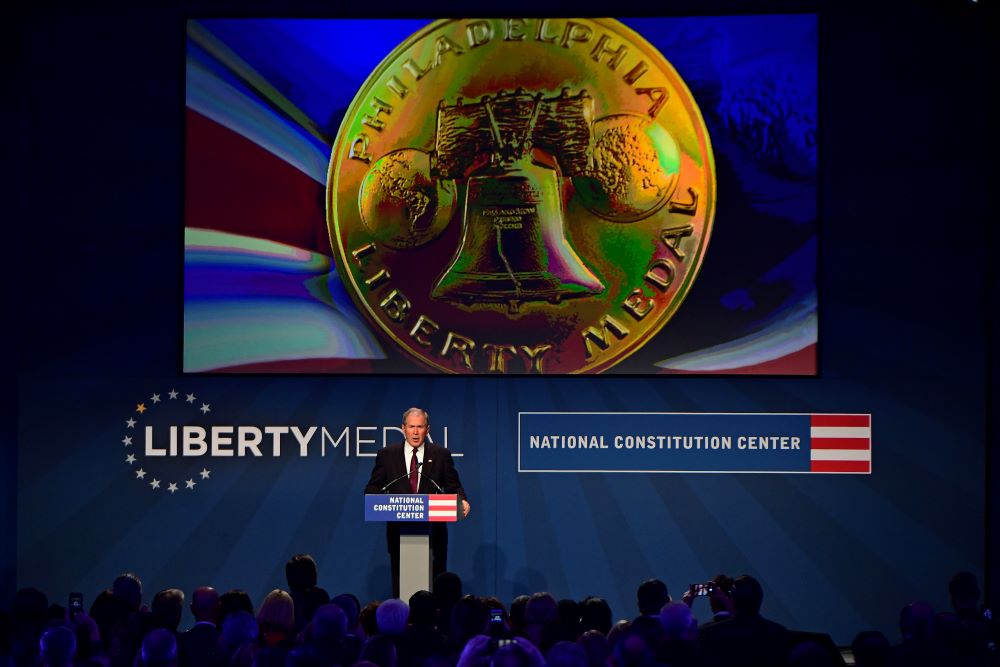
Former U.S. President George W. Bush speaks after he and his wife, First Lady Laura Bush, received the 30th annual Liberty Medal at the National Constitution Center in Philadelphia Nov. 11, 2018. (AP/Corey Perrine)
Since his election in May 2025 following the death of Pope Francis, Pope Leo XIV — born in Chicago and formerly a missionary and bishop in Peru — has emphasized interfaith dialogue and religious coexistence as central themes of his papacy. He has engaged with leaders from Jewish, Muslim and Christian communities in an effort to promote peaceful coexistence and defend religious freedom worldwide.
For the National Constitution Center, that emphasis mirrors the pluralistic vision embedded in America's founding.
Stango said the ceremony will highlight not only the pope's leadership but also the broader story of religious liberty in America.
"For us, with His Holiness representing the leader of the Catholic Church, a lot of the story will certainly center around him and his personal contributions," he said. "But we're also planning to tell a story that embodies freedom of religion."
"So all religions are included in that story," Stango added. "This will be a Catholic story, but there'll be a kind of a broader religious story."
The First Amendment's guarantee of religious freedom — prohibiting the government from establishing a religion or restricting its free exercise — was a radical idea in the late 18th century, emerging from centuries of religious conflict in Europe.
Yet the relationship between the early American republic and the Vatican was historically complicated.
In the 19th and 20th centuries, many native-born Americans viewed Catholic immigrants — especially from Ireland, Italy and Poland — as culturally inferior and politically suspect, fearing their allegiance to the pope made them a threat to the U.S. democratic independence. Anti-Catholic sentiment shaped politics, education and immigration debates, fueling social movements and policies to limit Catholic influence in public institutions.
Advertisement
Asked what the Founding Fathers might think about honoring a pope with a Liberty Medal, Stango said the struggle for liberty has always involved tension and debate.
"Well, I wouldn't pretend to know what the founders would say," he said. "But I do think that they all recognize that to achieve liberty, to achieve freedom of conscience, to achieve human dignity, that all comes at a cost, and that comes, at times, with a fight."
"I hope that while they might be surprised by some of the details, it would comport with their idea of how these things should go," he added. "That struggle continues to this day, 250 years later."
A papacy shaped by immigration debates
The announcement comes as immigration and religious liberty have become prominent issues in the United States and the global Catholic Church.
In recent months, Leo has criticized aspects of American immigration enforcement. He supported the U.S. Catholic bishops' rare Nov. 12 statement condemning mass deportations and raising concerns about detention conditions and limited access to pastoral care for migrants.
Speaking to reporters Nov. 18, Leo said that treating immigrants who have lived in the country for years "in a way that is extremely disrespectful, to say the least," is unacceptable and urged authorities to treat people with dignity while enforcing immigration laws.
In another development that drew international attention, a federal judge recently ordered immigration authorities to allow Catholic clergy access to a detention facility in the Chicago area after a legal dispute over religious services for detainees, including giving Communion and providing spiritual comfort to detained undocumented immigrants.
The issue also has symbolic resonance this year. On July 4, the day after the Liberty Medal ceremony and the 250th anniversary of the U.S. independence, Leo will travel to the Mediterranean island of Lampedusa — a major landing point for migrants attempting to reach Europe from North Africa, considered to be an historic European stronghold of welcoming immigrants fleeing sub-Saharan and Northern African countries.
The visit echoes a landmark trip by Pope Francis in 2013 — his first papal visit after his March 2013 election — and underscores Leo's emphasis on the humanitarian dimension of migration.