Michele Murray will be the first lay person to serve as president of the Association of Jesuit Colleges and Universities starting June 2. She currently serves as senior vice president for student development and mission at the College of the Holy Cross in Worcester, Massachusetts. (Courtesy of AJCU)

by Brian Fraga
Staff Reporter
Join the Conversation
Send your thoughts to Letters to the Editor. Learn more
Michele Murray will be the first lay person to serve as president of the Association of Jesuit Colleges and Universities when she assumes leadership of the organization on June 2.
It will be a fitting new professional assignment for Murray, who told National Catholic Reporter in an interview on April 10 that Ignatian spirituality has shaped her life and relationship with God.
"I would say that continuing my association with Jesuit higher education is an extreme privilege," said Murray, who has spent three decades serving at Jesuit institutions, including Loyola University in Maryland, Seattle University and the College of the Holy Cross in Worcester, Massachusetts, where she currently serves as senior vice president for student development and mission.
She succeeds Jesuit Fr. Michael Garanzini, who stepped down in August after five years as AJCU's president.
Murray, a nationally recognized educator, speaker and author who serves on the NCR board of directors, spoke about her vision for AJCU, which represents 27 Jesuit institutions in the United States and one in Belize, along with three associate members in Canada.
The interview has been edited for length and clarity.
NCR: How does it feel to be assuming this new position at AJCU?
Murray: I have been working in Jesuit higher education for 30 years. I was 10 years at Loyola University Maryland, 11 [years] at Seattle University, and now I'm finishing my ninth year here at Holy Cross. Although I'm not Jesuit-educated myself, Jesuit higher education has given me everything really in terms of a purpose in my life, my career and my vocation, and understanding all of that in a deeper way.
Ignatian spirituality has shaped my relationship with God. So, I would say that continuing my association with Jesuit higher education is an extreme privilege. And to do it in this particular way to lead the association, I feel both the weight of responsibility and also real hope for the future of Jesuit higher education.
Do you have any goals or do you bring a certain vision for what you would like to bring to the AJCU?
In the immediate, I would say that there are a few things that we are looking at. One is to develop a sense of network and look at Jesuit higher education as a whole. We have recently launched a campaign called We Are Jesuit Educated. And so harnessing the power of the collective rather than that of each institution, communicating that all 27 Jesuit institutions in the United States, that we are all Jesuit institutions and stand for the same mission and hold the same values. I think more of those kinds of partnerships are in the future.
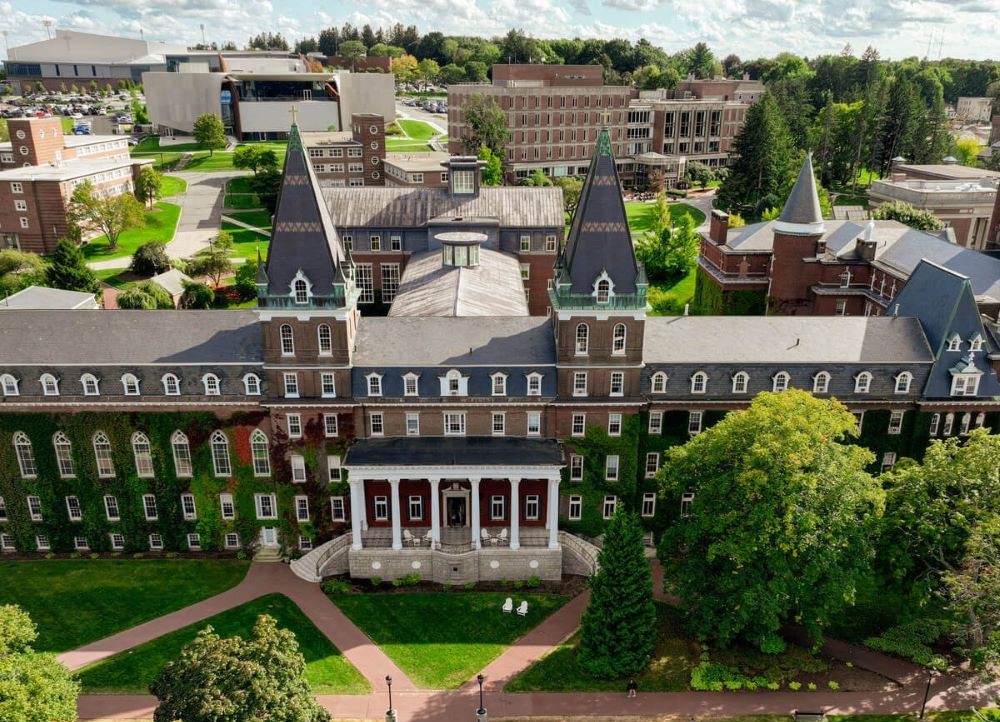
The College of the Holy Cross campus in Worcester, Massachusetts, is pictured in this undated photo. It is among 28 member institutions of the Association of Jesuit Colleges and Universities. (OSV News/Courtesy of College of the Holy Cross)
Another really important aspect is continuing to advocate for our students. As AJCU institutions, we are concerned about our most vulnerable students, particularly advocating for the financial assistance that the federal government has provided to students. We believe that talent is equally distributed across the population, but opportunity is not. And so advocating for the continuation of Pell Grants, for instance, the kinds of PLUS loans that allow students to go to graduate school.
I would be remiss if I did not say that one of the really big projects that we have on our plate is something called the Mission Priority Examen, which is co-sponsored by the AJCU and the Jesuit Conference. There are seven characteristics of Jesuit higher education that they have outlined and each institution has to respond to these characteristics every seven years. It sounds a lot like an accreditation process, but what it really is is a collective reflection and discernment process for each institution to really dig deeply into how they are living out their Jesuit Catholic mission. All of that information ends up going to the father general of the Society of Jesus, and that's where we have our Jesuit Catholic identity affirmed.
What do you make of the fact that you are the first lay person to lead the AJCU? What does that say about the evolution of Jesuit higher education?
Well, I think it actually means a lot of things. One is that my life, my professional trajectory, is a testament to the generosity of many Jesuits who have shared their charism with me, and have shared Ignatian spirituality. I would not be the person that I am today if I had not had the opportunities to learn alongside a great number of Jesuits who have been very generous in their sharing.
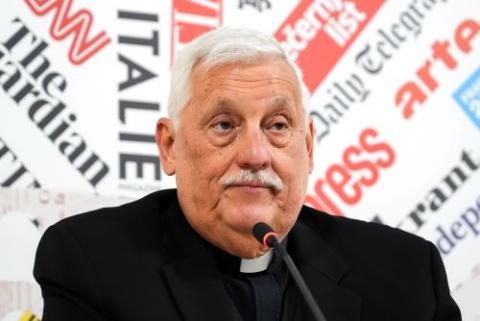
Jesuit Fr. Arturo Sosa, superior general of the Jesuits, speaks at a news conference in Rome April 10, 2025. (CNS/Lola Gomez)
Jesuits go where they are called. They are on the frontiers. That is their particular assignment. And in some ways, I think the emergence of lay leaders across Jesuit education means that higher education for the Jesuits is very well established and in some ways, Jesuits can turn their attention elsewhere to other apostolates because they have really [invested in] lay leaders who can carry the banner forward with great fidelity.
How can the AJCU help Jesuit colleges and universities navigate some of the well-documented challenges facing higher education, which include the rise of artificial intelligence, the so-called demographic cliff and indications that more people today seem to be questioning the value of a liberal arts education?
These are challenges that we have in common across higher education. To go back to the We Are Jesuit Educated campaign — that campaign emerged out of some research amongst young adults and teenagers who did not know the Latin words for the values of Jesuit education. But the values in plain language, that we are forming people to be for and with others, who care about the common good, who want to be a part of something bigger than themselves. Those values, translated in plain language, really resonate with young people.
There certainly are challenges to overcome, and I firmly believe that the education that we deliver is exactly what young people are asking for because they want to have hope in their future. And one of the four priorities for the Society of Jesus is accompanying youth toward a hope-filled future, and part of how we do that is helping them, our students, be well educated and well formed.
What is about the Jesuit charism that speaks to you on a personal level? How much has it shaped and impacted you?
By disposition, I think I am someone who takes to the concept of discernment fairly easily. I was born and raised Catholic, so this is part of my understanding of the world and my place in it. When I first went to Loyola, I was introduced to the Examen, a very simple prayer of trying to understand, in simple words, where did I find God today in my actions, where did I turn away from God and, knowing all of this, what do I want to do differently tomorrow?
Advertisement
Then of course, there would be no society of Jesus if there weren't the Spiritual Exercises. I have had opportunities to do two eight-day silent retreats with the Spiritual Exercises. Those were opportunities to really be with Jesus in prayer. Those opportunities have been incredibly profound for me in my life, helping me to develop a sense of interior freedom, which is, of course, a hallmark of Ignatian spirituality. Deepening my trust in God and in God's mercy, knowing that whenever God is calling me to a particular purpose, that I can rely on God's help, that we are working on it together. Those are actual gifts of the Spiritual Exercises for me. I would say that all applies to me in applying for and accepting this role as president of the AJCU.
What are you doing to prepare now for when you assume your new role on June 2?
I've been to Rome to meet my counterparts in the other regions, which was wonderful and fascinating.
Considering the magnitude of the work AJCU does, we actually have a very small staff. So I have met with everybody at least once, if not multiple times, to hear more about what it is that they do, from their own words, what they think is going well and what kinds of things they think we need to look at as a team.
AJCU is also offering the presidents of the 28 [member] institutions a chance to go to Rome at the end of June and meet with Fr. [Arturo] Sosa, superior general of the Society of Jesus. There will also be meetings at the Office for the Synod and the Dicastery for Culture and Education, as well as a retreat experience in Assisi. So we're getting ready for that, and making all of those arrangements, which I think is going to be a tremendous experience for everyone.