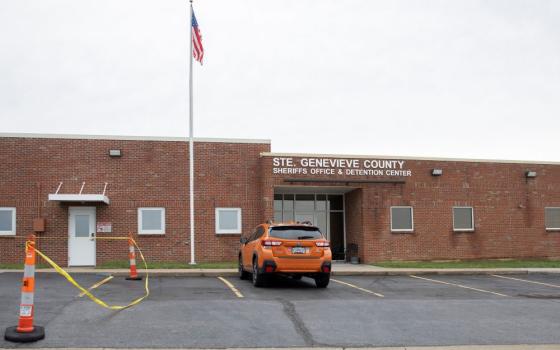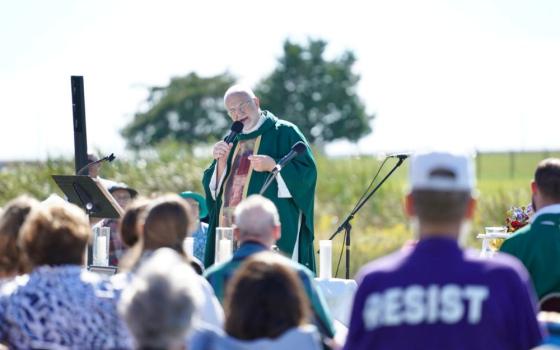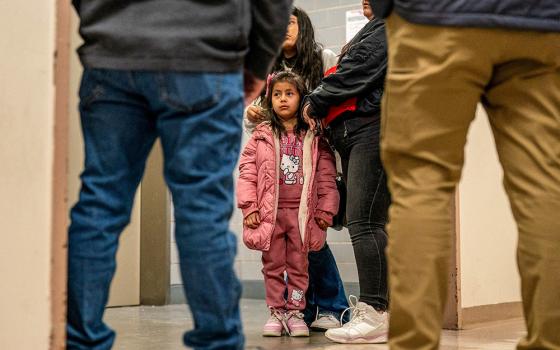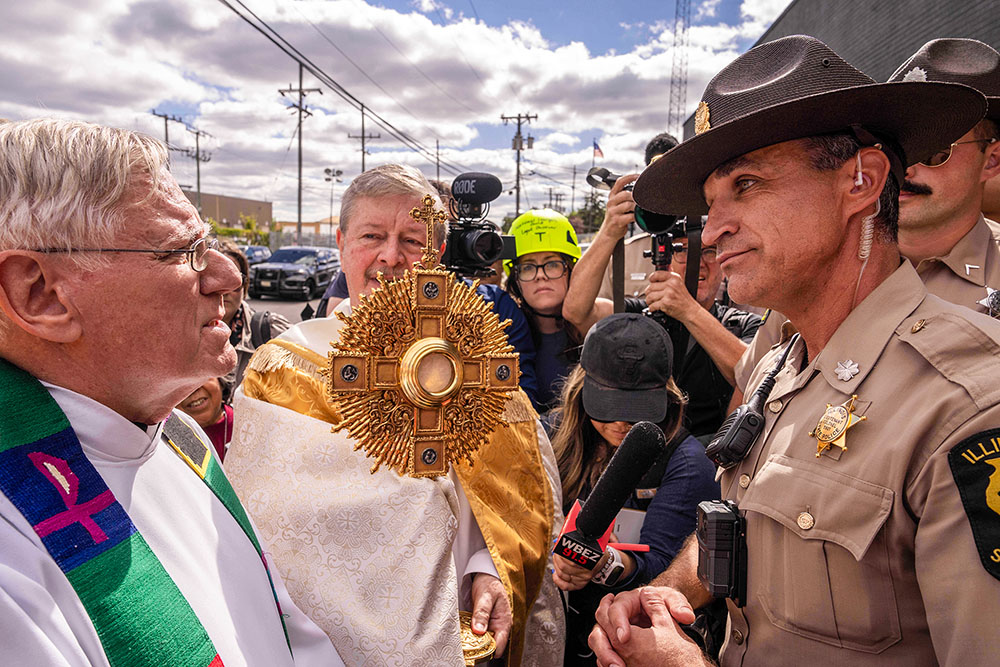
A member of the Illinois State Police, right, relays the message to clergy that U.S. Immigration and Customs Enforcement denied them access to detainees to provide Communion, outside an ICE facility in Broadview, Ill., Oct. 11, 2025. (AP/Adam Gray)

Religion News Service
Join the Conversation
Send your thoughts to Letters to the Editor. Learn more
In February, Paula White-Cain, an evangelical Christian pastor who oversees the White House Faith Office, stood before the crowd gathered at the National Prayer Breakfast and declared that her boss, President Donald Trump, is a champion of religious freedom.
"No president in modern history, or perhaps all of history, has done more structurally, substantially and sincerely to elevate and protect religious liberty," she said, sparking a round of applause.
But just 24 hours later, lawyers representing Trump's administration were defending themselves from the latest filing in a lawsuit brought by a group of Catholic organizations and leaders, including Mercy Sr. JoAnn Persch, a Catholic nun. In the 18-page legal filing, lawyers for the group accused the federal government of banning religious expression by preventing faith leaders from ministering to immigrants detained in a Department of Homeland Security facility.
"The denial of access did more than simply inhibit their conduct; it destroyed their ministry — their religious expression — which entailed pastoral care face-to-face with detainees, as Sr. JoAnn had done for years," the filing read.
It's a dynamic that has haunted almost the entirety of Trump's second term: While the president insists he has "done more for religion than any other president," he has been repeatedly sued by faith groups — particularly over his attempts to restrict immigration and facilitate mass deportation.
Beginning his first day in office, Trump has issued a series of executive orders related to immigration, including a proclamation that described immigration at the U.S.-Mexico border as an "invasion." Religious groups, in turn, responded by filing lawsuits against the federal government — and as the Trump administration's immigration enforcement campaign has accelerated, the lawsuits and plaintiffs have multiplied.
Dozens of clergy, houses of worship, faith-based organizations and entire religious denominations have joined at least 21 of the 22 lawsuits challenging the president's immigration policies, according to a new litigation tracker developed by Religion News Service with the Law, Rights, and Religion Project, a project of Union Theological Seminary that focuses on religious freedom and religious pluralism. (One of the cases, Kennedy Human Rights v. Department of State, makes religious liberty claims on behalf of immigrant detainees but does not feature a religious plaintiff.)
Overall, there are 81 religious plaintiffs from eight major religious traditions, including mainline Protestantism, Catholicism, evangelicalism, Sikhism, Judaism, Islam and others, the tracker shows.
Advertisement
Sorted by individual plaintiffs and their legal claims, the tracker reveals some clear patterns about who is suing and why. Among them:
- Fifteen religious denominations — collectively representing millions of Americans — are themselves listed as plaintiffs. Eleven are mainline Protestant, including the Episcopal Church and the Evangelical Lutheran Church in America. Three are Jewish, such as the Union for Reform Judaism, and one, the African Methodist Episcopal Zion Church, is Black Protestant. Another 23 plaintiffs are regional denomination bodies, such as Lutheran synods or Catholic dioceses.
- Of the 81 religious plaintiffs — which includes state-level councils of churches, faith leaders, individual practitioners and faith-based organizations in addition to denominational bodies — roughly half are mainline Protestant, followed by Catholics (20%), and Jewish traditions (nearly 9%).
- At least 14 of the 22 cases claim the federal government has violated the religious rights of the litigants, either by infringing on the First Amendment's right to free exercise of religion or, more often, the Religious Freedom Restoration Act of 1993 — a statute previously known for showing up in high-profile cases involving conservative religious groups.
- Four separate lawsuits, involving dozens of religious groups representing millions of religious Americans, are challenging the administration's decision to rescind an internal government policy that had discouraged immigration raids at "sensitive locations" such as churches, hospitals and schools.
"It's not just a lot of cases, but cases with some really significant actors," said Elizabeth Platt, director of the Law, Rights, and Religion Project at Union Theological Seminary.
Platt added that while Alliance Defending Freedom and other prominent conservative leaning legal groups that have traditionally handled religious freedom cases are not involved in this latest surge in cases, some of the heavyweight progressive legal advocacy groups, such as Democracy Forward, are representing the religious litigants.
"That makes a difference in terms of legal firepower," Platt said.
It's not unusual for there to be a surge in litigation when there are sweeping changes in government policy, notes Kimberlie Orr, an expert on both immigration law and religious freedom who teaches at Notre Dame Law School's Lindsay and Matt Moroun Religious Liberty Clinic. But she argued that the spike in religious figures and organizations filing immigration-related lawsuits reflects an often under-recognized reality: Faith groups have long been deeply intertwined with the U.S. immigration system through refugee resettlement services, legal and humanitarian assistance and ministry to people in detention.
"When immigration policies affect those activities, religious institutions may experience the consequences directly," Orr said.
Three major faith-based organizations that work with refugees — HIAS, Church World Service and Lutheran Community Services Northwest — together filed a suit challenging the president's decision to all but freeze the refugee program. That case, which is ongoing, initially focused on the halting of refugee admissions, but it has since shifted to litigating the administration's exceptions to the freeze — namely, admitting primarily white Afrikaners from South Africa as refugees.
Meanwhile, the United States Conference of Catholic Bishops — which has also long worked with the federal government to resettle refugees — filed a similar suit but focused its complaint more narrowly on the administration's suspension of agreements with the group and freezing reimbursements. A judge dismissed the bishops' case in January after the lawyers for the prelates said they had successfully recouped the relevant funds from the U.S. government.
Some individual faith leaders also are plaintiffs. Presbyterian pastors and Unitarian ministers signed on to a lawsuit alleging Department of Homeland Security agents fired tear gas and pepper bullets — including instances that were caught on camera — at clergy who said they were peacefully praying and protesting outside of an Immigration and Customs Enforcement facility.
Christopher Lund, a professor at Wayne State University Law School, framed the suit as part of a broader trend: Trump's mass deportation campaign has prompted an especially passionate response from liberal-leaning faith leaders and groups, he said, both in the streets and in the courts.
"The fact that we're very polarized, and that the Trump administration is approaching this from a very conservative angle, has led liberal churches to think hard about what their religions require of them or commit them to in terms of being receptive to immigrants," Lund said.
Asked about the buildup of cases, White House spokeswoman Lauren Bis insisted that "Trump is right" when he claims that he has done "more for religion than any other president in American history." The president, Bis argued, has "fought antireligious bias and ended the weaponization of government against all Americans of faith."
But many of the cases in the tracker argue the Trump administration has violated the religious rights of plaintiffs. Most invoke the Religious Freedom Restoration Act, a trend experts said was notable: While the law was originally passed in 1993 with broad support from both parties, it has become associated with legal victories for conservative religious groups, such as when the Supreme Court ruled in 2014 that craft store giant Hobby Lobby was exempt from the contraceptive mandate of the Affordable Care Act because its owners religiously objected to the regulation.
Caroline Mala Corbin, a professor who teaches about the U.S. Constitution's religion clauses at the University of Miami law school, said before Trump's second term, it was uncommon for liberal faith groups — many of whom are now plaintiffs — to make high-profile RFRA violation claims in court, at least when compared to their conservative counterparts. That has changed.
"The idea is: Well, if there is going to be this extensive protection for religion, there's no reason for only conservatives who are devout to benefit from it," Corbin said. "Why not also see if those on the liberal end of the spectrum who are devout might also benefit?"
Faith groups have clashed in court with the federal government over immigration policies before. In 2020, a federal judge overturned the convictions of four activists who faced federal misdemeanor charges after they left out water and beans for immigrants to find while crossing the U.S.-Mexico border. The judge concluded the activists were simply exercising their "sincerely held religious beliefs," citing RFRA and noting that the activists were working with No More Deaths, which was an official ministry of the Unitarian Universalist Church of Tucson at the time.
Similarly, after activists involved in the Sanctuary Movement of the 1980s were convicted of conspiring to smuggle immigrants, they appealed, citing the First Amendment.
That ultimately failed, and lawyers for the Trump administration have referenced instances of courts ruling against faith leaders in recent court filings.
But unlike cases from past decades, the new lawsuits filed against the Trump administration are far more plentiful and involve a wider spectrum of religious groups. The four sensitive locations lawsuits alone involve dozens of plaintiffs: individual houses of worship, such as a Catholic parish and Sikh Temple in Southern California; regional religious bodies, such as six Quaker conferences and five Evangelical Lutheran Church in America synods; state-level councils of churches in Massachusetts, North Carolina and Wisconsin; and even entire religious denominations such as the Episcopal Church, American Baptist Churches USA, African Methodist Episcopal Zion Church and the Union for Reform Judaism.
Catholics are also represented in 16 of the religious litigants. In addition to nuns and priests who have sued the government in hopes of accessing immigrants in detention, the Diocese of Las Cruces, New Mexico, is currently locked in a legal battle with the federal government over the Trump administration's efforts to invoke eminent domain to build part of the president's planned border wall on land owned by the Catholic group — an area that includes a 29-foot-tall statue of Jesus Christ, which serves as a shrine.
All of the religious freedom experts RNS spoke with stressed it's too early to draw conclusions about what sort of precedents these cases might set. While most of the 22 cases are ongoing, more than a quarter have been dismissed or are on appeal. And if any of the cases make it to the Supreme Court, it's unclear how the mostly conservative-leaning justices might rule.
Thus far, "most of the cases that have reached the Supreme Court have involved conservative Christians or those whose beliefs align with conservative Christianity," Corbin said. "So the question is, will it also be easy for others to bring religious liberty claims? Will their claims be as welcomed? Will the court be as deferential to religious liberty claims on the left, as they have been to religious liberty claims on the right?"
But at least two of the sensitive locations lawsuits have already won temporary injunctions barring federal agents from certain activities on the grounds of churches affiliated with the religious plaintiffs. In one case, religious groups have accused the federal government of violating the judge's court order, pointing to filings in a separate lawsuit that describe undercover federal agents operating on the grounds of a church that is a part of the lawsuit.
As the president continues to enact his mass deportation agenda, with ICE agents setting a record by arresting around 50,000 people last month, experts agreed that faith groups will likely continue filing challenges to the president's immigration policies. Lund noted that while some may view the cases as unusual, they are being filed at an unusual time in American history — especially when it comes to immigration.
"The kind of pressure that DHS policy now is exerting on houses of worship is just a different kind of religious interference than we've had before," Lund said.