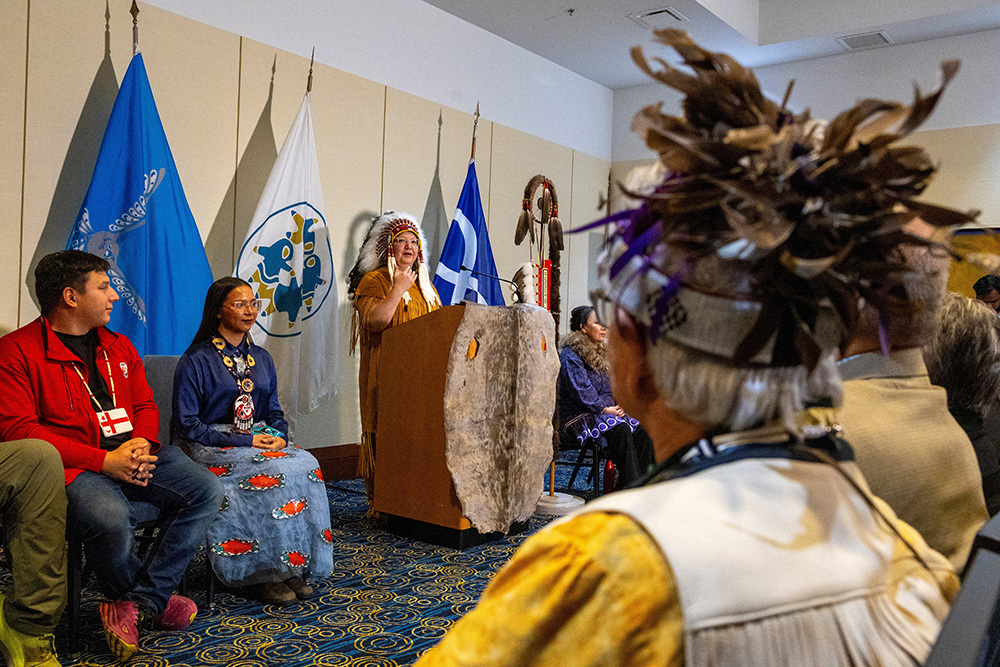
National Chief of the Assembly of First Nations Cindy Woodhouse Nepinak speaks during a Dec. 6, 2025, news conference in Dorval, Quebec, welcoming 62 cultural artifacts connected to the Indigenous Peoples of Canada, on their arrival from the Vatican. (OSV News/Reuters/Carlos Osorio)
Canadian Indigenous cultural artifacts held at the Vatican for the past century were returned to Canada on Dec. 6.
Representatives from the country's First Nations, Inuit and Métis communities were in Montreal to greet the arrival of 62 items that include a rare century-old Inuit kayak and pairs of moccasins, which were housed at the Vatican's "Anima Mundi" Ethnological Museum.
But the head of the Assembly of First Nations told National Catholic Reporter that at least "hundreds" more artifacts remain at the Vatican.
"We want all of our stuff back," said Cindy Woodhouse Nepinak, national chief of the Assembly of First Nations.
She was part of a Canadian Indigenous delegation that met with the late Pope Francis at the Vatican in 2022 when the request for repatriating the artifacts was raised. A year later, he told reporters that the items would be returned because "if you have stolen something, you must give it back."
Advertisement
In an audience last month with representatives of the Canadian Conference of Catholic Bishops at his Apostolic Palace, Pope Leo XIV "gifted" the 62 artifacts to the conference.
"This gift represent[s] a concrete sign of dialogue, respect and fraternity," said a joint statement by the Holy See and the Canadian Conference of Catholic Bishops. "This is an act of ecclesial sharing, with which the Successor of Peter entrusts to the Church in Canada these artifacts, which bear witness to the history of the encounter between faith and the cultures of the Indigenous peoples."
But Woodhouse Nepinak said that she is concerned about the wording of the statement.
"We don't look at this as a gift," she said, adding that "they just took the artifacts" and it "shows how we were treated in the past."
Victoria Pruden, president of the Métis National Council, also said: "This isn't gifting. This is a returning of extremely priceless and sacred objects [that] belong to the communities."
Vancouver Archbishop Richard Smith, former president of the Canadian Conference of Catholic Bishops and a member of its Canadian Catholic Indigenous Council, said the word "gift" takes "the whole endeavor out of the realm of transaction and puts it into the realm of relationship."
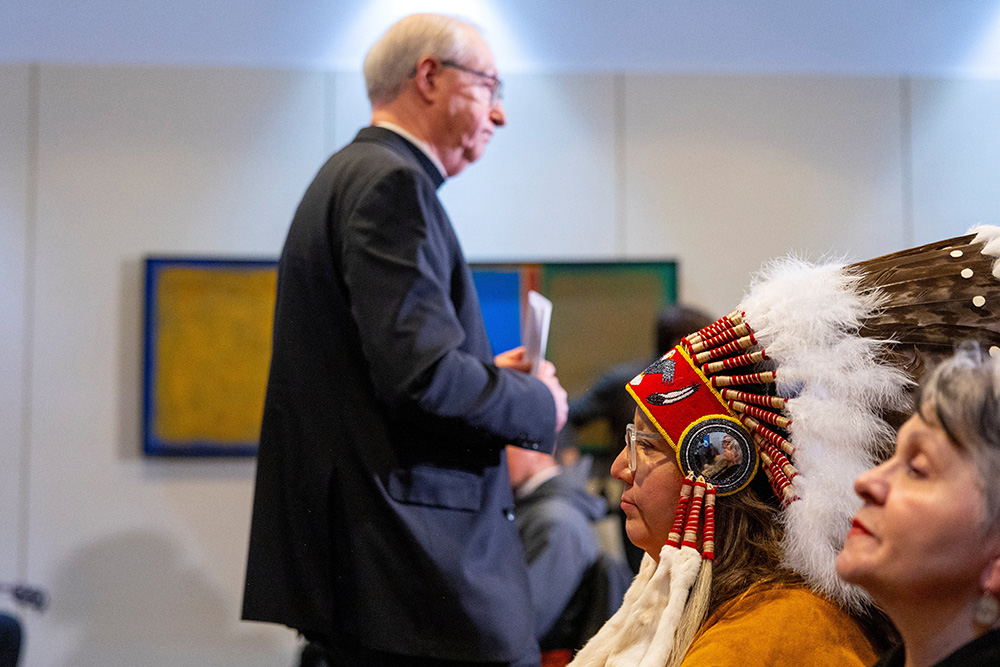
National Chief of the Assembly of First Nations Cindy Woodhouse Nepinak looks on as Archbishop Richard Smith of Vancouver, British Columbia, takes his seat after speaking during a Dec. 6, 2025, news conference in Dorval, Quebec, welcoming 62 cultural artifacts connected to the Indigenous Peoples of Canada, on their arrival from the Vatican. (OSV News/Reuters/Carlos Osorio)
In a statement sent to NCR, the Canadian Conference of Catholic Bishops said that "the term 'gift' is preferable because it carries much more depth; a gift is made in total freedom, without expecting anything in return, and as tangible sign of good will, human fraternity, reconciliation, and the renewal of relationships through God's grace."
According to the joint statement, the artifacts were "sent to Rome by Catholic missionaries between 1923 and 1925" and were "part of the patrimony received on the occasion of the Vatican Missionary Exhibition of 1925, encouraged by Pope Pius XI during the Holy Year, to bear witness to the faith and cultural richness of peoples."
Of the 62 artifacts that were returned, only one has not been revealed from the Vatican and belongs to Canada's Métis community.
"It was added late to the list of items," according to Cassidy Caron, former president of the Métis council, who said that the artifact has yet to be properly identified.
However, David Chartrand, president of the Manitoba Métis Federation, said that if the Métis artifact "was given as a gift, it's also an insult to return it back to us."
Caron said that Canada's First Nations, Inuit and Métis "didn't have a say in what items were coming back."
Vatican officials "selected those items," said Caron, who led a Métis delegation to the Vatican in March 2022 where they were shown Métis artifacts "and not all of the items I saw with my very own eyes are in the catalogue" of the repatriated artifacts.
"When we were there, they said, 'These were gifts from Indigenous peoples.' But sometimes those items were taken directly from our communities by missionaries who gave them to the pope," she said.
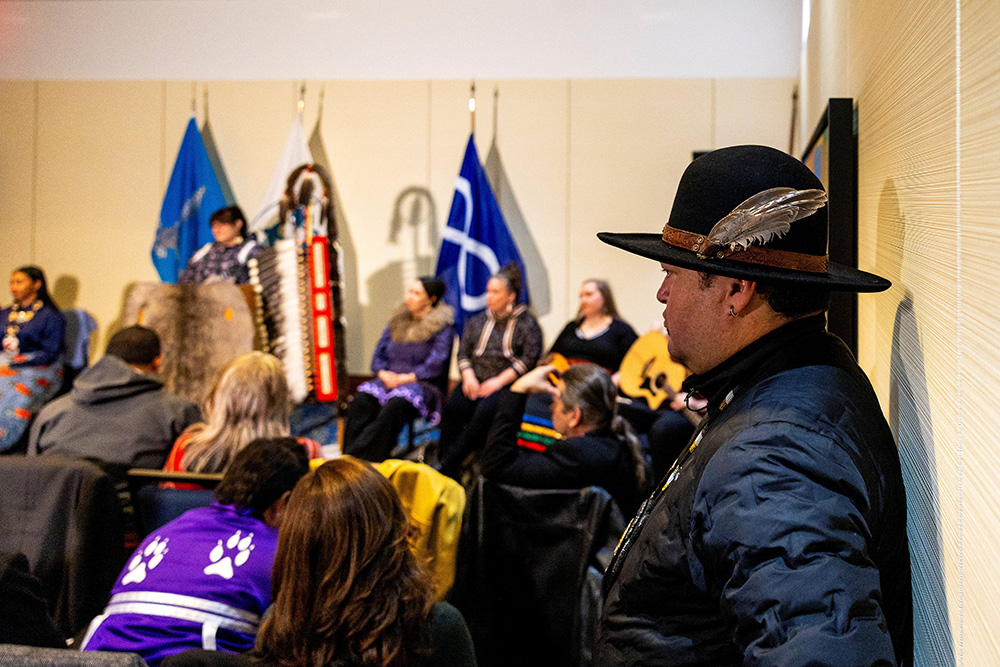
Tim Catcheway of Manitoba listens during a Dec. 6, 2025, news conference in Dorval, Quebec, welcoming 62 cultural artifacts connected to the Indigenous Peoples of Canada, on their arrival from the Vatican. (OSV News/Reuters/Carlos Osorio)
Caron said that an expert who reviewed the list of artifacts commented that they "had little value" and could be returned to Canada.
Smith, who was part of the Canadian bishops' conference delegation that met with the pope on Nov. 15 when the Vatican released the artifacts, said that there is little information on their provenance other than that they were sent to the Vatican for the 1925 exhibition.
He also doubted that "hundreds" of Canadian Indigenous artifacts remain but added "that's for the Vatican to confirm."
NCR obtained an Aug. 12, 2024 letter to Joyce Napier, Canada's ambassador to the Holy See, from Cardinal Fernando Vérgez, the-then president of the Pontifical Commission and Governorate for Vatican City, that listed the 61 items to be returned to Canada.
"The Vatican doesn't want to give up any of their items," said Caron. "Pope Francis had a heart for Indigenous peoples after the amount of time he spent with residential school survivors and hearing their stories."
Francis met with survivors during his one and only trip to Canada in July 2022 when he apologized for the church's role in running Canada's residential schools which, as the pope said, caused "suffering" for the Indigenous children who attended them.
Caron said that the Vatican has items from other Indigenous peoples from around the world and likely doesn't "want to open up the floodgates of having to return all their items."
The artifacts were sent to the Canadian Museum of History in Gatineau, Quebec, where Indigenous communities will try to determine both their origin and, as Caron said, "get them to their rightful homes."