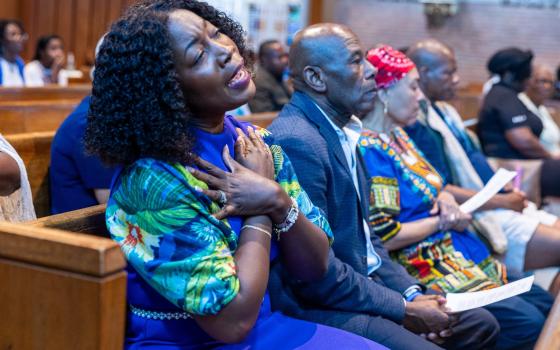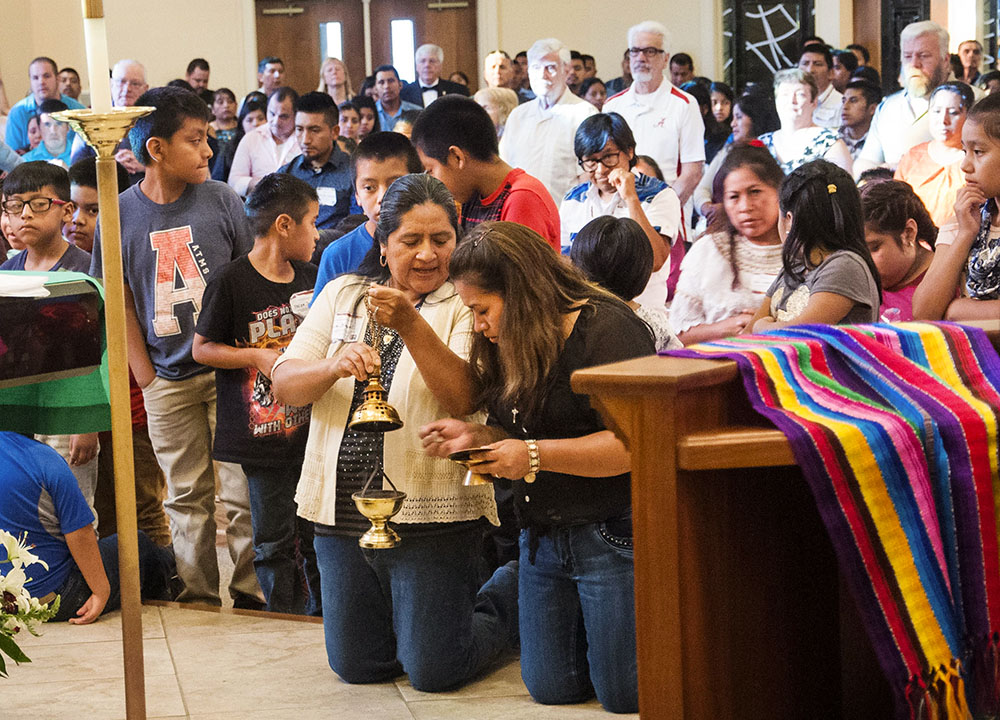
Catholics of Mayan ancestry attend Mass at St. Thomas Aquinas Church in Cookeville, Tenn., July 8, 2017. The Mass was part of a national Mayan conference celebrating traditional music, culture and spirituality. (CNS/Tennessee Register/Theresa Laurence)

by Mike Nelson
Join the Conversation
Send your thoughts to Letters to the Editor. Learn more
When immigrant communities are threatened by federal immigration raids, parishes that serve those communities have the opportunity to deepen their understanding of what it means to "welcome the stranger," church liturgists say.
But they also point out that for a parish to fully appreciate and nurture the diversity of its members, it needs to do more than just address this in the Sunday liturgies.
That means different cultural communities within a parish "have to spend time together," said John Flaherty, music director at the Los Angeles Religious Education Congress for 35 years, an event acclaimed for its inclusivity of a wide range of cultures and languages in its liturgies.
"Listen to and talk to one another, before you even talk about celebrating Mass together," said Flaherty, special assistant to the vice president of mission at Loyola Marymount University in Los Angeles. "Jesus welcomed the 'others' in society. He spoke with them, he ate with them. Jesus understood that to pass food and drink to the person next to you is to pass his very self. That's the example we are called to follow."
Advertisement
'There are people living in fear'
Jesus' teaching on recognizing and welcoming "the other" — most notably by example, as with the woman at the well (John 4:4-42) — is the basis for many church documents that address the need for open minds and hearts toward immigrants, such as the U.S. bishops' 2000 pastoral statement "Welcoming the Stranger Among Us: Unity in Diversity," and "The Love of Christ Towards Migrants," a 2004 document from the Pontifical Council for the Pastoral Care of Migrants and Itinerant People.
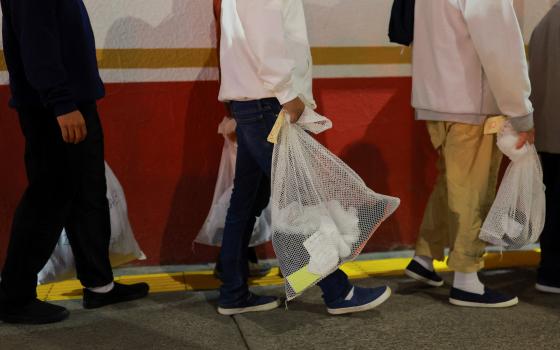
But it's one thing to feel welcome, and quite another to feel comfortable, especially when U.S. Immigration and Customs Enforcement agents are around. During the summer of 2025, many members of the Spanish choirs at Our Lady of Guadalupe Church in Santa Paula, California — a predominantly Latino parish with a sizable immigrant population, many of whom work in Ventura County's agricultural fields — suddenly disappeared.
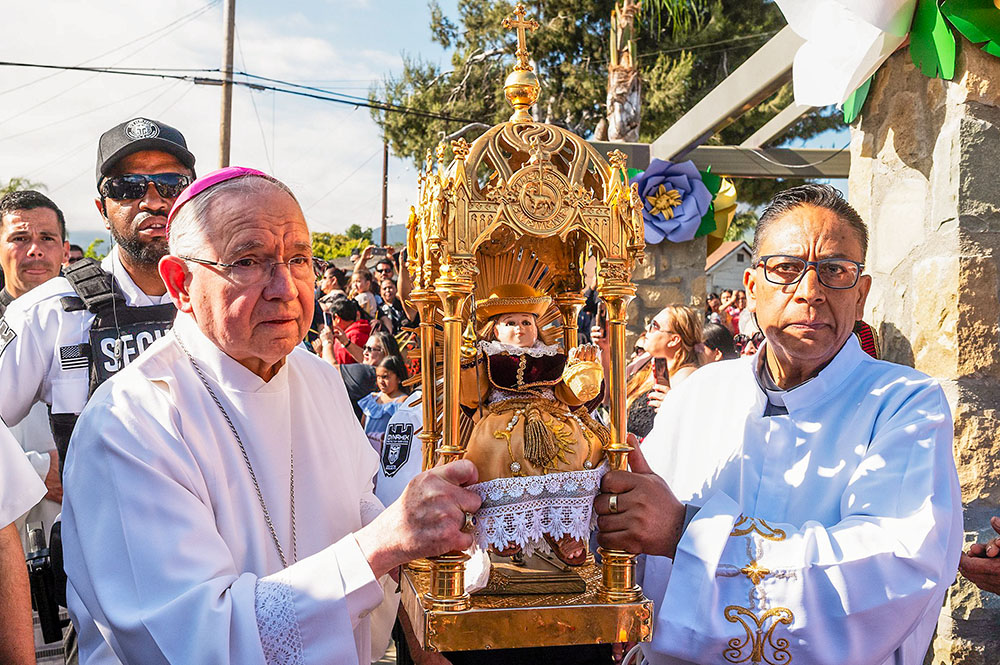
Los Angeles Archbishop José Gomez and Fr. José de Jesús López Acosta of Zacatecas, Mexico, carry a pilgrim image of Santo Niño de Atocha in procession before Mass at Our Lady of Guadalupe Church in Santa Paula, California, on May 25, 2024. (OSV News/Angelus/Víctor Alemán)
"What happened to them? No one seemed to know for sure," said Daniel Delgado, Our Lady of Guadalupe music director, whose grandfather immigrated to California from Mexico during the Mexican Revolution. "But I know that my wife, Teresa, who immigrated here with her family from Mexico in the '80s and has been a U.S. citizen since the mid-'90s, knows where her citizenship papers are in case ICE agents come around."
And in Portland, Oregon, where ICE agents have clashed with protesters decrying immigration raids, there was a noticeable post-raid effect in some parishes with significant Spanish-speaking populations, said Rodolfo López and Estela García-López, the husband-wife duo who compose bilingual music for Oregon Catholic Press and serve as music directors at Portland area parishes.
"We did see a drop at Mass attendance because of the ICE presence in our community," said García-López. "Even today, there are people living in fear, with supermarkets delivering groceries to homes because their businesses were suffering from customers not showing up out of fear," she told the National Catholic Reporter.
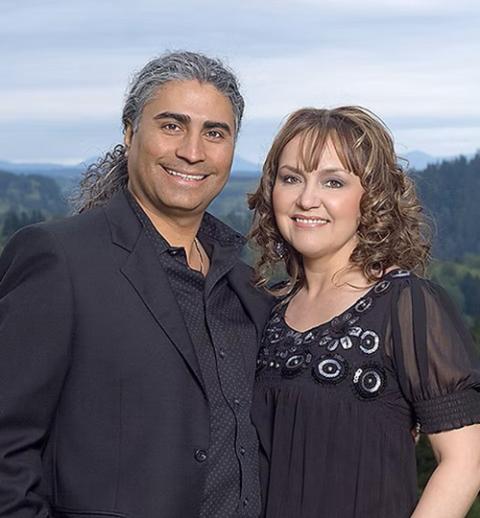
Rodolfo López, left, and Estela García-López (Courtesy of www.rodolfoyestelamusica.com)
'A broader strategy of dialogue'
So how can parishes help ease fear? Certainly, the hymns chosen for Sunday liturgies matter, said García-López. "At the parish, we keep doing music that offers hope, encouraging people to put their trust in the Lord."
Music that reiterates Christ's teaching on welcome while incorporating cultural and linguistic diversity can help, said López, who has worked with other composers in translating his and others' songs into different languages.
"We are blessed to be in a position to bring hope and awareness to people through our ministry," he said. "We respond every Sunday by singing about God's love and mercy and praying with our community."
But it takes more than music and homilies — no matter how scripturally based, theologically sound and well-intentioned they are — to foster faith-based intercultural awareness and appreciation.
"Music is just one tool in the toolbox of building a community of faith," said Antonio Gómez, a Tacoma, Washington-based percussionist who has worked on translations of liturgical music. He serves as chief engagement officer for Tacoma Arts Live, which promotes art, community building and cross-cultural understanding.
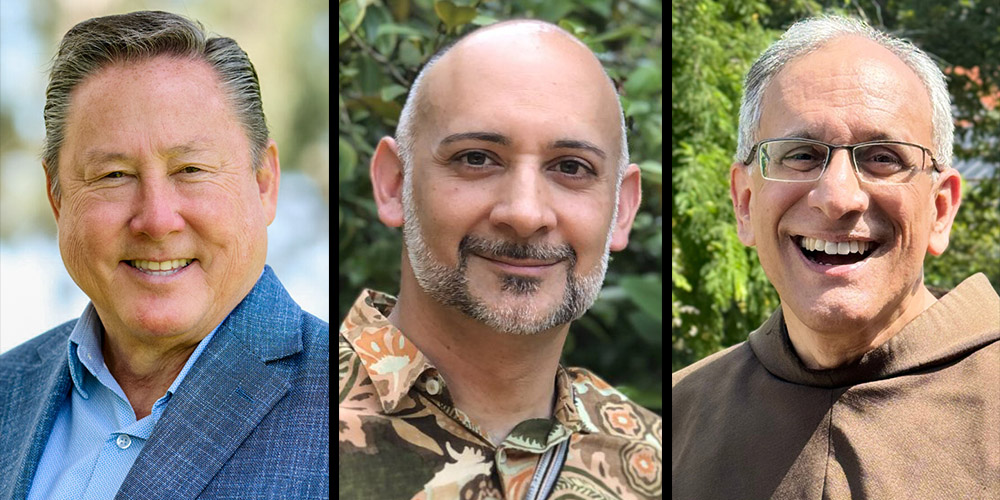
From left: John Flaherty (Courtesy of Loyola Marymount University); Antonio Gómez (Courtesy of Antonio Gómez); Franciscan Br. Rufino Zaragoza (Courtesy of Oregon Catholic Press)
Music is "not a golden ticket by itself, but part of a broader strategy of dialogue and community worship," he said.
Franciscan Br. Rufino Zaragoza, a liturgical composer noted for his work translating music from and into English, Spanish and Vietnamese, has witnessed in many parishes an evolution from multilingual celebrations to multicultural celebrations, "and perhaps, over time, with lots of trust, intercultural celebrations."
Such an evolution, he stressed, is essential in promoting intercultural relationships and understanding in parish communities and not only those with significant immigrant populations.
"To have parishes modeling hospitality and cultural understanding is crucial," he said.
As Flaherty put it, this happens by starting with humility and listening.
"You give up a little of your own power," he said. "You give up your seat at the table, and let your guest, whoever that might be, have your seat. It's about welcome and sacrifice, which ties directly to the Eucharist."
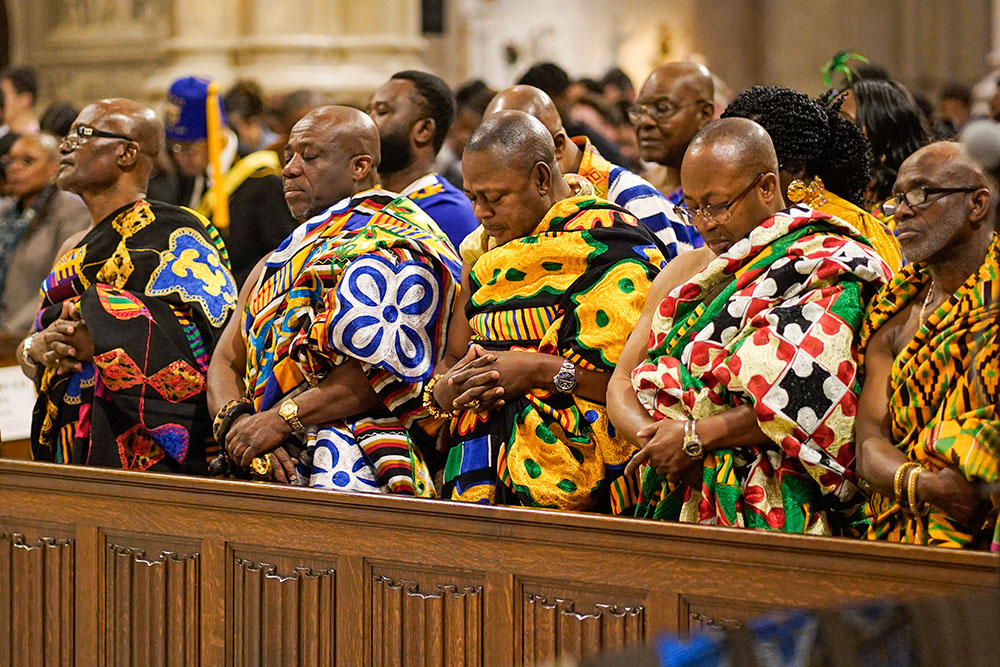
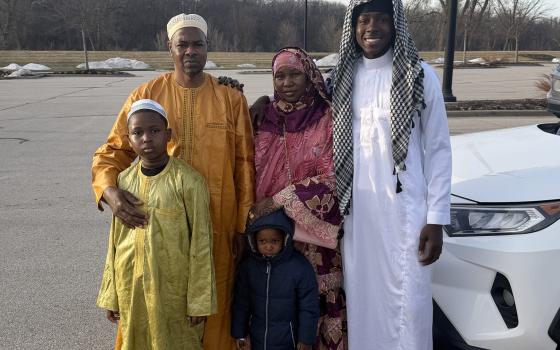
Men wearing ceremonial Ghanaian clothing pray during the New York Archdiocese's annual Black History Month Mass at St. Patrick's Cathedral in New York City Feb. 4, 2024. (OSV News/Gregory A. Shemitz)
That means more than coming together only for Mass a few times each year. There must be other occasions of dialogue, faith sharing, listening to immigration stories, listening to stories of the pioneers of the parish, and sharing food, music, dance and culture.
"Have parish picnics and regular gatherings where there is a celebration of cultures," said Flaherty. "Sing each other's music together, eat each other's food together. Listen to and talk to one another, before you even talk about celebrating Mass together. That's the beginning of real inculturation, and an appreciation of each other."
Personal and ancestral experience
Years ago, Flaherty asked the Vietnamese woman who cut his hair if she was familiar with a particular Vietnamese hymn: "Tinh Chua Cao Voi" ("Boundless Love"), by Fr. Duy Thien about love of God, creation and neighbor.
"I hummed it for her," Flaherty said, "and she broke down crying, right in the middle of the salon. She said it was a song her mother sang to her growing up in Vietnam. She remembered singing it the night her parents put her on a small boat, at age 16, to escape the country, knowing she would probably never see them again."
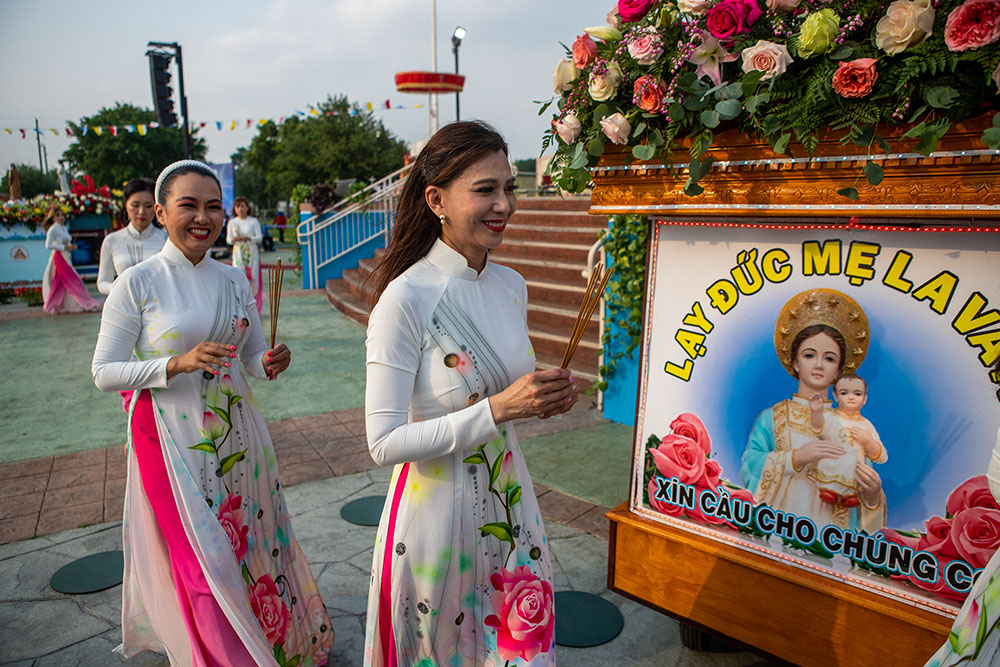
A group of Vietnamese Catholic women perform a dance to honor Mary during a Marian festival at Our Lady of Lavang Catholic Church in Houston May 6, 2023. (OSV News/Texas Catholic Herald/James Ramos)
That experience "is the experience so many of us have had, either in our lifetime or ancestrally," said Flaherty, who is of Japanese and Irish descent. "Many people who've been here for two, three, four generations have forgotten that their ancestors were immigrants. Think about the families who left Europe 200, 300 years ago, fleeing famine, tyranny, whatever. That's part of our own story."
Gómez, whose ancestors are Hispanic and Italian, invites people with Irish, Polish, Italian, French and German roots "to reflect on how they would want their ancestors to be received. Vatican II challenged us to fully embody the practices of worship we engage in, including the differences in culture."
There is always both challenge and opportunity, Gómez said, "to create a middle space in which we take elements like language, music and rituals that are both familiar and unfamiliar to cultural groups within a parish, and combine them to build something more."
"The more we intentionally lean into an oscillation between what's familiar and different, the stronger and tighter that fabric will be."