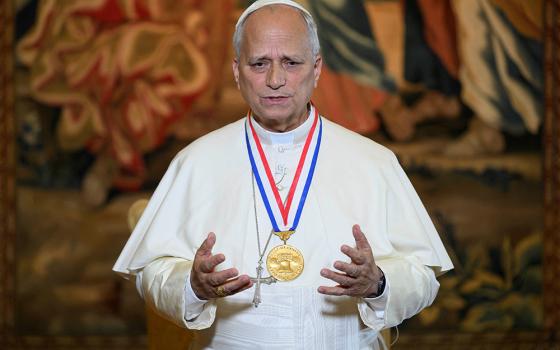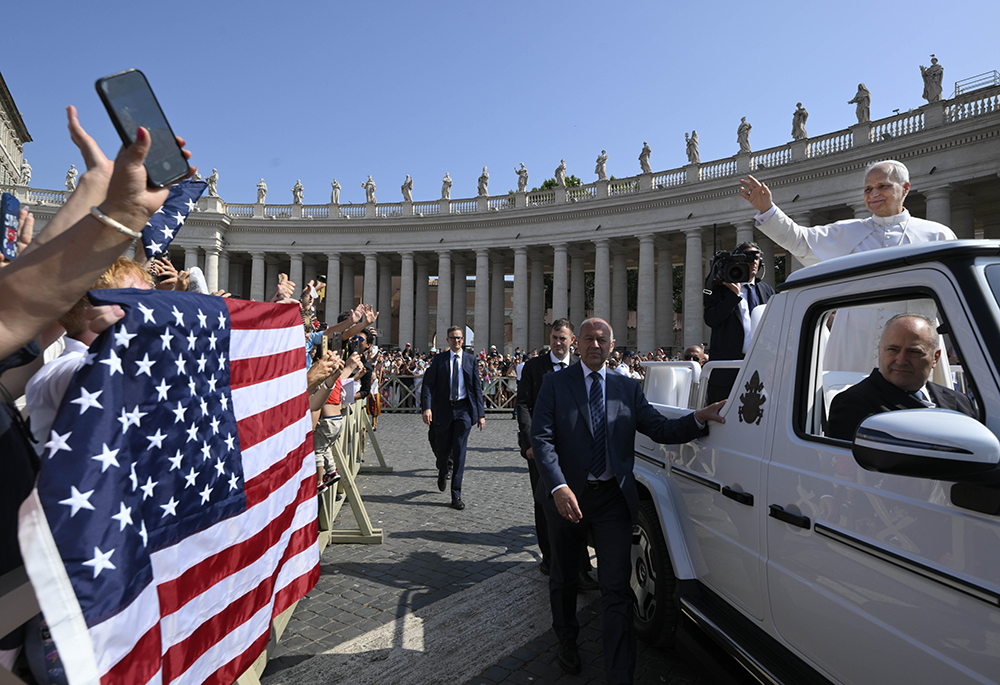
Pope Leo XIV waves to pilgrims holding a flag of the United States as he arrives in St. Peter's Square on the popemobile for his general audience at the Vatican June 18, 2025. (CNS/Vatican Media)

by Jeromiah Taylor
Join the Conversation
Send your thoughts to Letters to the Editor. Learn more
Pope Leo XIV will be honored as a recipient of the Liberty Medal by the National Constitution Center on July 3, joining the notable list of previous recipients including former President George W. Bush and former first lady Laura Bush, former Secretary of State Hillary Rodham Clinton and the late Supreme Court Associate Justice Ruth Bader Ginsburg. Leo, the first pope born in the United States, will address the event remotely from Rome as members of the center gather for a ceremony in Philadelphia — the city where the Constitution was forged in a series of compromises recently described by filmmaker Ken Burns as both "genius" and "tragic."
Leo is being honored as "a long advocate of freedom of religion and the American tradition of pluralism," the center's interim president and CEO said. The ceremony's date is right before the 250th anniversary of the Declaration of Independence, though the prize is issued by an entity committed to our other founding document which enumerates religious liberty in its first amendment.
While Leo's remarks about freedom and democracy will be especially parsed given that he is the first U.S. pope, the last three popes have all on at least one occasion made serious attempts to address the idea of America in its own terms.
Advertisement
While John Paul II delivered copious remarks during his several visits to the United States, perhaps the most representative among them of his views on America is his 1987 address to President Ronald Reagan marking the bicentennial of the constitution.
As for Benedict XVI, his 2008 address to President George W. Bush on the south lawn of the White House contains a sweeping assessment of the American project.
And of course, Pope Francis' historic 2015 address to a joint session of Congress remains a cornerstone of his legacy.
While each pope alluded to the humane, natural law-oriented Declaration of Independence, whereby we find ourselves endowed by our creator with certain inalienable rights, and urged respect for human life — they differed in their engagement with America's most cherished precept: freedom.
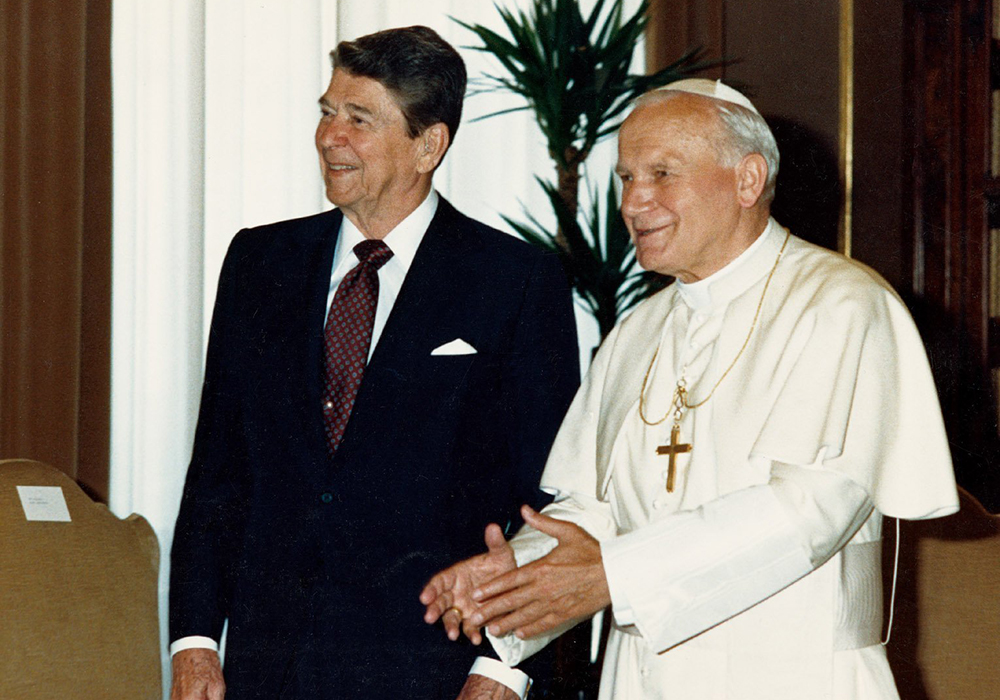
President Ronald W. Reagan meets with Pope John Paul II at the Vatican June 6, 1987. (CNS file photo)
Pope John Paul II, 1987
In his many addresses to American constituencies, John Paul II repeatedly qualified freedom as the ability to do what we should according to God's law — issuing stark warnings about freedom untethered from truth and service. In the 1987 address to Reagan, the late pontiff said that the only "true freedom" was the freedom to do "what we ought as human beings created by God according to his plan."
Though he was marking the bicentennial of the constitution, the pope mentioned the bicentennial of the declaration, which had happened 11 years prior, and quoted from Paul VI's address to members of Congress visiting Rome in 1976, invoking "moral principles, religious convictions" and inalienable rights.
However, the pope also expressed his own "deep respect for the constitutional structure of this democracy." John Paul II chose largely to focus on international relations, urging the United States to use its freedom in service to the global community, saying that it is "called to exercise it in such a way that it will also benefit the cause of freedom in other nations and among other peoples."
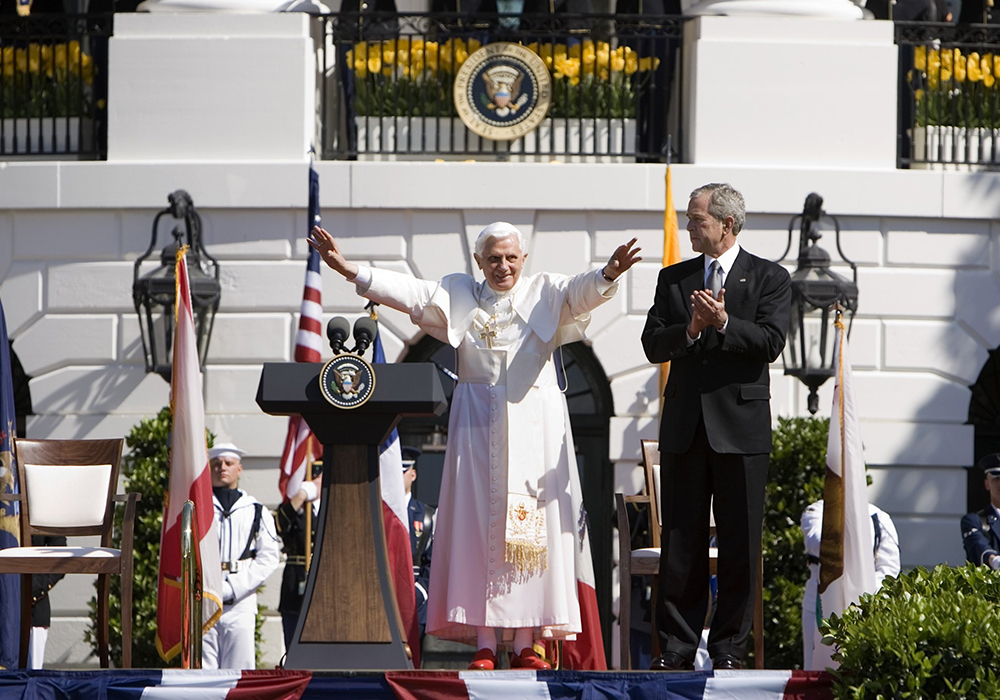
Pope Benedict XVI is greeted by U.S. President George W. Bush during a welcoming ceremony on the South Lawn of the White House in Washington April 16, 2008. (CNS/Reuters/Joshua Roberts)
Pope Benedict XVI, 2008
Pope Benedict XVI, when addressing President George W. Bush at the White House welcome ceremony for his 2008 apostolic journey, also leaned on the Declaration of Independence, saying that from its origins, "America's quest for freedom has been guided by the conviction that the principles governing political and social life are intimately linked to a moral order based on the dominion of God the Creator."
The pope echoed his predecessor's observation that religious principles were fundamental to the republic, but more explicitly addressed U.S. diversity, conveying his "great respect for this vast, pluralistic society." He also praised religious liberty, saying that not just Catholics, but all believers, had been free to follow the "dictates of their conscience" while still being "accepted as part of a commonwealth where each individual and group can make its voice heard."
The pope recognized the civil religion prevalent in the United States more than his predecessor, noting those "who sacrificed their lives in defense of freedom" and commending religiously diverse Americans for their commitment to "shared ideals and aspirations."
In true papal fashion, Benedict found time to insist that freedom is a "summons to personal responsibility" the preservation of which requires "the cultivation of virtue, self-discipline, sacrifice for the common good and a sense of responsibility towards the less fortunate." Alluding to his upcoming visit to the United Nations headquarters, Benedict also urged the United States to foster "global solidarity" and to support the "patient efforts of international diplomacy to resolve conflicts and promote progress."
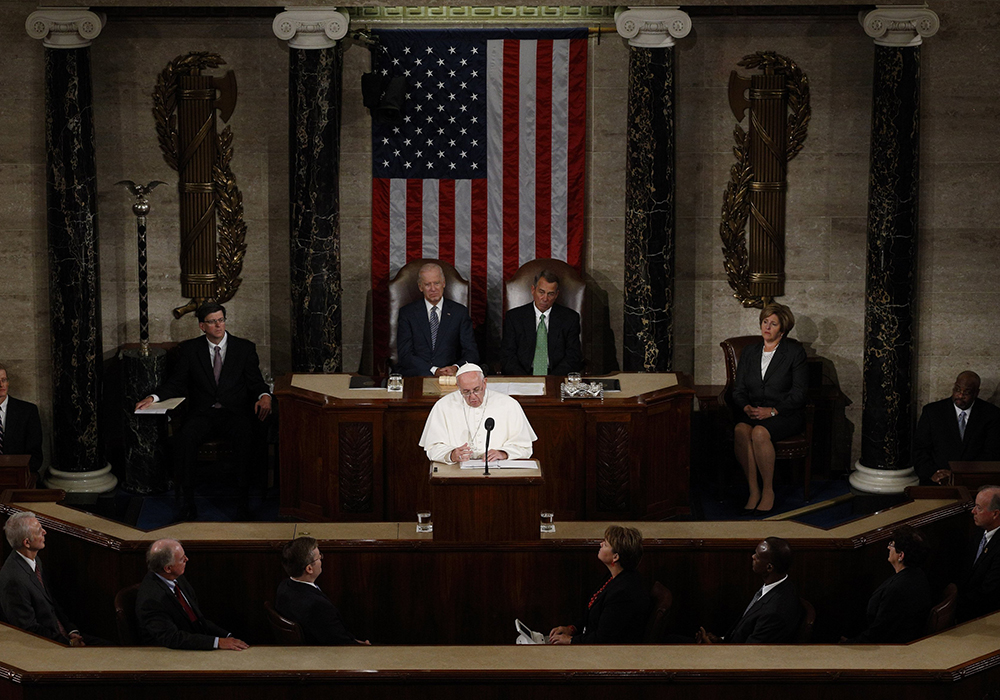
Pope Francis addresses a joint meeting of the U.S. Congress as Vice President Joe Biden, left, and Speaker of the House John Boehner look on in the House of Representatives Chamber at the U.S. Capitol in Washington Sept. 24, 2015. (CNS/Paul Haring)
Pope Francis, 2015
Though famous for its prophetic calls for economic and ecological justice, as well as its list of four great Americans, Francis' 2015 address to Congress was quintessentially American. While critics sometimes argued that the pope did not understand the complexities of the United States, Francis revealed a subtle understanding of the political tightrope engineered into the Constitution, and the republic's perpetual precarity. The pontiff opened not with an appeal to inalienable rights, but rather gratitude for the "land of the free and the home of the brave," before invoking Moses as an interpretive figure for the "delicate balance" between legislating justice and preserving liberty. Francis then explicitly enumerated sacrosanct American freedoms — "religious," "intellectual," and, even "individual."
Rather than once again warn Americans that freedom depends on virtue, Francis warned against "the simplistic reductionism which sees only good or evil; or, if you will, the righteous and sinners." In a line reminiscent of Alexander Hamilton's fear that a demagogue mounting the "hobby horse of popularity" and exploiting "faction and anarchy" would undo the republic, Francis said that to "imitate the hatred and violence of tyrants and murderers is the best way to take their place."
"That is something which you, as a people, reject," he added.