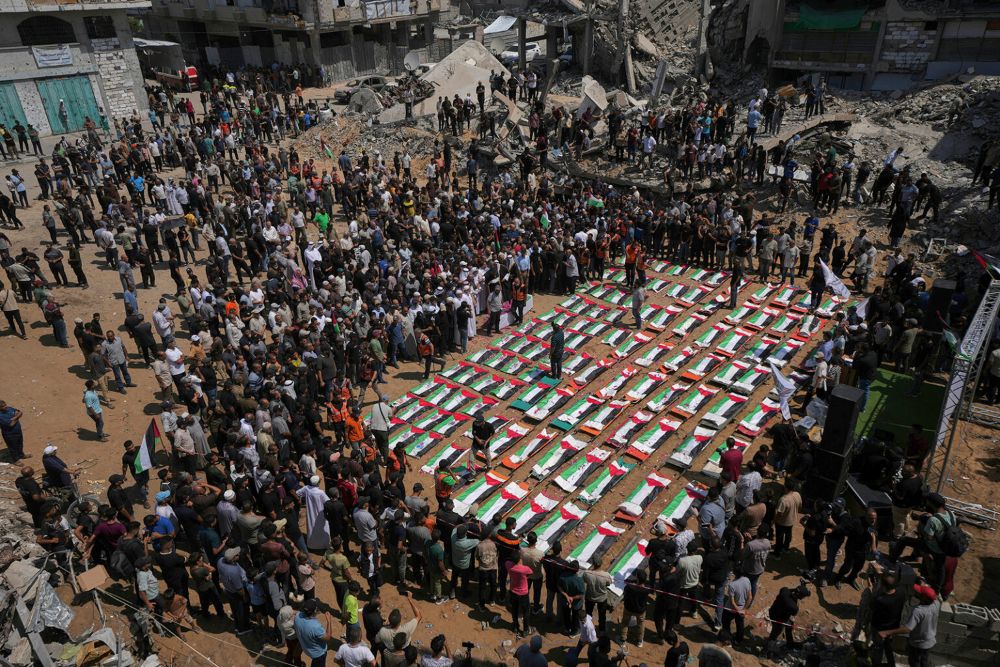
Bodies of members of the Hassayna and Abu Sharia families, killed in an Israeli strike in 2023 and recently recovered from the rubble, are draped in Palestinian flags during their funeral in Gaza City, Tuesday, Aug. 4, 2026. (AP/Jehad Alshrafi)
Ten Catholic clergy from Africa, including Cardinal Stephen Brislin of South Africa, issued a statement Aug. 21 describing the Israeli government's actions in Gaza as genocide, drawing on their continent's experience of war and apartheid.
"We believe that the policies and actions of the Government of Israel in Gaza constitute genocide," the statement read, citing arguments by international legal scholars and genocide experts. "Having learned to recognise dehumanisation in our own history, we cannot refuse to recognise it in another people."
The statement was issued by Priests Against Genocide, a network of Catholic priests, bishops and cardinals advocating for Palestinian rights. The organization was founded in 2025 and says it represents over 2,500 members across 67 countries.
On Aug. 16, Pope Leo XIV made an appeal for peace and called for a two-state solution that would respect the national integrity of Israel and Palestine. But the pontiff has stopped short of declaring Israeli actions in Gaza a genocide.
Brislin, among the signatories of the statement, is the archbishop of Johannesburg in South Africa and was appointed last year by Leo as a member of the Vatican department overseeing clergy. The pope also gave Brislin a prominent advisory role in the June consistory, a summit of cardinals.
South Africa — which enforced racial segregation and white minority rule, called apartheid, between 1948 and 1994 — has a long history of Palestinian advocacy. Nelson Mandela, the anti-apartheid leader who became the country's first Black president, declared in 1997 that "our freedom is incomplete without the freedom of the Palestinians."
In December 2023, South Africa brought a case before the International Court of Justice accusing Israel of violating the Genocide Convention in its war in Gaza. South Africa argued that Israel's conduct unfolded "against a background of apartheid" and an "institutionalized regime of discriminatory laws, policies and practices" toward Palestinians. The case is still pending with the ICJ.
Advertisement
In their statement, the African clergy said they "cannot condemn apartheid in our history and refuse to recognise these patterns inflicted upon Palestinians."
The statement, directly addressed to the government of Israel, also rejected "antisemitism and Islamophobia alike" and condemned the "grave crimes" committed by Hamas on Oct 7, 2023, that resulted in the death of about 1,200 people in Israel and the abduction of some 250 hostages.
"Their crimes do not diminish Israel's obligations under international law, nor justify genocide or collective punishment. We will not answer one dehumanisation with another," the statement added.
Israel has not issued a response to the clergy's statement but has denied past genocide allegations, stating that its war is against Hamas and not Palestinians.
Israel launched its military offensive in Gaza after the Oct 7, 2023, attack. Since then, more than 73,000 Palestinians have been killed in Gaza, according to the territory's Health Ministry, including at least 21,000 children. A ceasefire took effect in October 2025, but Israeli strikes and gunfire have continued, killing more than 1,200 Palestinians since the agreement. Tensions have also intensified in the occupied West Bank as attacks by Israeli settlers against Palestinians have increased.
The statement called for Israel to put an immediate end to "genocidal policies" and forced displacement and to cooperate with international judicial systems. The signatories also asked that Israel suspend weapons and technologies that risk violating international law. And they called on Christian groups to scrutinize their investments for ties to human rights violations. Finally, they demanded humanitarian, medical and trauma-healing support for those who were harmed in the conflict and called for the creation of a dignified and safe future for Palestinians and Israelis alike."
The African clergy stated that their "continent knows war," not only in its past, but also through the ongoing conflicts in Sudan and South Sudan, the Democratic Republic of Congo, the Sahel and northern Mozambique. They issued the same demands for peace and justice to African governments.
"A particularly horrifying feature of this genocide is that, for the overwhelming majority of Gaza's population, there has been no reliable route to safe refuge — only repeated displacement within a closed territory, from one unsafe place to another — the statement read. "To order people to flee when there is no safe place to flee to is not protection."
The document drew from the sacred African tradition of Ubuntu, which emphasizes interconnectedness and shared responsibility, as well as sacred Scripture and Vatican pronouncements to make its case.
"Our answer cannot be silence. Our answer cannot be hatred. Our answer must be truth, justice, mercy — and a true peace which is never merely the absence of fighting," the statement read.