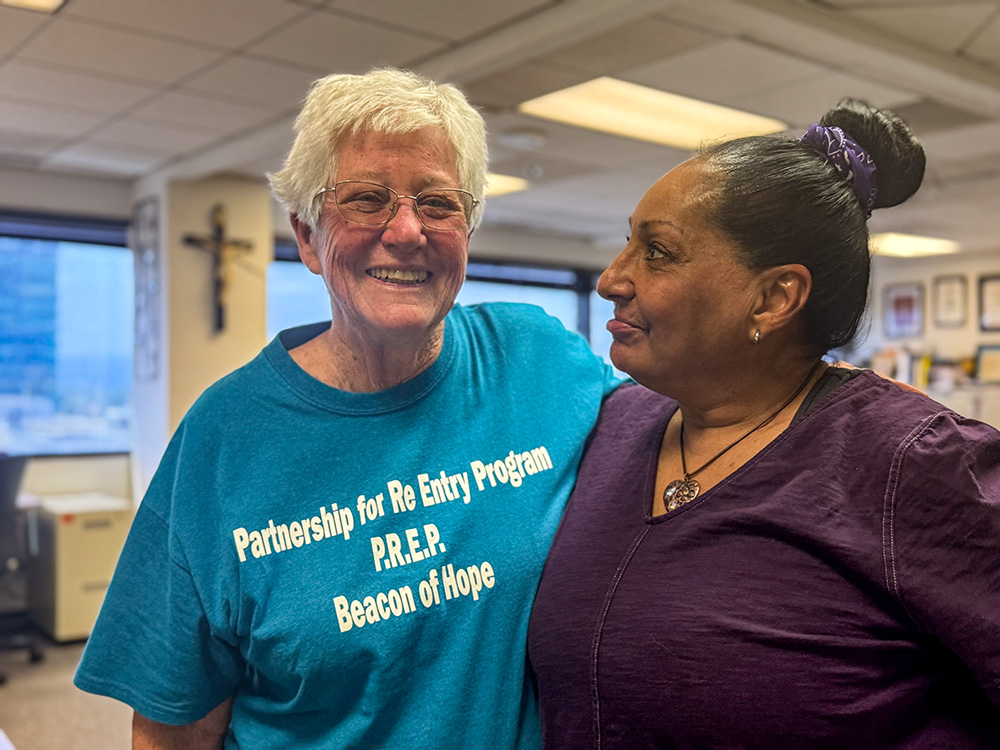
Dominican Sr. Mary Sean Hodges talks with Sylvia Trevino at the offices of the Partnership for Re-Entry Program June 8, 2026, in Los Angeles. (GSR photo/Rhina Guidos)

by Rhina Guidos
Join the Conversation
Send your thoughts to Letters to the Editor. Learn more
Sylvia Trevino had never met Dominican Sr. Mary Sean Hodges, but she knew her work.
For years in prison, Trevino had encountered the kinds of written materials Hodges helped send to incarcerated people through the Partnership for Re-Entry Program. So when Trevino walked into PREP's downtown Los Angeles offices after 30 years behind bars and spotted Hodges folding mailings, she immediately recognized her.
"You don't know, but you did a lot of miracles in prison," Trevino told her softly, almost in tears.
Hodges is known by many in California for her decades as a teacher and principal in Catholic schools, but also by inmates like Trevino across the state's correctional system. As a known national leader and advocate for restorative justice in religious circles, she believes people should be held responsible for their actions, but should also be led down a path of healing, not strictly punishment.
Through the PREP program, under the auspices of the Los Angeles Archdiocese, Hodges has spent a quarter of a century seeking to do something she believes Jesus would do: healing others through a ministry of second chances.
PREP, according to its website, works to transform formerly incarcerated individuals into productive members of society by providing parole preparation, emotional healing, and spiritual growth, aiming to reduce prison populations, ease the financial burden on taxpayers, and build stronger, safer communities.
But for those who walk through its doors, PREP's mission is much simpler: to form a community.
It's where Hodges, along with a small group of staffers, including some who have been in prison, and sisters from various congregations provide a lifeline of sorts. They minister to current prisoners and former ones, helping them heal from past trauma, preparing them for parole hearings, and sometimes providing orientation for those like Trevino, looking to adapt to a world that changed while they were away. There's no talk about what they have done, but about the future. To Hodges, they are "returned citizens."
Advertisement
Her journey into prison ministry began with an unexpected meeting. She had long enjoyed life in Catholic schools until an encounter with another sister during a spiritual retreat changed her journey. The sister she met talked about ministering to inmates. Intrigued, Hodges tagged along on some of her visits. When she returned from the retreat, she approached St. Joseph of Carondelet Sr. Suzanne Jabro, then director of the archdiocese's office of restorative justice.
"Suzanne, I want to work in the prisons," Hodges recalled telling her.
Jabro didn't hesitate: "You're hired."
From the beginning, Hodges was looking to provide unconditional compassion and a welcoming place, knowing that punishment continues for those who've committed crimes, long after they have served their sentences.
"People are punitive," she told Global Sisters Report, recalling an experience in a Catholic parish she had visited to talk about PREP. After her talk, a man approached and told her that if a person commits murder, that person deserves to be murdered also.
"I didn't want to get into it with him," she told GSR. "But that's not Catholic teaching. ... Our God is a merciful God, a compassionate God. He's a God of love. All he can do is love us into redemption."
She's also sought to explain why some commit crimes.
"A person goes to prison because of the woundedness in their body," she explained, pointing to childhood traumas like abandonment, family incarceration, socioeconomic inequality, addictions, and physical or sexual abuse as contributing factors. "Whatever wound goes into me in my early years, that's what a person becomes. That's what we do — is work with the woundedness in people in order to help them heal and come back into the community."
Helping the incarcerated is a first step in restoring their dignity as children of God, and yet Hodges also is of the belief that not everyone should be let out of prison. But for those who have done the work of looking deep inside, have changed and now pose no threat to the world, Hodges believes in helping them return to a community as redeemed members.
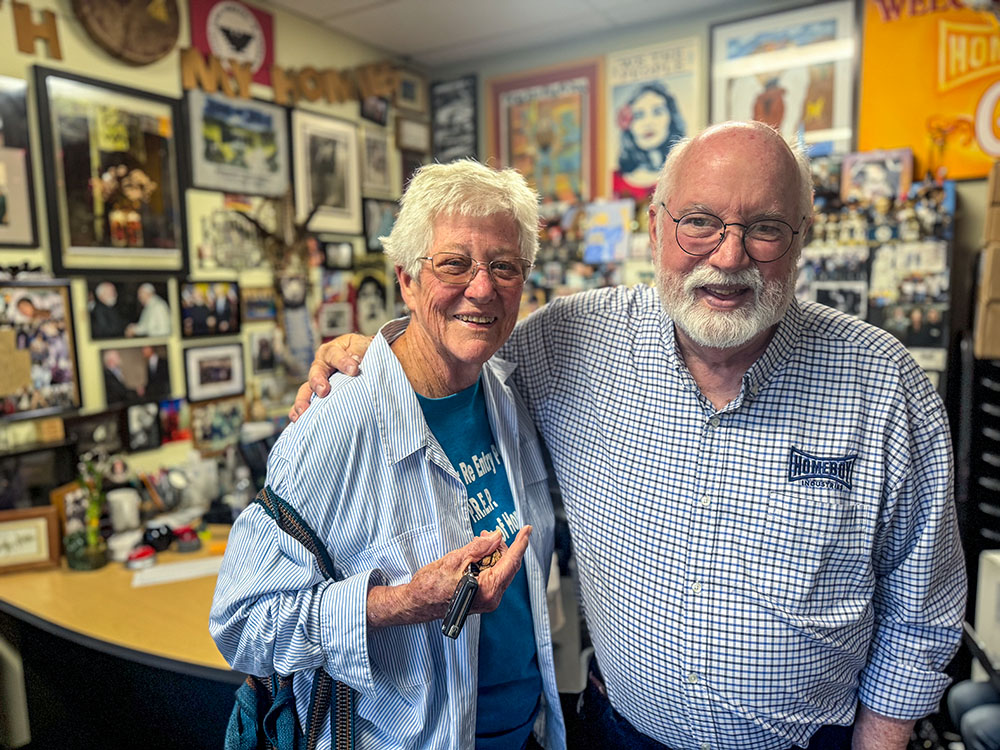
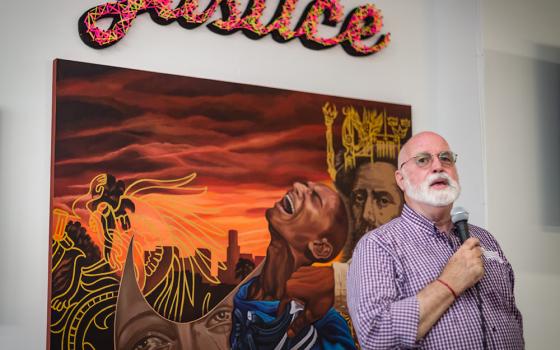
Dominican Sr. Mary Sean Hodges stops by the office of Jesuit Fr. Greg Boyle June 8, 2026, in Los Angeles. Along with Boyle, Hodges has been a leading voice for restorative justice in California. (GSR photo/Rhina Guidos)
For Trevino, PREP was the catalyst for personal change inside prison and her eventual release.
PREP classes, which she received via mail as a packet of written information, forced her to confront her past and her woundedness, she said. It offers classes on topics such as anger management, confronting criminal thinking, victim awareness, and financial literacy, as well as dealing with trauma.
The material gave Trevino insight she needed to face a parole board in an honest way — an element she found missing in other institutional programs, she said.
"PREP helped me mature spiritually, mentally, emotionally," Trevino told GSR. "It helped me to want better for my life. It grew me a conscience. It softened my heart. It just made me human again."
Today, Trevino credits the PREP community with helping her adapt to life outside prison, adhering to a principled way of living, one based in the belief of God's mercy and in giving back to the community.
Hodges credits her staff for helping those like Trevino embark on a new life. Though prison may have been the last place some expected to return to, they have done so — not as inmates, but as guides, she said.
"It's more effective when the staff goes into the prisons because they've lived it. I haven't," Hodges acknowledged.
Some of them also participate by writing the material sent to inmates as part of PREP based on the language and culture they encountered in the correctional system. Despite the modest pay, the staff is dedicated, she said.
For Hodges, the work aligns with her Dominican charism: to serve the poor, the young and the vulnerable. Redemption is at the core of the ministry.
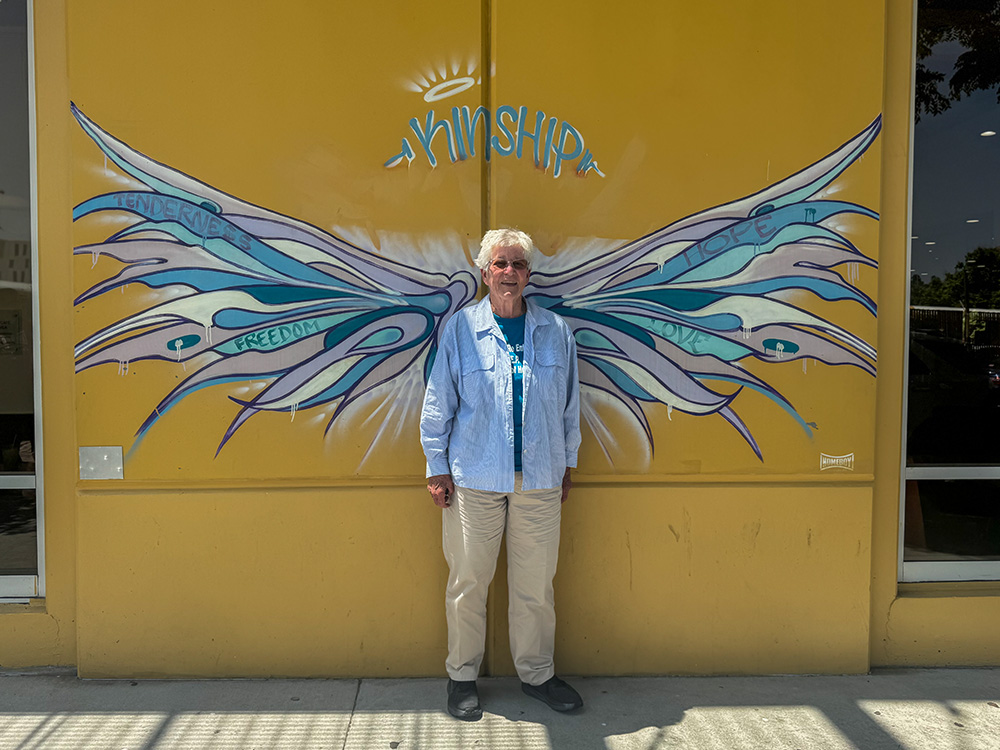
Dominican Sr. Mary Sean Hodges outside the offices of Homeboy Industries, a gang-rehabilitation and reentry program, June 8, 2026, in Los Angeles. Hodges is a leading voice in religious circles on restorative justice. (GSR photo/Rhina Guidos)
Tony Kim is a testament to the cycle of redemption Hodges believes in. Kim was a "lifer" who met Hodges while in prison, and he remembers that she told him: "When you get out, you're gonna come work for me."
Incarcerated at 17, Kim received a chance to go free at almost 50, after juvenile sentencing laws in California changed, allowing him to go before the parole board. When he transitioned out of prison, Hodges kept her word.
"I went in when I was a juvenile. ... I really didn't know which direction to go," Kim said.
In Hodges, he found a caring friend and champion.
"Sister treated us with open arms. Very loving. There's a lot of anxiety because you don't know how the world is gonna treat you," he told GSR.
Had it not been for PREP, Kim believes that, at best, he would have slipped into the margins. Instead, in PREP, he found a purpose. Today, he works full-time for the ministry as its executive director, regularly staying late into the night to read letters from inmates. He works too much, Hodges said, like a concerned mom. But Kim says there's a reason.
"What touches home for me is when I read letters from people ... and they're asking for the same things that I used to ask for," Kim said. "I consider being out here a blessing and God's grace. We are here because we want to be here, because this is a mission, not just a job."
Even as PREP celebrates its successes, the ministry continues to expand. Hodges is currently focusing efforts on increasing the program's presence in the state's women's prisons.
At its core, PREP remains an organization fueled by the belief that no human being is beyond repair. As for Hodges, her prayer is that those like Kim continue the work of loving people into redemption long after she's gone.
"We believe in second chances," Kim said. "We believe that anybody could be the person that God created them to be. We just need to give them a little chance."