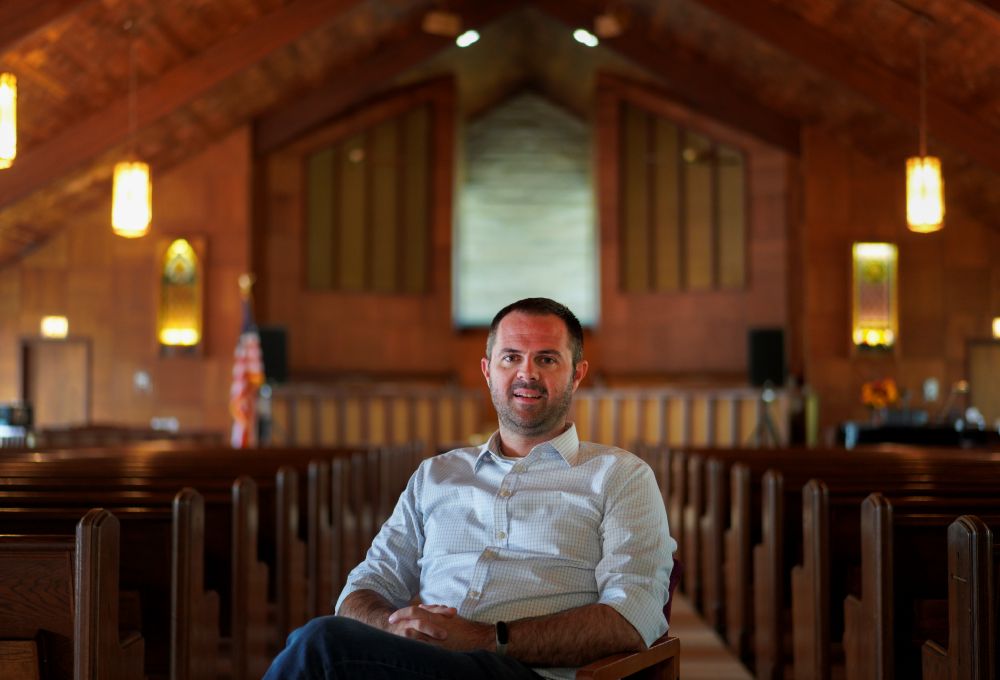
Ryan Burge, a sociologist, professor at the John C. Danforth Center on Religion and Politics at Washington University, and author of "The Vanishing Church," poses for a portrait at First Baptist Church in Mount Vernon, Ill., Sept. 10, 2023. (AP/Jessie Wardarski)

by Peter Feuerherd
Join the Conversation
Send your thoughts to Letters to the Editor. Learn more
Those celebrating how American Christianity is enjoying a revival, particularly among the young, might not want to invite Ryan Burge to the party.
Burge — teaching political science this year at the John C. Danforth Center on Religion and Politics at Washington University in St. Louis after 13 years at Eastern Illinois University — has emerged as a widely quoted sociologist about American religion.
His Substack newsletter is followed by thousands and his data analysis is regularly shared with The New York Times, The Wall Street Journal, CBS News' "60 Minutes" and other outlets. Burge is the author of five books on religion and politics in American life, including this year's The Vanishing Church: How the Hollowing Out of Moderate Congregations is Hurting Democracy, Faith, and Us (Brazos Press).
His number crunching disputes recent anecdotes describing the burgeoning state of American Christianity. Instead, Burge concludes that American Christianity is losing ground, with older and whiter congregations — heavily skewed towards conservative politics — often closer to dying than experiencing long-term growth.
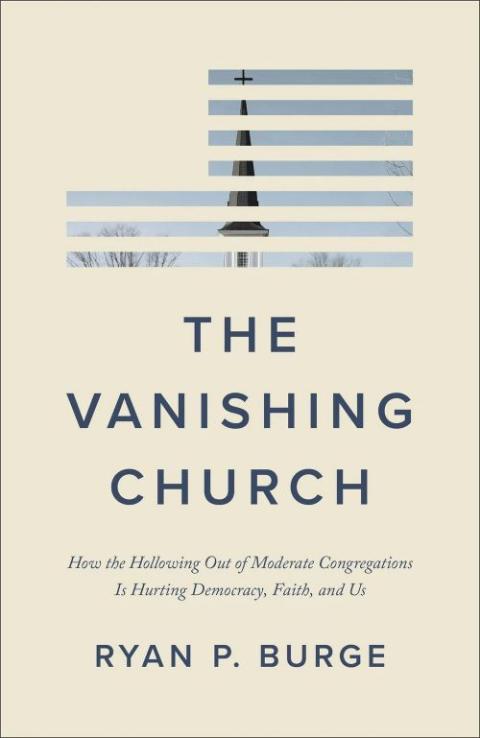
Ryan Burge's latest book is "The Vanishing Church: How the Hollowing Out of Moderate Congregations is Hurting Democracy, Faith, and Us."
Burge has found his niche, but it is not without controversy.
"It's telling the truth, telling people what they don't want to hear," he said. Even though he wants Christian life in America to flourish, he said, he finds little evidence that it's happening, even as mainstream media outlets such as The New York Times and The Wall Street Journal feature accounts of young urban professionals flocking to churches in Washington, D.C., and New York.
In The Vanishing Church Burge describes how his faith life as the pastor of an American Baptist church in Mount Vernon, Illinois, for two decades met up with the sociological data. His congregation, nestled in a declining Midwest town with an aging population, eventually withered away, finishing with just 30 congregants unable to sustain a church.
Burge wore the dual hats of pastor and sociologist, but for now, except for an occasional fill-in preaching role, his focus is on his academic work.
"It's the question that haunts me. What could I have done?" Burge said, about keeping his church open. His struggle with that is a theme of his book, pushing his work as a sociologist into personal pastoral reflection.
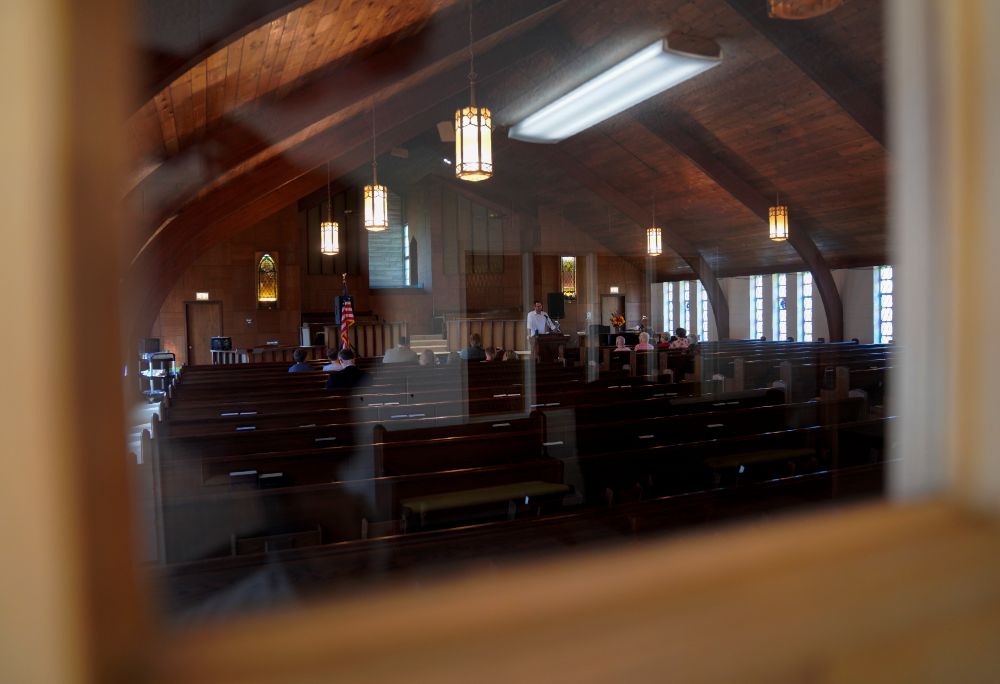
Pastor Ryan Burge preaches a Sunday sermon at a nearly empty First Baptist Church in Mount Vernon, Ill., Sept. 10, 2023. The church held the last service of its 156-year history in July 2024. (AP/Jessie Wardarski)
The question emerges for Burge as pastor and preacher. As a sociologist the answer lies in the data, indicating that his closed church is a tiny slice of a national trend.
His analysis focuses on the occasional quirky question, such as: Who is more likely to be at Sunday church, finance majors or English majors? The answer, finance majors, reinforces much of Burge's wider analysis of American Christianity.
Mainstream Protestant congregations, like his former church, have been declining across the country, a trend that doesn't just impact denominational leaders but is felt in our current polarized politics, Burge said.
As he put it, mainline churches have "long been a great mixing of American life," noting that in the postwar era Republicans and Democrats, liberals and conservatives, could be found sharing a pew on Sundays. As remaining Christians gather in largely monochromatic spaces, it's become easy to demonize those who hold different views.
Diverse congregations provide routine lessons in how to play well with others, particularly those with varied viewpoints. Without that experience, "these muscles will atrophy," Burge told NCR.
Evidence of that polarization is partly seen in the attacks by Burge's critics who argue that he fails to account for why some churches are experiencing growth.
"No one can believe that anyone can try to be impartial," he said.
While much of his attention focuses on American Protestantism, Catholics are experiencing much of the same trends. "The wave is not going to wash over one part and not another," he said..
Burge knows about that wave.
In his personal life, he straddles denominational lines. His wife is Catholic and so are his two sons, one of whom attended a Steubenville University youth jamboree this summer, an event popular with faith-driven teen Catholics. Burge now attends both a Methodist church and his family's Catholic parish. Sundays in the Burge household are diverse religious experiences.
He said Catholics increasingly reflect the trend of their Protestant neighbors with church attendance skewed towards upwardly mobile professionals with a conservative bent.
White churchgoing Catholics remain a central part of the MAGA coalition. They voted for President Donald Trump at 65% in 2024. That trend towards the Republican Party has been a swift one: In 2008, white Catholics voted for Republican John McCain in just slightly higher numbers than they did for Democrat Barack Obama.
Regular churchgoing Catholics — about 28% of the total — are becoming more like other churchgoers. There are exceptions, however: Catholics are more inclined to accept gay marriage than their evangelical peers, a view at odds with church teaching. They are also more likely to oppose the death penalty, a stance supported by bishops and popes.
Sociologist Ryan Burge says that while there is little or no growth in church attendance nationally, there is a "vibe" among clergy and others hopeful that faith resurgence is happening. (OSV News/Tyler Orsburn)
If there are currents of a renewal in American Christianity, "it's not a blue-collar revival," Burge noted. He provides some of his own anecdotal evidence by pointing out that the Catholic parish he attends — located in a diminishing mid-American town — recently instituted a group to welcome new adult members. So far it has landed a single participant who plans to partake in the sacraments of initiation.
"That ain't good," he said, for those seeking anecdotes of growth.
While media stories feature younger Catholic professionals flocking to urban churches, Burge argues that this is not being seen elsewhere.
"What about Des Moines? What about Mount Vernon, Illinois? Parishes are not seeing massive growth," he said. While there is little or no growth in church attendance nationally, there is what he describes as a "vibe" among clergy and others hopeful that faith resurgence is happening.
What's happened is a phenomenon common to social science: "Our minds are drawn to the outliers," he said, noting that it's easy to extrapolate from a single example of growth to a wider framework. "People want to see the anecdote rather than the data."
Advertisement
What is happening among Catholics, he said, is a church moving toward the right. Among younger Catholic priests, 85% label themselves as conservative. Catholicism, of course, remains distinct from Protestantism, whether mainstream or evangelical. For example, he said relatively few Catholic priests regularly preach politics from the pulpit.. He also notes the diversity in Catholic parishes, noting that the Catholic parish he attends in rural Illinois includes a Filipino community among a largely white congregation.
Burge said Catholic diversity is also expressed in quiet ways, such as how people receive Communion at Mass, either in the hand or on the tongue, and he suspects the difference indicates different views on Catholic doctrine and spirituality.
In the big picture, Burge said, we are living in odd times in American religious life. Not only is congregational diversity on the decline, but younger progressives hear a message that they are no longer welcome, or they are no longer interested in church life. In American history, "religion had a way of liberating people," he said, noting the influence of radical religious leaders such as Dorothy Day and Martin Luther King Jr. The 19th-century reform movement sparked by Protestant clergy who proclaimed the social Gospel is now labeled as heresy in many evangelical pulpits.
That raises another question for further study: Did Christian doctrine change or did American Christians change?
"I don't have an easy answer to that question," Burge said.