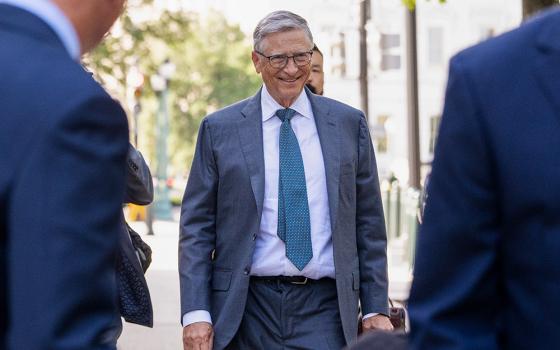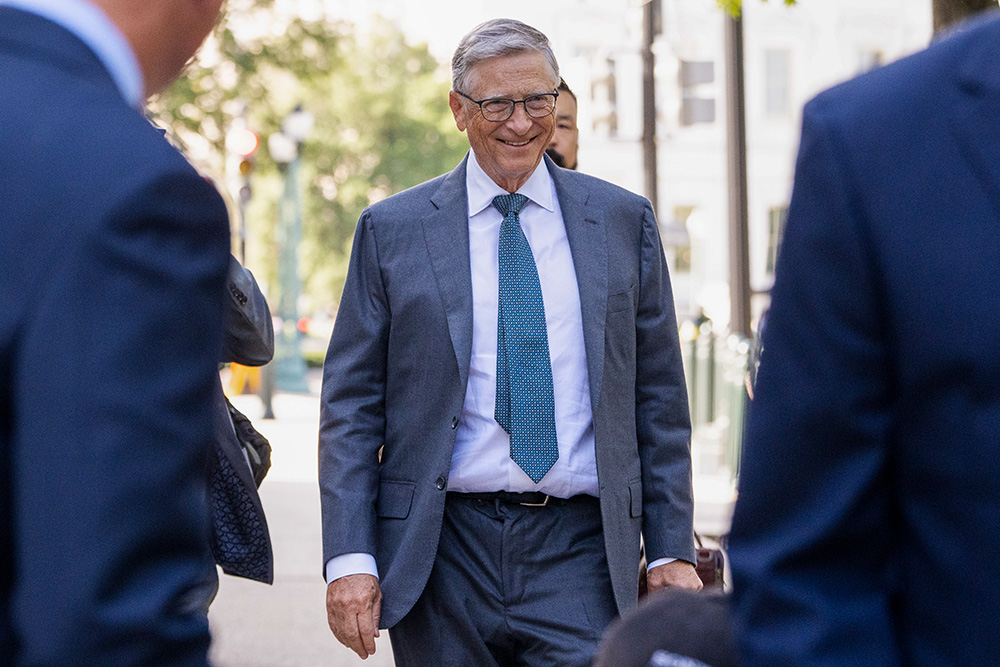
Microsoft co-founder Bill Gates arrives for a closed-door gathering of leading tech CEOs to discuss artificial intelligence and how it should be regulated, at Capitol Hill in Washington on Sept. 13, 2023. (AP/Jacquelyn Martin)

Join the Conversation
Send your thoughts to Letters to the Editor. Learn more
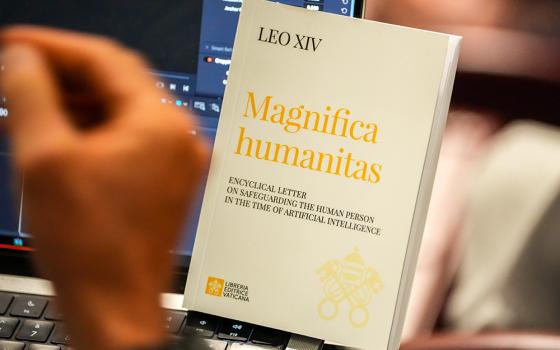
Shortly after the release of Pope Leo XIV's landmark encyclical on artificial intelligence, Magnifica Humanitas, a leading AI expert expressed skepticism over the document's ability to effect concrete change around regulation of the tech industry.
Elham Tabassi, director of the Brookings Institution's Artificial Intelligence and Emerging Technology Initiative, said on the encyclical: "I don't think that this is going to be a driver for any sort of legislation or anything," though she maintained that the document could still influence important conversations around AI.
Yet three months after the encyclical's release, Magnifica Humanitas continues to gain traction among tech leaders and policymakers alike.
And now, public backers of the pope's vision on safeguarding humanity in the age of artificial intelligence include Microsoft founder Bill Gates.
Expounding the risks of unchecked AI development in a lengthy essay published on Aug. 26, Gates wrote that religious leaders, "as people who spend their lives thinking about what it means to be human," can play a key role in responding to the questions posed by AI's rapid development and application, "including how we preserve our humanity in a time when machines can out-think us."
"I was fascinated by Pope Leo XIV's encyclical on AI," Gates wrote. "It lays a strong foundation for the work that needs to be done."
Advertisement
Unlike Rerum Novarum, Pope Leo XIII's 1891 landmark encyclical on Catholic social teaching that served as an autopsy of the Industrial Revolution that had begun more than a century prior, Magnifica Humanitas arrived at the advent of an emerging societal revolution.
The document's timing, and the digital media landscape that allowed for its instantaneous and far-reaching dissemination, means its teachings can be inserted into the conversation about how the industry is developing, including in policymaking.
California Rep. Ro Khanna, whose district encompasses the headquarters of several Silicon Valley companies such as Apple and Intel as well as the campus of the Jesuit-run Santa Clara University, demonstrated the political heft of the pope's encyclical after he co-led a congressional delegation to the Vatican for a meeting with the pope last month.
After the meeting, the congressman sent letters to the CEOs of Amazon, Anthropic, Apple, Google, Meta, Microsoft, Nvidia and OpenAI, "asking how they intend to align their technology with the Pope's encyclical," according to a press release on Khanna's website.
In a letter to Meta CEO Mark Zuckerberg, Khanna — who traveled to Europe as a ranking member of the House Select Committee on the Chinese Communist Party — stated that the pope, "more clearly than any other global leader, has offered in Magnifica Humanitas an ethical framework for AI grounded in two fundamental principles: human dignity and equality."
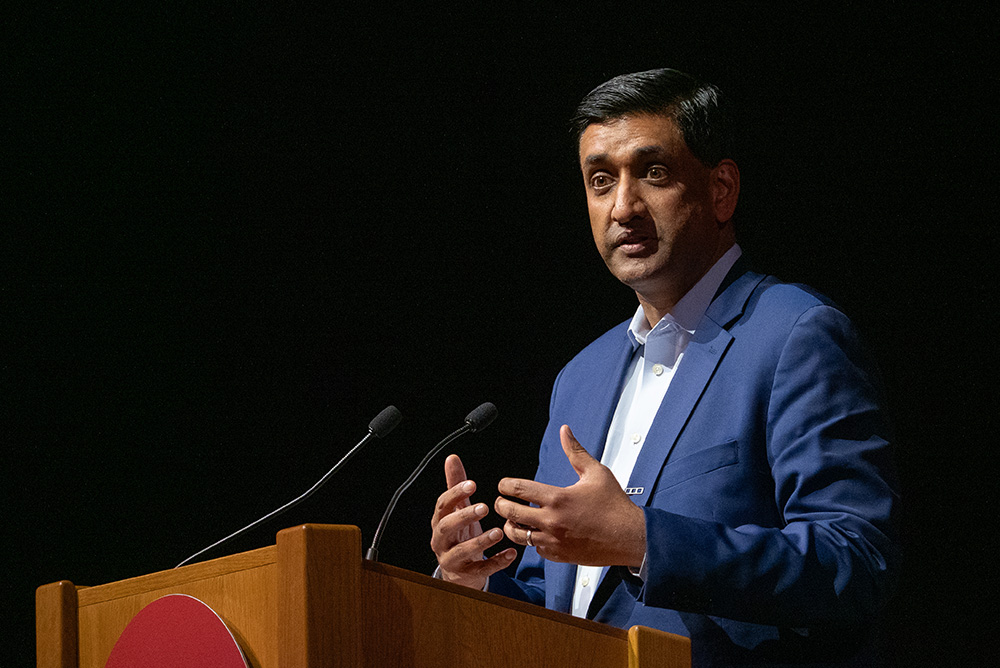
Rep. Ro Khanna, D-California, speaks at a student Q&A at Stanford University about "Who Controls the Future of AI: The Oligarchs or the People?" on Feb. 20, 2026. (Wikimedia Commons/Anderseidesvik)
"We should embrace our humanity, including our mortality and imperfections, rather than pursue the illusion of becoming godlike," the congressman wrote. "Artificial intelligence should strengthen human judgment, creativity, and wisdom, not seek to replace them."
Magnifica Humanitas ("Magnificent Humanity"), on safeguarding the human person in the time of artificial intelligence, was released at the Vatican in May with the support of Anthropic executive Christopher Olah. It garnered widespread praise among world leaders, including Vice President JD Vance and Mexican President Claudia Sheinbaum, who read out two paragraphs of the document at a press conference.
But not all rushed to throw their support behind the pope.
Tech billionaire Peter Thiel, a co-founder of Palantir and PayPal, said that with his calls for AI regulation, the pope was acting as a "Chinese communist agent."
David Sacks, Trump's former crypto and AI czar who now serves as co-chair of the President's Council of Advisors on Science and Technology, praised the pope for stating that "AI must serve human dignity," but quickly turned to attack the prospect of government regulation on AI called for in the encyclical.
"But if we hand governments sweeping power over AI development in the name of safety, how do we prevent it from being used to censor, surveil, and control citizens — as Orwell foretold in 1984?" he wrote in a post on X following the release of the pope's encyclical.
Following initial reactions to the document, Khanna's and Gates' more recent signs of support for the document demonstrate its staying power more than three months since its release.
And at more than 42,000 words, the encyclical may need ample time to be digested by the world and its leaders alike. German chancellor Friedrich Merz, a Catholic, said earlier this year that he planned to take the encyclical with him to read during his summer vacation.
The National Catholic Reporter's Rome Bureau is made possible in part by the generosity of Joan and Bob McGrath.