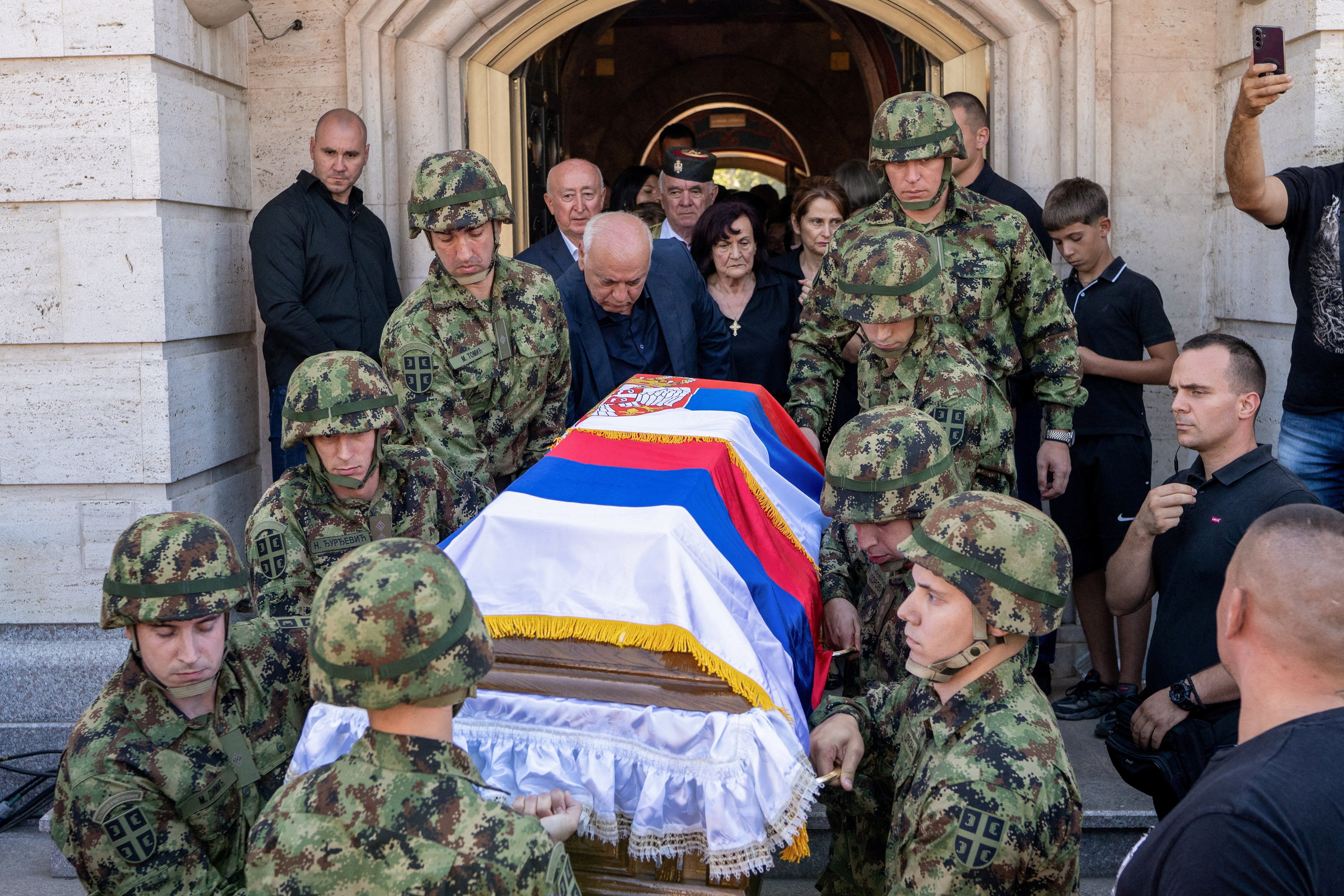
Serbian army soldiers carry the coffin of former Bosnian Serb wartime leader Ratko Mladic outside the Church of St. Luke in Belgrade, Serbia, Sept. 7, 2026. Mladic died at age 84 Aug. 27 at The Hague, Netherlands, where he was serving a life sentence for genocide and other atrocities during the war in Bosnia. His body was flown back to Serbia on a government plane. (OSV News/Reuters/Uros Arsic)
Jonathan Luxmoore

OSV News
Join the Conversation
Send your thoughts to Letters to the Editor. Learn more
Cardinal Ladislav Nemet of Belgrade is urging Western governments not to let recent controversy over the funeral of convicted Bosnian Serb wartime leader Ratko Mladic derail Serbia's ties with Europe.
Mladic, dubbed "Butcher of Bosnia," received a funeral attended by state officials in the capital.
"I'm always rather surprised when the so-called international community reacts this way to stories of real life," said Nemet.
"And I was particularly surprised by calls for a delay in Serbia's Western integration — since this incident didn't really involve Serbia. It involved a relatively very small group of people — and it wasn't the greatest event of the year, nor even of that particular week," he said.
The cardinal, a Divine Word Missionary, spoke in the wake of the lavish public funeral of former Bosnian Serb leader General Ratko Mladic, who died Aug. 27 in a United Nations prison hospital in The Hague, Netherlands, five years after being given a life sentence by the International Criminal Court for genocide and crimes against humanity.
In an OSV News interview, Nemet said around 12,500 people had turned out for the Sept. 7 Orthodox funeral in Belgrade, a city of 1.7 million, adding that he regretted the incident had been used by international media to portray Serbia "as a place where bad things happen."
"Everyone has a right to a decent funeral — and if you're styled by some as a national hero, it's hardly going to be left to some simple parish priest," said the cardinal, vice president of the Council of European Bishops' Conference, or CCEE.
"We can criticize how the event was handled," he said. "But although I live in Serbia and was born there, I've never personally experienced any nationalist feelings. Like many others, I have a different worldview and scale of values."
Mladic, a former Yugoslav People's Army general, led Serb forces during a 1992-1995 war that left 100,000 dead across Bosnia-Herzegovina.
His troops were responsible for the forced ethnic cleansing of non-Serbs and indiscriminate siege of Sarajevo, as well as a 1995 massacre of 8,000 Muslim male detainees at Srebrenica, Europe's worst atrocity since World War II.
Condemning the public honoring of Mladic, whose flag-draped coffin was flown to Belgrade aboard a government plane, the European Union's Commission president, Ursula Von Der Leyen, described the TV footage as "shocking" and expressed condolences for those affected by his crimes.
Advertisement
"The elements of official support and the presence of some senior Serbian officials at the funeral are deeply regrettable," the statement noted.
"They demonstrate a failure to confront a dark chapter in Europe's recent history and contradict the values underpinning Serbia's path towards the European Union."
Zdravka Gvozdjar, mother of a 9-year-old boy killed by Mladic-led forces during the siege of Sarajevo, told Reuters that Mladic "deserved to be erased from memory for good, not to be ... promoted as a hero."
"He should be remembered only as a butcher," she said.
Nemet said Mladic's burial had been conducted in line with his wish to rest alongside his daughter, who committed suicide over his actions in 1994 at age 23, rather than in "some great mausoleum" in his native Bosnia.
"While people know about his crimes, they seem less aware of tragic events in his personal life," the cardinal told OSV News.
"It's important to recognize that the state-like funeral ceremonials actually played a lesser role than this — his simple last wish."
The Belgrade funeral for Mladic was led by Serbian Orthodox Patriarch Porfirije, who said the general's name would remain "deeply etched in the memory and prayers of the majority of our Serbian Orthodox people, who feel and nurture a deep sense of gratitude towards him."
Nemet said relations with Serbia's predominant Orthodox Church had improved significantly since the 2021 election of Patriarch Porfirije, who was 25 years younger than his predecessor and had a "very different perception of the world."
The cardinal was attending an international symposium in Austria on "Shaping Synodality in Europe," organized by the Catholic University of Linz under the CCEE's patronage, which included calls for closer ecumenical ties with non-Catholic denominations.