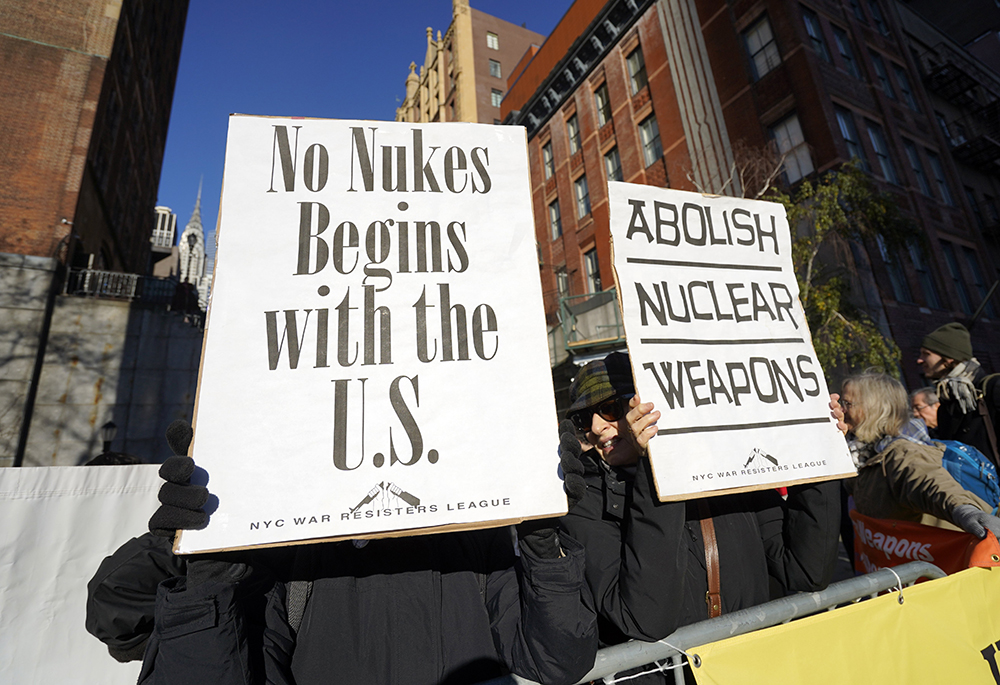
Demonstrators hold signs as they face United Nations headquarters in New York City during a rally to abolish nuclear weapons Nov. 28, 2023. Catholic Worker and Pax Christi members were among the participants. (OSV News/Gregory A. Shemitz)

by David Cortright
Join the Conversation
Send your thoughts to Letters to the Editor. Learn more
This year's International Day of Peace occurs as the midterm elections approach and people of faith are called to be peacemakers. The world day of peace was established by the United Nations in 1981 to encourage support for disarmament and peace, but this year it comes at a time of mounting nuclear weapons danger and the continuation of wars in Ukraine, Iran and beyond. The risk of nuclear war is greater now than in decades, reflected in the decision of the Bulletin of Atomic Scientists to move its iconic Doomsday Clock closer to midnight than it has ever been. Compounding the risk is the integration of AI technology into nuclear command and control systems worldwide. These worrisome trends have prompted church leaders to sound the alarm and call for a greater commitment to peace. "I invite everyone to join in prayer and action," Pope Leo XIV said recently, "that we may become channels of the living water of God's peace, refreshing our wounded world."
Given the immensity of the threat, some may feel that little can be done to stop the weapons juggernaut, but success is possible even in the most difficult times. An equivalent level of risk existed in the 1980s, when the United States and the Soviet Union deployed tens of thousands of nuclear weapons and were rapidly building more. In those years, the religious community led a great wave of social mobilization against the mounting threat of nuclear war. The National Conference of Catholic Bishops and other religious bodies spoke out boldly for peace. The global outcry created a political climate conducive to arms reduction, setting in motion a process of US-Soviet negotiations that slashed strategic nuclear weapons levels by more than 80%.
Today, the bomb is back. The threat is more complex and dangerous. Great power tensions have increased, Russia continues to upgrade its nuclear capabilities, and China is rapidly increasing its nuclear arsenal. Nuclear weapons have spread to other countries, including Israel, India, Pakistan and North Korea — and potentially to Iran, which some analysts believe is more likely with the US-Israeli war.
The arms control treaties that previously constrained U.S. and Russian arsenals have been discarded in recent decades and are gone completely now with the expiration of the New START treaty this past February. In the absence of agreed weapons restrictions, the United States and Russia could deploy hundreds of additional warheads in the coming years.
Political leaders in Washington are pursuing a massive upgrade of the entire U.S. nuclear arsenal, at a cost of a trillion dollars. The U.S. is building a new system of land-based intercontinental ballistic missiles, improved ballistic missile-firing submarines, updated strategic aircraft, new air-launched and sea-launched cruise missiles, and enormous new facilities to produce at least 80 plutonium pits per year for new nuclear warheads.
Advertisement
This enormous nuclear construction program is euphemistically termed "modernization" in Washington. It is more properly understood as a vast program for enhancing the capacity to use nuclear weapons.
Pentagon officials are also pushing for the acquisition of more tactical nuclear weapons, which have a shorter range and smaller yield and are intended for operational use on the battlefield. These weapons are described as "employable" options for "managing escalation" if the U.S. wages war with Russia and China. As Leo warns in Magnifica Humanitas, tactical deployments make "the use of such weapons seem less improbable."
Political leaders and security experts talk about nuclear weapons as if they are mere pieces on a chessboard, to be brandished and maneuvered for strategic advantage. We are told that nuclear weapons are necessary for peace, but there can be no genuine peace if security rests on the threat of using instruments of indiscriminate mass annihilation.
One large bomb detonated over a modern city could kill more than a million people. A nuclear war with Russia would devastate global food production and could kill 5 billion people.
Nuclear deterrence does not create peace. It has not prevented major wars, by Russia in Ukraine, or by the US in Vietnam and Iraq. The number of armed conflicts in the world today is at an all-time high. Pope Francis criticized the reliance on nuclear weapons as a destabilizing strategy that creates "a false sense of security."
Cardinal Robert McElroy of Washington, D.C., issued an impassioned plea for peace action last year during the Catholic pilgrimage to Japan for the 80th anniversary of the bombings of Hiroshima and Nagasaki.
The ethical stance of the church "demands collective action to eliminate the nuclear arsenals of the world," he declared. "We will resist, we will organize, we will pray, we will not cease, until the world's nuclear arsenals have been destroyed."
Deterrence against aggression is achievable through non-nuclear means, scholar Mary Kaldor reminds us. Wars can be avoided by strengthening mechanisms of global cooperation and applying proven methods of conflict prevention and peacemaking diplomacy. Leo has emphasized the need for a genuine "culture of negotiation" to avoid war.
Diplomacy with Moscow will be difficult given its aggression in Ukraine, but arms control negotiations can succeed despite sharp differences over policy. The Reagan administration's forceful opposition to Moscow's invasion of Afghanistan did not prevent negotiations that led to significant arms reductions in the 1980s. The Kremlin has offered to maintain weapons limits in the expired New START treaty as long as the U.S. does likewise, but the White House has refused to respond.
The current administration has shown no real interest in arms control diplomacy, either with Russia or Iran, so the initiative for nuclear restraint and arms reduction will have to come from concerned citizens. In the atomic age steps for weapons limitation and disarmament usually have been the result of public pressure and grassroots political action. People of faith played a decisive role in that process in the 1980s. We need more of the same now. It is especially urgent that we raise concerns about the nuclear danger with candidates of both political parties in the coming congressional elections.