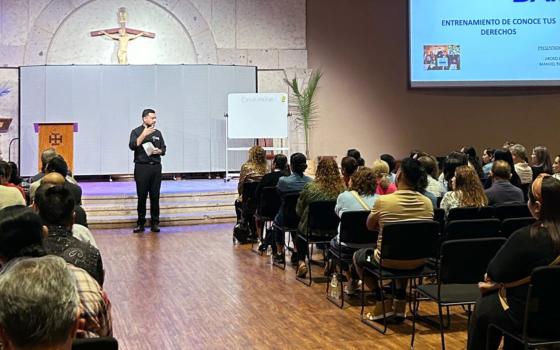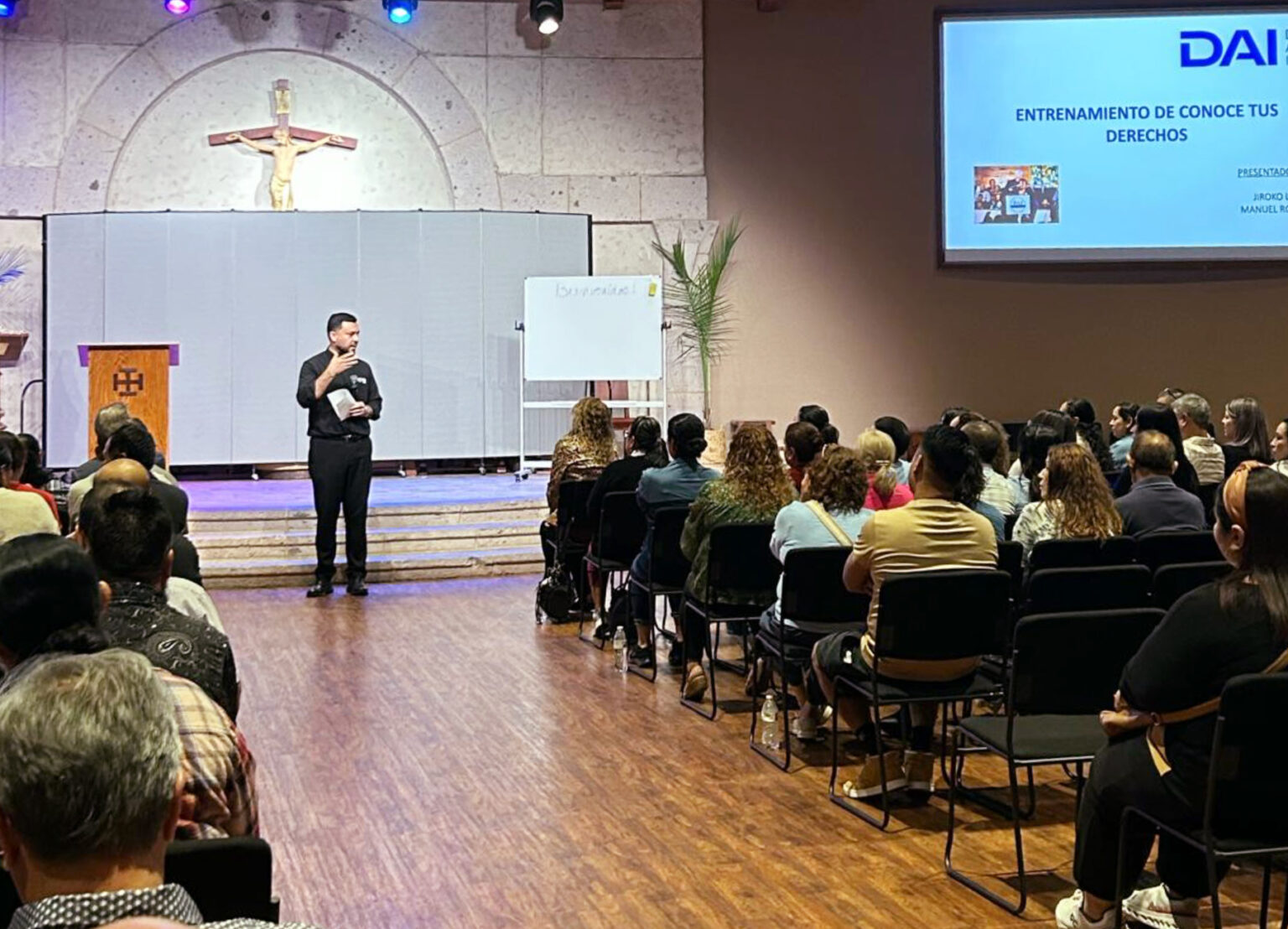
Dallas Area Interfaith teaches attendees about habeas corpus on Nov. 8, 2025, at St. Ann's Catholic Parish in Coppell, Texas. (Courtesy of Dallas Area Interfaith/Silvia Manzano)

Religion News Service
Join the Conversation
Send your thoughts to Letters to the Editor. Learn more
After the Communion rite at Mass at Our Lady of San Juan de los Lagos-Santa Teresita Catholic Church in Dallas, parishioners might hear announcements about prayer groups, community events or religious education. Lately, they also have heard something else: If a loved one has been detained by immigration authorities, call us.
The parish's pastor, Fr. Ángel Ríos, is a leader with Dallas Area Interfaith, whose recent efforts have centered on immigrants and refugees as the Trump administration has enacted its mass deportation agenda. Over the last two years, it has built a network of clergy, organizers and volunteer lawyers trained to challenge immigration detentions in federal court through habeas corpus petitions, or judicial orders that compel law enforcement to bring a person they are detaining to court to justify the prisoner's confinement.
"The judicial system in this country is something completely unknown for immigrants," Ríos said. "It's something that is often unfamiliar even to those of us accompanying them."
Dallas Area Interfaith, comprising clergy from various faith traditions that work together on shared civic issues, has partnered with the Industrial Areas Foundation, a network of local faith- and community-based organizations, Texas A&M Legal Clinics and others on what it calls the Immigration Detention Project.
According to organizers, when the project began in late 2024, they saw a gap between an increasingly restrictive immigration system and a shortage of specialized legal representation.
"We knew we couldn't stop everything that was happening," said Tim McManus, a senior organizer with the Industrial Areas Foundation and Dallas Area Interfaith. "But we wanted to find ways to slow it down, scale it back and create opportunities for people to get their cases heard."
At first, the coalition recruited non-immigration attorneys to handle pro bono bond hearings. But McManus said changes in immigration policy sharply reduced those opportunities, prompting the group to shift toward habeas petitions challenging detention in federal court. Since its launch, the project has mentored pro bono attorneys representing clients held in detention as they pursue asylum claims. This area of law required not only compassionate, diligent advocates but experienced attorneys, McManus said.
The effort is ongoing as immigration detention policy faces a legal test. The U.S. Supreme Court has agreed to hear a case over whether federal law permits the government to detain certain immigrants during deportation proceedings without a bond hearing.
Advertisement
According to the project, several cases have resulted in detention releases, including a mother and young daughter from Plano, Texas, detained separately while pursuing asylum claims, a 33-year-old Mauritanian man with serious medical needs and a Mexican father who arrived in the U.S. at age 4 and was nearly deported away from his U.S.-citizen children.
Across North Texas, local religious congregations, like Our Lady of San Juan, and grassroots partners across faith traditions are critical for this organizing. Through DAI initiatives, clergy, staff and lay volunteers also monitor immigration courts and accompany migrants to check-ins at Immigration and Customs Enforcement field offices, organizers said.
Silvia Juliana Manzano, a DAI organizer working with Spanish-speaking congregations, said churches are trusted spaces where immigrant families can seek information they might hesitate to find elsewhere. Over the past year, she said the coalition has reached more than 1,200 people through "Know Your Rights" workshops hosted by congregations.
"The community has a lot of fear right now," Manzano said. "But the church became a place where they felt safe."
The workshops discuss issues like legal rights, immigration fraud and family preparedness. Organizers also help families prepare powers of attorney, compile financial records and identify potential caregivers for children should a parent be detained or deported.
"If people may end up in detention," McManus said, "then what can we do now to prepare their family, prepare their lawyer and prepare their case?"
The answers increasingly come through interfaith alliances and faith-based advocacy groups as heavily immigrant and lower-income Catholic parishes work alongside Protestant, Jewish and Catholic congregations whose members are less likely to face detention themselves.
For example, at First Unitarian Universalist Church of Dallas, most members are U.S.-born, and congregants include attorneys, former government officials and related professionals. One of the church's ministers, the Rev. T.J. FitzGerald, said many members have given their professional expertise and time participating in court monitoring, producing educational videos and providing legal support to immigrants.
"More and more people being detained has meant that it's starting to touch the lives of even people who thought maybe two years ago that they were mostly removed from it," FitzGerald said, adding that many detention cases fail to take into consideration the poverty, violence, domestic abuse or political or religious persecution many asylum-seekers in North Texas confronted before coming the U.S.
While the Department of Homeland Security, which oversees ICE, rejects claims its policies deny due process to immigrants, attorneys and organizers interviewed by RNS said access to counsel remains uneven, and many migrants struggle to secure legal representation. And DAI organizers said that for some participants in the trainings, concerns have centered on enforcement operations. McManus recalled a rights-training session in West Dallas where participants told organizers that "knowing our rights doesn't matter right now" and that they were hearing reports of "people being grabbed and thrown into vans."
In response to questions from RNS, a spokesperson for DHS wrote in an Oct. 9 email that people arrested by ICE receive due process and are provided "a court-approved list of free or low-cost attorneys." The spokesperson also disputed concerns raised by immigration advocates and faith leaders about family separation.
"Illegal aliens in detention have access to phones they can use to contact their lawyers," the email said.
Although ICE detainees may receive information about free or low-cost legal services, immigration courts generally do not provide government-funded attorneys for people facing deportation. Federal law permits representation by counsel in removal proceedings, but only at no expense to the government, according to the Justice Department.
Jiroko Lopez, an immigration attorney who volunteers with the project, said many of her clients have endured sex trafficking, forced labor, physical violence, severe emotional trauma and religious persecution before arriving in the U.S. seeking safety. She said that detention and the legal process can leave them feeling further dehumanized. Some clients also fear retaliation or other repercussions while their cases remain active, and they rely on networks of volunteer attorneys, congregations and community organizations to navigate the legal system.
"As an immigration attorney, I'm pretty burned out," Lopez said. "This work is so hard." But seeing congregations and community organizations mobilize around families in crisis has renewed her sense of purpose. "It's brought me back to faith," she said.
In addition to courtroom efforts, congregations have fundraised, provided transportation and clothing and connected newly released migrants with educational and social services.
Ríos said that as a pastor, he has had to acquire some degree of legal expertise to help his predominantly Hispanic and largely migrant congregation. Recently, a detained congregant's family was connected to legal assistance through DAI's network, he said.
"Many families have lost everything," he said. "Through this work, they learn how to protect their property, protect their families and prepare for what may come."
McManus credited more than three decades of relationship-building among congregations and civic institutions in Dallas for the group's ability to serve migrants and asylum-seekers and their families. "You don't build that overnight," he said.