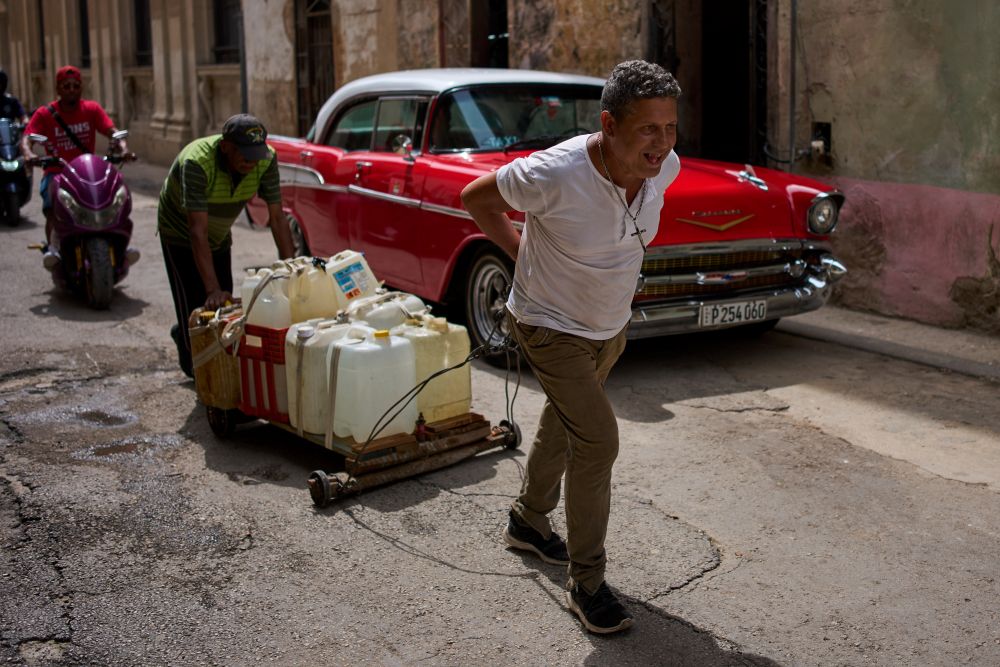
People transport containers of water in Havana June 3, 2026. (AP/Ramon Espinosa)

by Rhina Guidos
Join the Conversation
Send your thoughts to Letters to the Editor. Learn more
A group of sisters in Havana told priests in Cuba in early June that the lack of electricity has made it difficult for them to continue their ministry, leaving some to wonder how long a remaining reserve will last if the U.S. keeps blocking fuel from reaching the island.
"The remaining supply will be rationed so that there is enough for everyone," the Discalced Carmelites in Havana wrote to priests in a message made available to Global Sisters Report June 3. Using a machine that uses electricity, the contemplative sisters produce hosts, unleavened bread consecrated by priests at Mass, for all the parishes on the island.
Fuel is one of many essentials the U.S. is stopping from entering Cuba as it seeks to bring the government to its knees and create regime change, even as ordinary Cubans, which also includes nuns and religious life serving missions there, suffer the consequences.
"Daily life for Cubans has become a challenge, and as religious sisters we enter into that dynamic of the struggle for food and the shortage of what is necessary to carry out our mission," Sr. Noemy Ayala, a Carmelite Sister of St. Joseph, based in Havana, told GSR June 1.
Religious communities that have been unable to secure basics to continue their mission work have left altogether, said Bishop Arturo González Amador, head of the Cuban Bishops Conference, in a May 20 interview with Aid to the Church in Need. He didn't say how many have left.
The scarcity of food, water, fuel and medicine — along with the threat of war — has brought Cuba to its "saddest moment," he said.
"Cuba is suffering," said González, describing an island where the only people who stay are those unable to leave and where some pass out during Mass because of hunger. It's a situation so dire that a person who needs medical attention, including surgery, has to procure his or her own materials — pain medicine, suture thread and needle — before heading to the hospital, he said.
'For a religious sister, living in Cuba today means navigating and taking on a series of structural and economic challenges that require an enormous capacity for adaptation and resilience.'
—Sr. Noemy Ayala
While Cubans have suffered material limitations for decades due to U.S. sanctions and economic mismanagement, the ouster in January of Venezuela's Nicolás Maduro — whose government had long supplied the island with subsidized oil and other necessities — sent the island into unprecedented distress this year. Some say the current crisis is much worse than Cuba's "special period," an economic crisis in the 1990s produced by the collapse of the Soviet Union, which yielded widespread hunger and death on the island.
Even China and Russia, which have strategic interests in the island because of its proximity to the U.S., have been unable to help.
The New York Times reported May 28 that a Russian tanker that appeared headed for Cuba changed course, crushing the hopes of humanitarian groups that had been waiting for fuel so they could distribute food around the island.
Cuba is a communist country. Its constitution guarantees religious liberty, although its leaders do restrict some religious practices. About 60% of the country's 11 million people are Catholic.
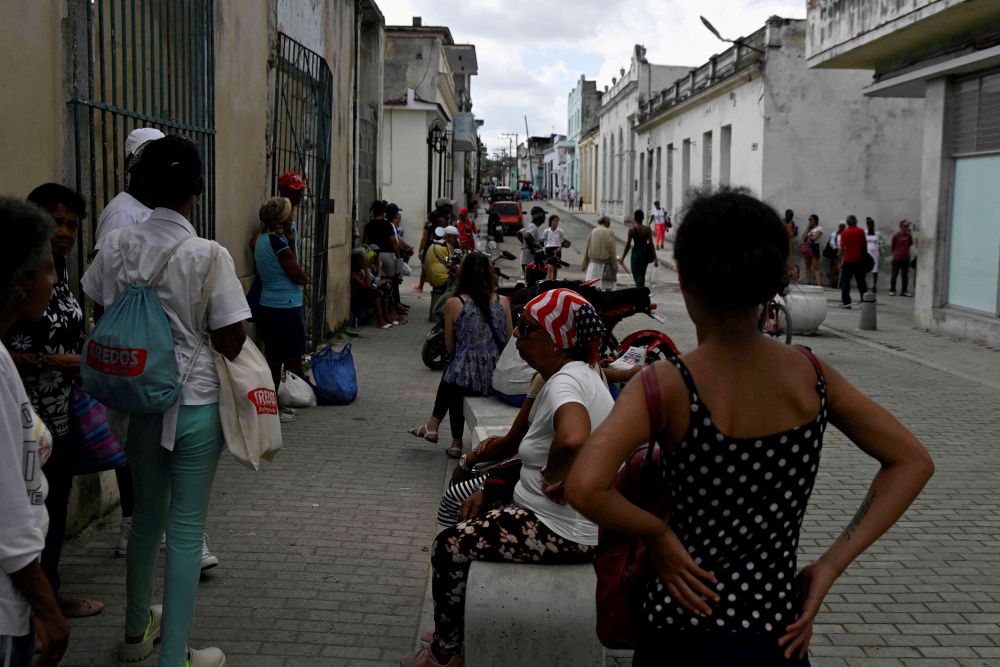
People wait in line to enter a bank branch in Havana, as Cubans from all walks of life hunker into survival mode, navigating seemingly interminable blackouts and soaring prices for food, fuel and transport as the United States increases pressure on the communist-run nation Jan. 26, 2026. (OSV News/Reuters/Norlys Perez)
Ayala, whose community of three sisters serves children and the elderly, said that while they can offer love, hope and a little bit of food, they can't do it if children can't make it into their daycare center because there is no transportation or water. Electricity, which the sisters use to pump potable water, randomly comes and goes.
"We have to live with the uncertainty that the power could go out at any moment…and when it does, we have no water because the pump cannot get started," she said. "For a religious sister, living in Cuba today means navigating and taking on a series of structural and economic challenges that require an enormous capacity for adaptation and resilience. These challenges are not only material but also take up a large part of people's mental load and time."
Before a person on the island can secure food, they first have to find transportation but also connections to obtain necessities, she said. And not everyone has access to that.
"There are people who come in saying they haven't eaten in days and don't know who to turn to. Food cannot be preserved due to the lack of electricity, and recently there have been frequent fainting spells during [church] services because many people haven't eaten," González told ACN. "Everything is a struggle for survival. The present is precarious, the future entirely uncertain."
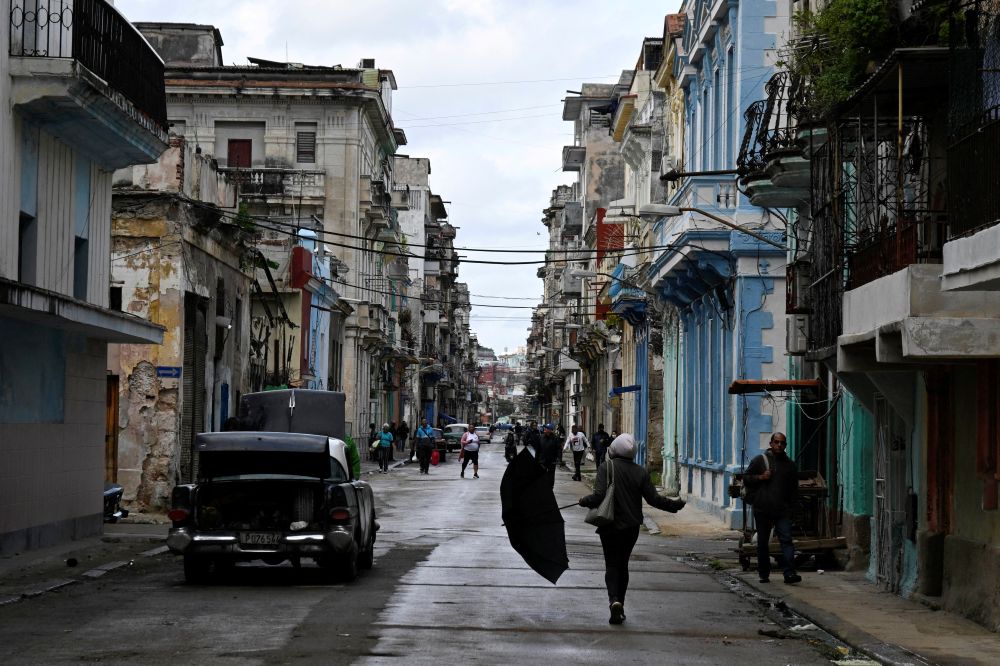
People walk on the street in Havana Jan. 30, 2026. (OSV News/Reuters/Norlys Perez)
Late last year, Alena Douhan, special rapporteur of the United Nations Human Rights Council, called on the United States to lift sanctions against Cuba, saying continuing the policy would have a high humanitarian cost.
The crisis has hit the poor, the elderly who live alone, retirees and single mothers, the hardest, González said. And it's also affected the life of churchgoers.
The Easter Vigil, for example, had to be moved to the daytime, not only because of the lack of electricity, but also because of worries of burglaries and muggings of church-goers on the way home, González said in the interview.
Ordinary Cubans fear finding themselves hungry, weak and helpless in the middle of a violent conflict that could erupt at any moment between the U.S. and the regime that's controlled the island since 1959.
"Fear reigns," González said. "The fear of war is tremendous; it is part of the daily concerns of many people … there is constant talk about it, which causes distress, especially among children and the elderly. On the street, you hear: 'We can't take any more of this pain, and we have no one to turn to.' "
Advertisement
The U.S. recently charged former Cuban president Raúl Castro with murder and other crimes over the 1996 downing of two planes between Cuba and Florida, and members of the U.S. military reportedly met with Cuban counterparts in late May, sparking speculation of an invasion.
Many Catholic church organizations, including religious congregations, have told Cubans they will stay no matter what happens. Even as resources dwindle, religious communities that run soup kitchens, for example, have been finding creative ways to feed the hungry as the need increases, González said.
"What remains is an increasingly aging country, left with only the elderly, without resources and with minimal pensions," he added. "The church's task is to keep the spirit alive, to give hope where there is none, to listen and to accompany."
For sisters like Ayala, that task involves taking the day moment by moment, relying on prayers and faith.
"This is what our days are like, filled with people's anguish and despair, and this is where our mission becomes a constant act of listening and a shared anguish," she said. "But above all, the most important thing is that we feel the power of the prayers of many people both on and off the island who accompany us in prayer."