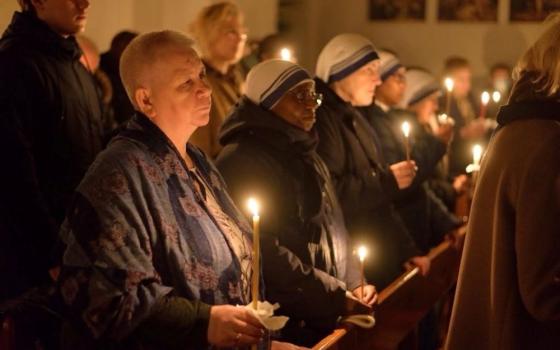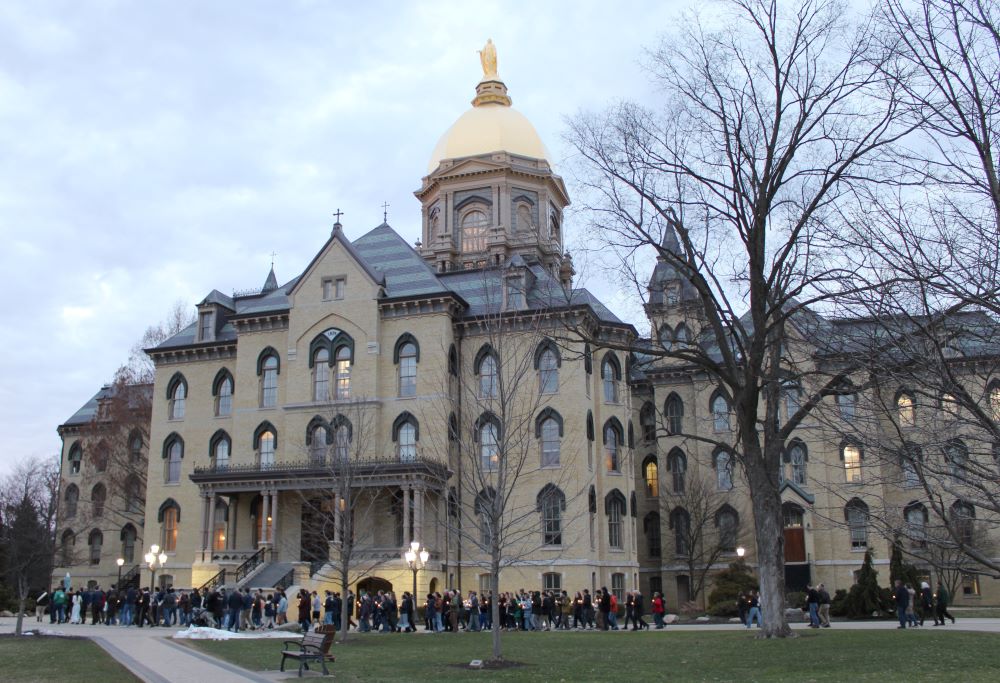
Student leaders and others from groups across campus take part in the "March on the Dome," at the University of Notre Dame in South Bend, Ind., Feb. 27. The march was in response to the appointment of professor Susan Ostermann to one of its institutes. Ostermann, who was criticized for publications that supported abortion rights, withdrew from the appointment after criticism. (OSV News/James Whitaker)

by Chris Damian
Join the Conversation
Send your thoughts to Letters to the Editor. Learn more
Sociologist Christian Smith has publicly announced his retirement from the University of Notre Dame. His First Things essay, "Why I'm Done with Notre Dame," highlights what he says are discrepancies between Notre Dame's stated Catholic mission and its search for secular relevance. He cites the administration failing to cultivate a mission-oriented faculty, a lack of bold leadership in addressing culturally unpopular Catholic positions, and scholarly expectations that do not leave time or energy for intellectual engagement across disciplines and with the Catholic tradition.
In response, Catholic scholars and former Notre Dame professors Cathleen Kaveny and Robin Darling Young defended the university in Commonweal. They highlight how the commercial kitsch that Smith bemoans is a sign of a Catholic shrine's significance, and how Catholic spaces have often been characterized by "impurity" and a dynamic pluralism. Unfortunately, they also caricature Smith's views. For example, they claim that "Smith tacitly suggests that opposition to the Church's firm positions must not be given a platform." This is untrue. Rather, Smith argues for more space for controversy that might come from the prioritization of sympathetic engagement with certain Catholic views. Smith's actual argument leaves ample room for the platforming (though perhaps not privileged) of views opposed to Catholic positions, and may even encourage this.
At the same time, Smith misses many of the fundamental issues at hand, and he seems unaware of the broader history in which his essay is taking part. The failings he highlights when it comes to Notre Dame's religious mission are not new to his tenure and are not unique to Notre Dame. They were outlined in part in the 1998 book The Dying of the Light by Notre Dame theologian James Turnstead Burtchaell and go back at least to the controversial 1967 Land O'Lakes Statement (officially the "Statement on the Nature of the Contemporary Catholic University"). In his concerns about academia and the demands of research for the modern university, Smith does not highlight new issues but, rather, the latest developments of shifts that preceded him by decades.
I entered Notre Dame in 2009 as an undergraduate deeply concerned about this history. Despite being a closeted gay student, I was enthralled by the Catholic university tradition and wanted to promote it. During my freshman year I sat in David Solomon's office with two friends and shared how we wanted to help reform the university, aligning it more strongly to John Henry Newman's The Idea of a University. I had gone to the philosophy professor, partly because of his work as director of the Center for Ethics and Culture and also partly because he had encouraged students in organizing an alternative commencement event when Notre Dame honored President Barack Obama as commencement speaker in May 2009.
I spent time in the Program of Liberal Studies, and then left the program after frustrations over the lack of an integrated Catholic vision and began a deep dive into the history of Notre Dame's mission and curriculum. I explored the diminishment of Notre Dame's core curriculum into a set of distribution requirements, the gutting of theology and philosophy requirements over the years, and the generally un-integrated disciplines across the university.
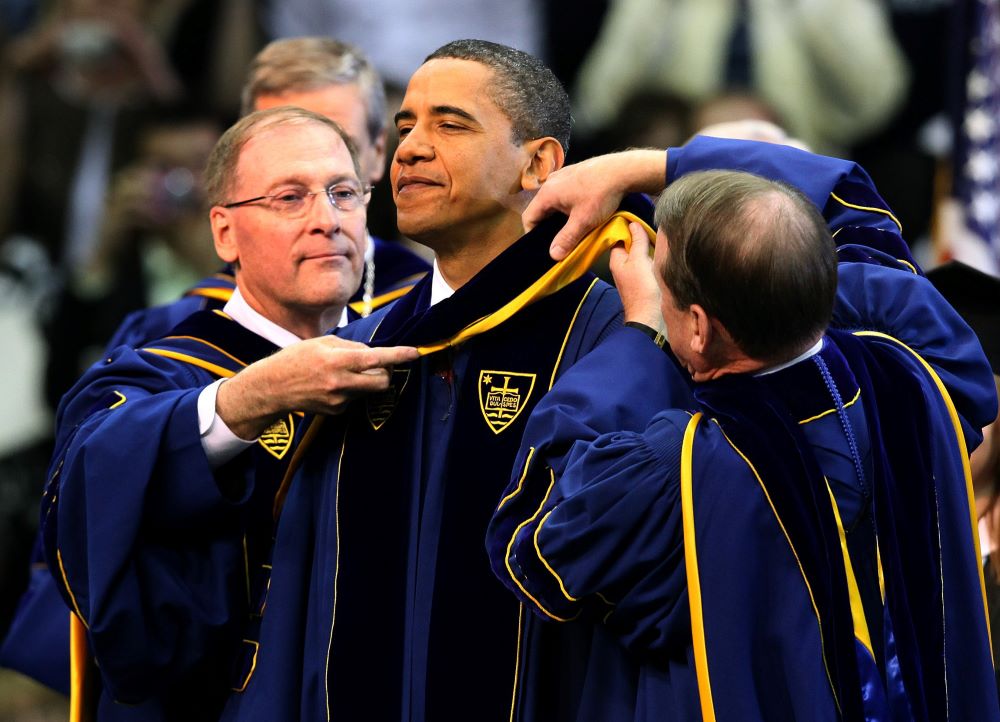
The chairman of the University of Notre Dame's board of trustees, Richard Notebart, and university registrar Harold Pace present U.S. President Barack Obama with an academic stole signifying the honorary degree he received during the commencement ceremony at the university in Notre Dame, Ind., May 17, 2009. (CNS/Christopher Smith)
I wrote for the campus paper, asking whether Notre Dame was sufficiently Catholic and also whether Notre Dame was sufficiently a university. My conclusion was that, to receive a true "Catholic university education" at Notre Dame, one must seek it out actively. I translated this realization into a mentoring program my junior and senior years, where we helped other undergrads navigate course selections each semester. I'm especially grateful to Solomon and to the philosopher David O'Connor for encouraging creative responses to the challenges we faced at Notre Dame.
A range of faculty and students have raised concerns over Notre Dame's mission as a Catholic university over the years. They include Solomon and O'Connor, as well as the historian Fr. Bill Miscamble, Charles Rice from the law school, and former Mendoza College of Business Dean Carolyn Woo. The fight for Catholic mission has not come without sacrifice. Solomon's removal from the directorship of the Center for Ethics and Culture struck many as delayed retaliation for encouraging the alternative commencement event in 2009. Janet Smith faced a tenure denial that seemed to come from her Catholic views on contraception. And Bill Kirk was fired from his role as associate vice president for residence life, ostensibly partly over insisting that athletes be held to the same disciplinary standards as other students.
I especially cherish Solomon's example. In conference remarks about the ending of his directorship, he said: "A flower is meant to bloom for a time." Whatever injustice may have been a part of those circumstances, he rose to the occasion with a graceful passing of the baton. The curtailing of one's work may not actually be "the end," but an invitation to pass the baton to the next runner. That moment still challenges me to hope.
The message of hope is where Christian Smith's piece finds its greatest failure. Unlike others who faced adverse consequences for their critiques of Notre Dame's failure of mission, Smith is entering retirement after an esteemed career and "an enviable salary" under the Dome. He chooses to frankly speak hard truths when he's in a position to comfortably step away from them without professional consequence. And his parting gift to his colleagues is a dump of despondency. He closes his remarks with this piece of advice to those who care about Notre Dame becoming a genuinely Catholic university: "Don't get your hopes up." I can't think of a more un-Christian closure than his invitation to despair.
Advertisement
I will offer something else: a challenge to work for an enlivening of Catholicity in whatever circumstances, including in pursuing a Catholic mission for Notre Dame. Whether or not you appear to succeed in this work, it matters. Like pursuing an education, it is good work, not just because of what you can accomplish from it, but because the work itself is good to do.
I'm an odd person to be putting forward a message of hope for enlivening Notre Dame's Catholicity. I sympathize in many ways with Smith. I understand feeling "disappointed and vexed" after one's time at Notre Dame. The Catholic environment I had promoted ultimately left me with so much trauma from my experiences as a closeted student that I couldn't remember much of my sophomore year.
But when the trauma is processed and the pain is attended to, space can open up to find beauty and gratitude. Out of despair ultimately came a renewed relationship with Catholicism and a hope for the future. More than a decade away from Notre Dame has given me the space to cultivate new ways to hold both the pain and beauty of my time there, and to find creativity and resilience in it. I hope that Smith's retirement will give him space for this as well.