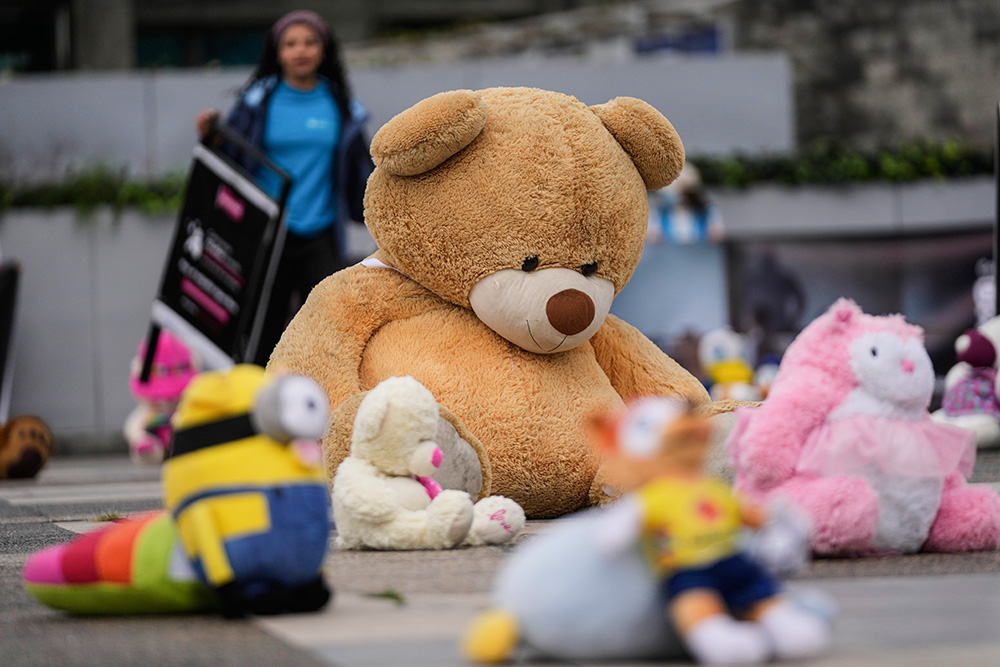
Toys are displayed outside the prosecutor's office in a symbolic act seeking to draw the attention to child sexual abuse in Bogotá, Colombia, Nov. 20, 2025. (AP/Fernando Vergara)

by JoAnn Stevelos
Join the Conversation
Send your thoughts to Letters to the Editor. Learn more
Growing up, I didn't know I was living inside a persistent but largely silent epidemic. Like most children who experience clergy sexual abuse, I thought what was happening belonged only to me. The secrecy, shame and confusion felt deeply personal.
After two decades working in public health, I learned to widen the lens. I came to understand what happened to me not only as a crime and an institutional failure, but as part of a much larger public health problem extending far beyond the Catholic Church into families, schools, sports, youth organizations, and communities around the world.
The Centers for Disease Control and Prevention estimates that about one in four girls and one in 20 boys in the United States experience child sexual abuse, and that approximately 90% of children who are sexually abused are harmed by someone they know and trust. The lifetime economic burden of child sexual abuse in the United States has been estimated at more than $9.3 billion. Globally, the World Health Organization estimates that one in five women and one in seven men report having been sexually abused as a child.
The Catholic Church, which serves 1.4 billion Catholics worldwide, has spent decades developing policies to address and prevent child sexual abuse. The church has invested significantly in prevention. Programs such as Virtus train clergy, employees, volunteers, parents and children to recognize grooming behaviors, establish healthy boundaries, report concerns, and create safer environments. These efforts represent an important foundation.
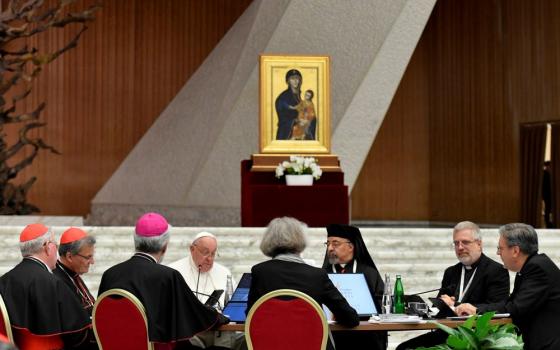
In June, the Pontifical Commission for the Protection of Minors' new statutes were released under Pope Leo XIV. As I read them, I found myself asking what a public health perspective might add to its work. What I learned was that it reaffirmed its commitment to listening to survivors, strengthening safeguarding, advancing zero-tolerance policies, improving reporting systems, and expanding accountability. It also emphasized that survivor experience should continue to shape policy and practice.
These are important developments, but from a public health perspective, implementing prevention is only the beginning.
Public health asks whether prevention efforts are reaching the people they are intended to serve and achieving their intended outcomes. Are children disclosing earlier? Are adults recognizing grooming sooner? Which strategies work best? Which strategies need to be strengthened? How should they be adapted across different cultures and communities? How do we continually improve as new evidence emerges? What opportunities exist for community-based participatory research so that survivors, families, faith communities, and local organizations become partners in developing and evaluating prevention strategies?
This shift toward prevention is also gaining momentum beyond the church. The bipartisan PREVENT Act was recently introduced in the U.S. Senate. If passed, the act would strengthen and expand the Centers for Disease Control and Prevention's national child sexual abuse prevention program, increasing federal investment in prevention research, data collection and evidence-based strategies. It reflects a growing recognition that child sexual abuse is not only a criminal justice issue or a pastoral concern, it is a preventable public health priority.
The pontifical commission has assembled expertise in safeguarding, child protection, mental health, theology, canon law, and survivor advocacy. As its prevention efforts mature, public health, implementation science and prevention research could help evaluate outcomes and strengthen what works.
The commission has made meaningful progress by placing survivors at the center of its work. That is an important and necessary shift. Public health also asks who may be missing from our understanding of the problem. Who isn't being heard? Who never disclosed? Who died before telling their story? Who left the church decades ago? Who remains too traumatized, too ashamed or too fearful to participate? The voices we hear are indispensable, but they are not the whole population.
Advertisement
The public health response to HIV demonstrated that epidemics cannot be controlled through prevention and treatment alone. They require surveillance, education, community engagement, evidence-based prevention, and continual adaptation as evidence evolves. People living with HIV became partners in research, policy, education and prevention.
Child sexual abuse prevention, treatment and mitigation deserve the same public health discipline: prevention that continually asks who remains unseen and how interventions can be improved.
The church has already begun adopting evidence-informed prevention practices. Public health invites it to complete the cycle: implement, evaluate, improve and share what works.
Effective prevention begins with understanding the problem accurately. Public health also begins with precision. Researchers, survivors and advocates continue to debate the language we use to describe these crimes. "Child sexual abuse" remains the accepted umbrella term in public health, but some survivors and scholars argue that it can obscure the reality that many children experienced crimes more precisely described as rape or sexual assault.
Their concern is not merely semantic. In public health, medicine and law, the way we define a problem shapes how we measure it, research it, communicate it, respond to it legally, and ultimately how we prevent it.
Where would we be today if, at the start of the HIV epidemic, we had referred to AIDS simply as "an immune disorder"? Public health depends on naming problems accurately because language shapes surveillance, research, prevention and public understanding.
Once a problem is clearly defined, the next question becomes: Who has the capacity to help prevent it?
The church has learned to think theologically, legally and pastorally about child sexual abuse.
No other institution has quite the reach of the Catholic Church. It has built thousands of parishes, schools, hospitals and youth ministries across the world. Imagine if that infrastructure became one of the world's largest implementation networks for evidence-based child sexual abuse prevention.
Imagine dioceses partnering with public health researchers to evaluate prevention strategies. Imagine openly publishing what works and what doesn't. Imagine a global network of public health researchers continually improving based on evidence rather than assuming today's policies will always be enough. Imagine schools, sports organizations, youth programs, and other faith communities learning alongside the church.
The church's greatest contribution may be helping to scale evidence-based child sexual abuse prevention through its global infrastructure. It has an opportunity to apply the same imagination it has devoted to education, healthcare and service for centuries to scaling the prevention, treatment and mitigation of child sexual abuse.
I often wonder what my childhood might have looked like if someone had been asking the kinds of questions public health could ask today. When I was 8 years old, my mother learned beyond any doubt that the man she loved, a Catholic priest who lived publicly as clergy and privately as our father, was sexually abusing her five children. Years later, during our Child Victims Act case against the Roman Catholic Diocese of Albany, New York, Fr. Thomas Doyle, one of the world's foremost experts on clergy sexual abuse, reviewed our case and concluded that, among the thousands he had examined over his career, ours was one of the worst.
So much harm has already been done that could have been prevented. The church can help build systems that make it less likely to happen again. Safeguarding policies matter. Accountability matters. But the truest measure of success is prevention: the number of children who never need to tell a story like mine.