(Unsplash/Dimitri Kolpakov)

by Daniel P. Horan
Join the Conversation
Send your thoughts to Letters to the Editor. Learn more
One of the most frequent courses I teach to undergraduates is "Philosophy of Religion." This class focuses on key problems, questions, challenges and insights related to religious thought and examined from philosophical perspectives across the centuries. I inform the students from the outset that, while I teach many theology courses, this is not one of them. It is designed for us to consider the complexity of religious themes beginning from human reason rather than starting with the presuppositions of confessional faith. One does not have to be a religious believer to interrogate religious questions, and both students who are and are not religious adherents find themselves diving deeply into meaningful lines of inquiry and learning.
While there are lots of ways to organize a philosophy of religion course, I have long structured the class into four units: the concept and existence of God; faith and reason; the problem of evil; and death and the afterlife. Almost from the outset when we begin exploring how philosophers have proposed a range of concepts for God and attempted to prove the existence of God through reason, many students find an inherent tension when they attempt to hold fast to the classical divine attributes (for example, that God is omnipotent or "all powerful," or omniscient or "all knowing") and other dimensions of life they hold to be true, such as human freedom and free will or God's absolute goodness.
If God knows everything, including outcomes and decisions that have yet to be made, then how can we seriously say that we truly have and exercise free will? What does it mean to say that "God has a plan," as many of my students insist, often repeating the phrase they were regularly told growing up, and yet acknowledge the proliferation of what the late Christian philosopher Marilyn McCord Adams would call "horrendous evils" that plague our world?
Is it part of God's "plan" that at least 156 civilians — 120 of whom were children — were killed in the U.S. bombing of a school in southern Iran earlier this year? Or is it part of God's "plan" that babies die of malnutrition every day or that young parents are diagnosed with cancer or that global climate change threatens all life on this planet?
These and many questions like them challenge us to think more deeply about our religious language, convictions and narratives. As a Catholic theologian and professor of philosophy, I am a stalwart believer in the God of Jesus Christ. But that belief, I sometimes tell my students, does not mean that I shut off my critical thinking skills and merely repeat religious platitudes that are, minimally, intellectually problematic and at times pastorally harmful. It means that, as a Catholic who believes in the importance and compatibility of faith and reason, I have a responsibility to think deeply and engage humbly with these consequential questions and the centuries of thinkers who engaged them before us.
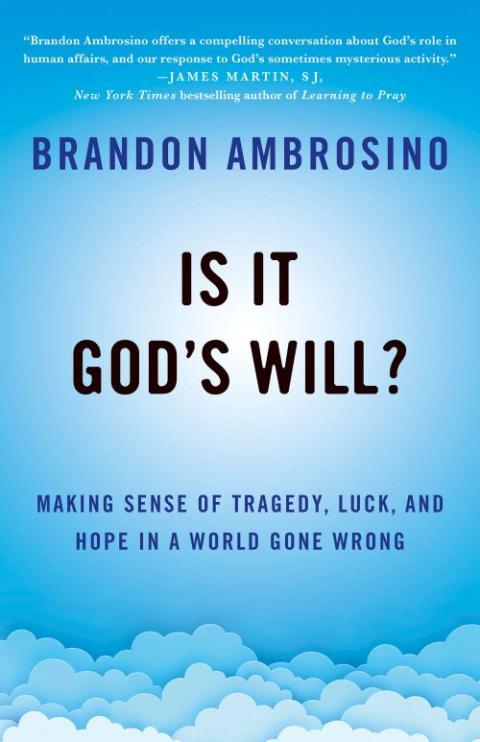
"Is It God's Will? Making Sense of Tragedy, Luck, and Hope in a World Gone Wrong" by Brandon Ambrosino
I recently read Brandon Ambrosino's book titled Is It God's Will? Making Sense of Tragedy, Luck, and Hope in a World Gone Wrong, in which he engages in many of these same questions. Ambrosino, who teaches theology at Villanova University and is an online columnist for The Christian Century, writes in a thoughtful, accessible and, at times, humorous style that introduces these kinds of questions and resources to the general public.
I enjoyed his book and wanted to talk with Ambrosino about it and his thoughts about the coherency of religious belief in today's world, and so I was happy that he agreed to an interview.
Horan: You open your book with several illustrations of how "the world seems to have gone very wrong recently" and unpack how these events challenge some classic religious beliefs, especially about God. When did you first find yourself drawn to these sorts of tensions and questions? How do you find yourself resolving them in your own faith and intellectual journeys?
Ambrosino: I've experienced my fair share of tragedies throughout my life, but there was one terrible going-wrong that happened just before I started writing this book. Our sweet 44-year-old friend dropped dead of a heart attack, leaving behind a beautiful wife and two kids, our godchildren. I found myself wondering where God was, accusing God of failing Carl, feeling let down once again by the all-powerful deity I grew up counting on. But the more I cried and raged, the more I found myself saturated by God's presence. The more I suffered, the more I discovered God suffering with me. God is near to the brokenhearted, especially when they're orphans and widows, as my friend and goddaughters now are. In my book, I think with the theological imagination of Psalm 82, which narrates in mythical form the emergence of monotheism. God becomes "The One God" by out-loving all the other gods in the pantheon, which he does simply by loving the overlooked. In Jesus, we see how costly this love can sometimes be. That's where I come down in response to your question: the dead body of Jesus. I can't point to any answers to explain away tragedy, but I can point to a cross, to the place where God falls silent and allows himself to undergo a fate as shocking and cruel as Carl's.
What do you think most people get wrong or misunderstand about Christian theology? Why is that the case and what do you propose as a corrective?
It's probably because of the outsized influence of American evangelicalism on Christianity in the West, but a lot of Christian theology has been reduced to apologetics. Many public-facing Christians believe their job is to defend doctrine in an age of secularization, moral relativism, postmodernism or whichever term they use to mean "not as Christian as I think it was back then." As John Caputo, one of my mentors, says, "There is an event that happens in the name of God." The event, however, is not reducible to the name.
My earliest theological education was at Liberty University, where I was taught that theology was essentially gatekeeping; theologians, I believed, were the guardians of orthodoxy, of God's truth, and since God is his truth, we were guardians of God himself. But God does not to be defended; as C.S. Lewis imaginatively writes of Aslan, he's not a tame lion. God does what God does, and my vocation as a theologian is to critically reflect on those doings as I and others experience and talk about them. But I also have a responsibility to avoid idolatry, and the first step of avoiding it is to realize that the event that happens in the name of God will never be contained in my or anyone's theologies.
Early in your book, you introduce the metaphor of "doing theology in the basement." What does that mean to you? And what does it look like to do theology in this context?
The basement is the place where we ask the uncomfortable questions that we can't ask upstairs. This image came from a Christian Century article I wrote where I talked about laying out systematic theological arguments as if I were ascending a staircase. President Trump had just been shot in Butler, Pa, and a lot of my evangelical friends were posting on social media that God had saved his life. That made me very uncomfortable. So, I took the premise into the basement. If the premise is that God can intervene to stop bullets, then I wanted to know why he doesn't use that magic trick to prevent school shootings? This is where Christians might say, "Well, God's ways are unknowable." But, sorry, friend, you just claimed to know God's ways when you said you knew he intervened to keep the president alive. I don't mean to sound like I'm trying to catch anyone in a trap. I have a lot of empathy for folks who do theology this way. The world feels less scary if we believe someone's calling all the shots. But I'm not sure that the goal of Christian theology should be to quickly zap away all of our fears. Read the Resurrection accounts in the Synoptics: even in the dawn of God's new world, there’s a fear of the unknown. But — and this is the part we can't forget — even in a basement, even in a tomb, even in Hell, God is with us, God is for us, and God is not afraid.
Advertisement
In your chapter on the cross and Resurrection, you raise strong objections to classic atonement theories, which I also find objectionable in most cases. What would you say to those Christians who hold firmly to such sin-centered and violent concepts of the death of Jesus?
If sin is the failure to bother to love, as [Jesuit] Fr. James Keenan says, then it is sin that killed Jesus. Our sin — our individual and corporate failures of love. That's why our tradition says Christ died for our sins in accordance with the Scriptures. We all have access to the news and history books: Humans do bad things, we've always done bad things, and one of those bad things was to murder Jesus. On a Roman cross, Jesus bears the weight of the world's failure to love.
The important theological question is this: What exactly was God's relationship with the murdered Jesus? Or put differently, what about Jesus' death gave God the opportunity to overcome the world's failures of love? Paul says God was in Christ reconciling the world to himself while he bled out as a criminal; this is where our atonement theologies need to begin. Whatever God was doing, he was doing it while united to, while at-one with the Son, and at-one with the world that the Son sums up and offers to God in obedience and worship. God was not punishing Jesus. Jesus was not paying a debt to God. These are some of the theopoetic images and metaphors our tradition offers us as it invites us to try and comprehend the incomprehensible.
But transpose it into Caputo's formula: There is an event that happens in the name of the crucifixion. That event is not reducible to our ways of talking about it. The important thing to say about it is that in the event of Jesus' death and resurrection, all the powers of darkness and violence are unmasked and seen as the sham that they are. In the cross, God has spoken an irrevocable NO to violence — including violent atonement theologies. We need to resist them, reframe them and move beyond them. Because every time we demand our God to be a bloodthirsty, thuggish mastermind, we once again fail to love Jesus the way he should be loved.
To those readers who are not familiar with the work of postmodern philosophers and theologians, how do you explain theopoetics? What is the relationship between theopoetics and hope for you?
My version is slightly different than Caputo's, but one way of looking at it is to say that theopoetics dispenses with the logos of theology, thereby draining the gravity and self-certainty from the entire theo-logical enterprise. Theopoetics emphasizes the process, as opposed to the outcome, of theological reflection. Theopoetics also blurs the line between theology and literature. To go back to Psalm 82, the theological concept imaginatively explored in these eight verses is that God comes to be as he takes loving responsibility for the world. There are countless books and essays explaining systematically what it means to call God love, but none of them comes close to the theological genius of Psalm 82.
Rosemary Haughton wrote that poetry is "the most accurate way in which some inkling of an incommunicable experience can be communicated," which is why she believed theology is "the poetry of a holy people." When we are reflecting on God, we are making poetry: we are digging down into the concrete everydayness of life and, as [Carl] Sandburg writes, searching for "syllables to shoot at the barriers of the unknown and the unknowable." That the unknown should make himself not only known but approachable is the primary mystery of Christian theopoetics. Not that we approach God of our own initiative: We are provoked to hear and speak God. We are provoked, in this midst of a situation of hopelessness, to hope, and God is the name we assign to this provocation. Theopoetics is the kind of imaginative reflection that, to me, is best suited to explore these feelings of provocation
In the later chapters in the book, you introduce the concept of "camp." Can you give us the "elevator pitch" summary of how you understand "camp theology"? You have another book coming out later this year title, Laughing in a Tomb: An Experiment in Camp Theology (Fortress Press). What can we look forward to with that publication?
Christopher Isherwood says that when we camp, we make fun out of seriousness. Susan Sontag is getting at something similar when she says, "The whole point of camp is to dethrone the serious." When we camp, we establish a new, a different, more productive, more liberating relationship to the serious. We take it seriously, but we don't let it take us.
Camp emerges in gay men, especially at historical moments of suffering and marginalization, like the pre-Stonewall era and the AIDS crisis. What's remarkable is that from these moments in time, we can hear what Jacqueline Bussie calls "the laughter of the oppressed" — folks who found a way to throw their suffering in quotation marks, as David Halperin puts it. The first anthropologist to study camp was Esther Newton, who wrote that she was dumbfounded by campy drag queens' tendency to laugh at situations that she found horrifying and tragic. What were my ancestors up to when they were laughing at what mainstream society deemed horrifying? Camp. To modify a line from [Paul] Tillich, camp is the courage to laugh, a courage which is rooted in the God who appears when God disappears in the anxiety of seriousness. The first step of camping it up is to throw your suffering in quotation marks to remind yourself that there's something more going on. On Easter Sunday, God throws quotation marks around the cross of Christ and invites a new world to listen for his beloved's out-of-place laughter — and to join in.