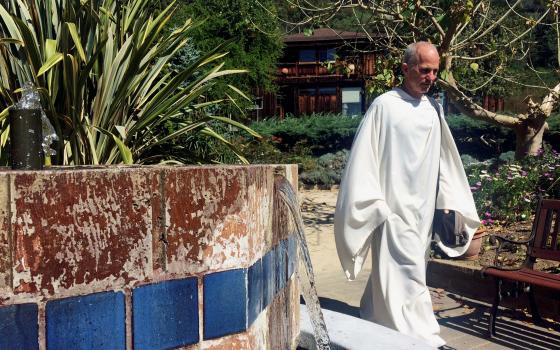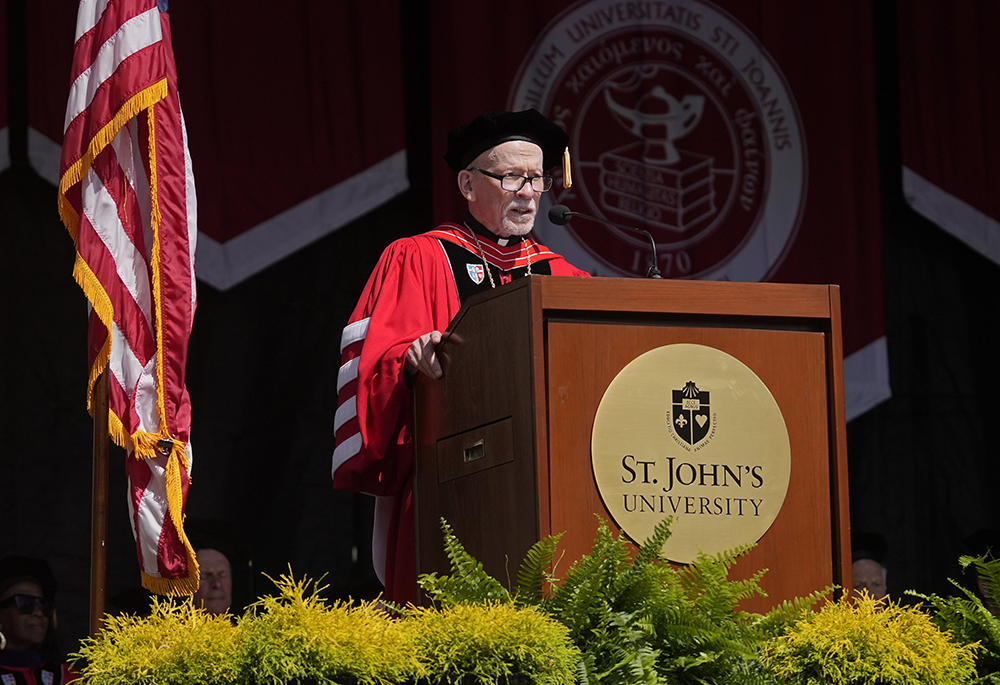
Dominican Fr. Brian J. Shanley, president of St. John's University, addresses graduating students during commencement ceremonies May 17, 2026, at the Vincentian school's campus in the Jamaica section of the New York borough of Queens. (OSV News/Gregory A. Shemitz)

by John Waters
Join the Conversation
Send your thoughts to Letters to the Editor. Learn more
In 1965, St. John's University erupted into a crisis that would engulf the university and captivate higher education for the next five years. Against the turbulent background of the Civil Rights Movement, a rapidly changing student body, and vast changes introduced to the Catholic Church by Vatican II, the faculty at St. John's, who were among the lowest paid in the country, dared to demand more of their institution.
Two hundred faculty walked out in protest after a faculty meeting in March 1965. In response to further agitation for better working conditions, the university leadership fired 21 full-time faculty without due process and dropped the contracts of 10 others. A strike by faculty ensued. The controversy put the university at the center of debates about academic freedom, labor rights and shared governance. What was ultimately born were two faculty unions, 50 years of good-faith bargaining, a thriving university, and a transformed landscape of higher ed.
Ancient history? Unfortunately not. This past spring, the university president, Dominican Fr. Brian Shanley summarily withdrew recognition of these same two faculty unions. Only one reason was given, couched in vague corporate-speak: "flexibility." This gets at the heart of the matter. Shanley has adopted a managerial approach taken from the corporate playbook and culture of Big Tech and most famously put by Mark Zuckerberg as: "Move fast and break things." Collective bargaining was portrayed as a barrier to the university's attempt to move forward. Vast changes to departments, curricula and faculty governance began to happen at breakneck speed. In the same month that the faculty union was derecognized, the administration targeted 18 programs for elimination, including chemistry, physics and foreign languages. They have unilaterally replaced the legally bargained collective bargaining agreement with a previously nonexistent "Faculty Handbook draft," revised the University Statutes, and left important faculty workloads and compensation for program work in confusion for the Fall 2026 semester, which begins in less than a month.
These unilateral changes are substantial, damaging and fundamentally disrespectful to faculty's ability to ensure the quality of the education provided to the students we serve. In addition, an unknown number of staff members and administrators were unceremoniously laid off in late July, and then escorted to their cars by Public Safety officers.
This reckless behavior is a betrayal of the University's Vincentian mission and does nothing to strengthen St John's. When you see your faculty as a barrier to student success, it may be time to reconsider who your corporate role models are. As the great Catholic thinker G.K. Chesterton put it: When you come across a fence and you don't understand why it is there, you don't just remove it. You try to understand its function and the history behind it. Derecognition of long-established unions should be seen for what it is, a naive assertion of power, dissenting voices be damned. The well-documented history of labor strife at St John's? Not a factor, and who remembers what happened back then anyway?
I do. My father, a graduate of St. John's College and St. John's Law School and an assistant professor in the College of Business, was an active member of the founding cohort of the American Association of University Professors chapter that Shanley wishes were gone and seems to know nothing about. My father was one of a generation of post-Vatican II Catholics who saw the rights of workers to bargain collectively as a direct expression of their Catholic values and perfectly aligned with Catholic social teaching. Their idealism and organizing helped elevate the reputation of St John's and integrated the faculty into a modern governance structure.
Advertisement
Although the strike was unsuccessful at getting the dismissed faculty reinstated, the board eventually came to recognize the essential role faculty played at the university, and shared governance took root through a rigorous and equitable process of collective bargaining that has been part of the culture of the university ever since. Presidents come and go, but it was faculty organizing that gave birth to the unions that continue to strengthen Catholic education across the country. Unfortunately, once again, faculty governance and academic freedom are being threatened at St John's in a time where higher ed is under attack all around us.
But if Catholic values are not enough for Shanley and the board to keep faith with their faculty, strategic thinking should be. As the leadership at New York University, where I teach, recently learned, New York is still a union town. The corporate "flexibility" that allowed NYU administration to hire hundreds of faculty outside the tenure system led to a two-tiered system, a long campaign to organize a union, and a faculty strike in March. We were reluctant to strike, but when we did, Teamsters and other labor unions honored our picket line, disrupting basic university functions; elected officials walked beside us and, most importantly, so did our students. They recognized the basic truth that Shanley and the board want to deny: Faculty working conditions are student learning conditions.
It's not too late for the leadership at St. John's to do the right thing, to heed the lessons of the past and stop breaking things, and, most importantly, to adhere to its professed Catholic values. In other words, it's not too late to go back to the bargaining table.