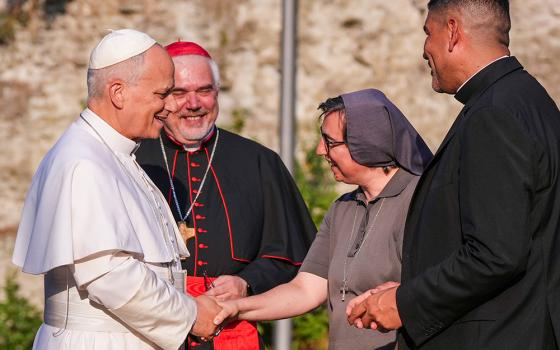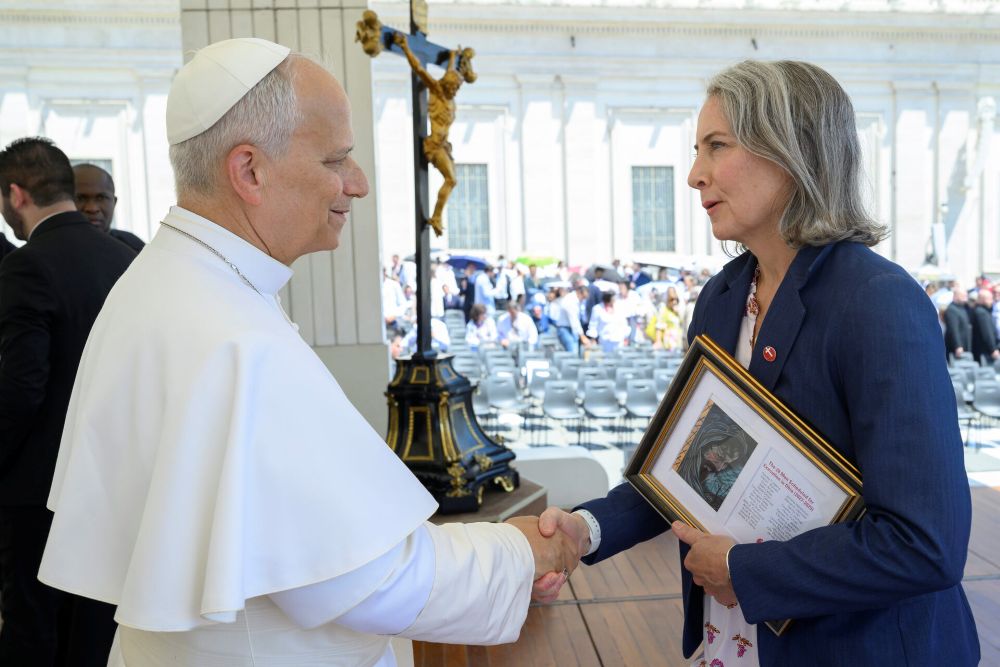
Krisanne Vaillancourt Murphy meets Pope Leo XIV on June 17, 2026, and gives him a framed drawing from a man on Ohio's death row with 28 names of men who have scheduled execution dates. (Courtesy of Vatican Media)

by Krisanne Vaillancourt Murphy
Join the Conversation
Send your thoughts to Letters to the Editor. Learn more
It is an intense and distressing time for those of us fighting against the death penalty in the United States. With eight executions scheduled in September, it is regrettably the most active executing month this country has seen in 15 years.
Last year there were 47 executions — the most in a decade — and we are already up to 24 in 2026.
In the face of such death there is an urgent need for strong, moral voices to demand a stop to the immoral practice of state-stanctioned homicide.
Our Catholic faith calls each one of us to be that voice. And thankfully we have leaders setting prophetic examples.
Starting at the top, Pope Leo XIV has put it succinctly: "Someone who says, 'I'm against abortion' but says, 'I'm in favor of the death penalty,' is not really pro-life."
Following in the footsteps of his three predecessors, he has asserted that the dignity of the person is not lost even after very serious crimes are committed.
Here at home, I am in awe at the bold, incredible actions of the Florida Catholic bishops. Horrifyingly, their state accounted for 40% of executions in 2025 and this year has already executed more than all other states combined.
Individually and collectively, the responses of the Florida bishops have been poignant.
When Florida killed two men in one day, Bishop William Wack of Pensacola-Tallahassee held vigil the entire day in front of the prison. Archbishop Thomas Wenski of Miami has publicly condemned the execution rampage and next week will speak with my organization, Catholic Mobilizing Network, on "Does Every Life Really Mean Every Life?"
In July, the Florida bishops unanimously issued with a compelling pastoral letter on the death penalty:
We do work with determination for its abolition, and we urge all Catholics, and our fellow citizens of good will, to end the practice of capital punishment in our state. [We implore] God that the ethic of human dignity will infuse every element of society with respect for persons — from the most innocent unborn child to convicted felons — through people of faith transformed by the Gospel message of Christ's love and life.
Education and inspiration is the leadership Catholics in the pews need. It is devastating that Florida's Republican Gov. Ron DeSantis has chosen to willfully defy church teaching as well as ignore the bishops' repeated calls for him to stay executions and commute sentences.
Catholics in political leadership must also embrace a consistent ethic of life and act accordingly.
The example of South Dakota State Republican Rep. Tim Reisch and his bill to repeal the death penalty in his state proves that it is never too late to change one's view on this issue.
At the age of 68, after a long career in corrections, Reisch heard the Holy Father and realized that, "In order to be pro-life, as my faith instructs us to be, life needs to be from conception to natural death of everyone."
More pro-life champions like this need to rise from the ranks.
We've also seen this change in Ohio's Republican Gov. Mike DeWine. He went from being a state legislator who co-wrote the bill to reinstate Ohio's death penalty to a governor who has postponed every execution while in office.
Then in June, DeWine publicly announced his belief that Ohio should abolish the death penalty. Deterrence, he said, "was the moral justification for having a death penalty. … I no longer believe the death penalty is a deterrent to murder."
Praise God for this transformation and for his courageous leadership. But there is one more crucial action DeWine must take: Grant clemency to all 114 people on Ohio's death row.
By changing their sentences, he would give them a tangible sign of hope and a chance for rehabilitation — for the 28 men whose names I presented to the Holy Father in June, DeWine is their last hope. They have exhausted their appeals and their deaths would be imminent if the next governor of Ohio decides to restart executions in the state.
Advertisement
DeWine is not alone in this opportunity. California Gov. Gavin Newsom and Kansas Gov. Laura Kelly, both Democrats, are also in the final months of their terms. They, too, can and should use their executive authority to spare the lives of those on death row in their respective states.
It was fantastic when early in his tenure Newsom put a moratorium on executions and dismantled California's death chamber. But now it's the time for Newsom to take the next step. At almost 600 people, California's death row population is still larger than that of any other state and even most countries. By using his executive authority to grant universal clemency, Newsom could create the largest commutation in history.
As Pope Leo has reminded us, "The dignity of the person is not lost even after very serious crimes are committed." With the power of universal clemency, Govs. DeWine, Newsom and Kelly are in the unique position to exercise their leadership in a way that publicly upholds the dignity of all human life.
Justice can be rooted in mercy and restoration instead of vengeance and death.
Pro-life champions are needed at all levels and, let's face it, most of us aren't church clerics or elected politicians. Nevertheless, we too can take meaningful steps to respect every life.
Indeed, it is time for Catholics and people of good will to stand up.
One way could be to sign Catholic Mobilizing Network's urgent petitions to these departing governors, urging them to do what is right, possible and in their power.
And we can pray — fervently and without ceasing. Join me in a novena to end the death penalty, as we pray that the United States will soon discard this violent practice and create in its place a restorative kind of justice that honors the human dignity of all.
Editor's Note: This story has been revised at the author's request to replace references to Pope Leo XIV as "Leo" with either "Holy Father" or "Pope Leo."