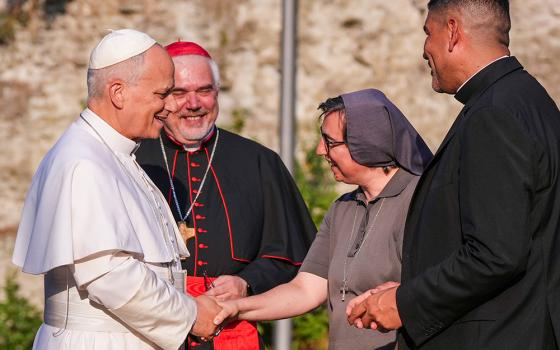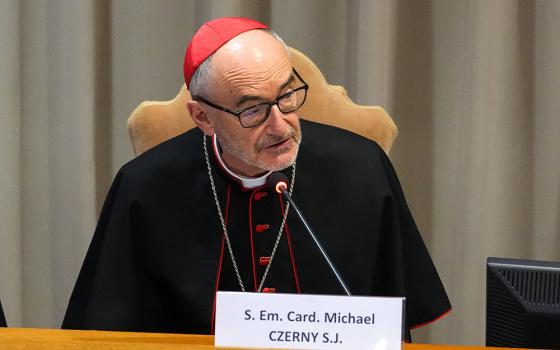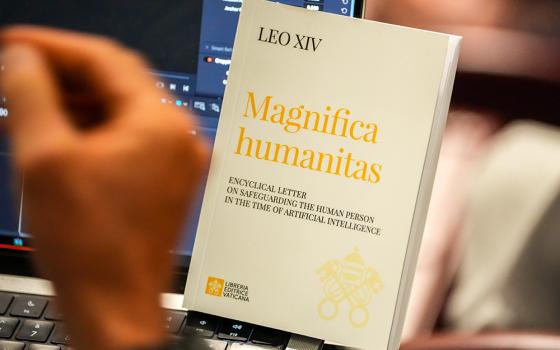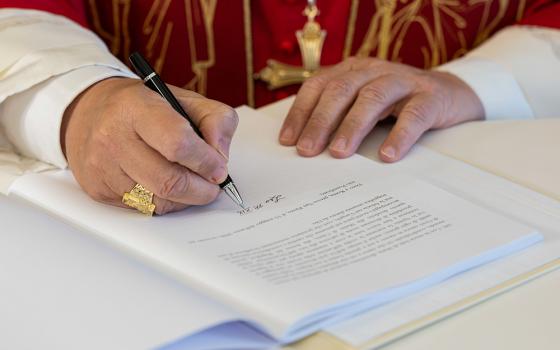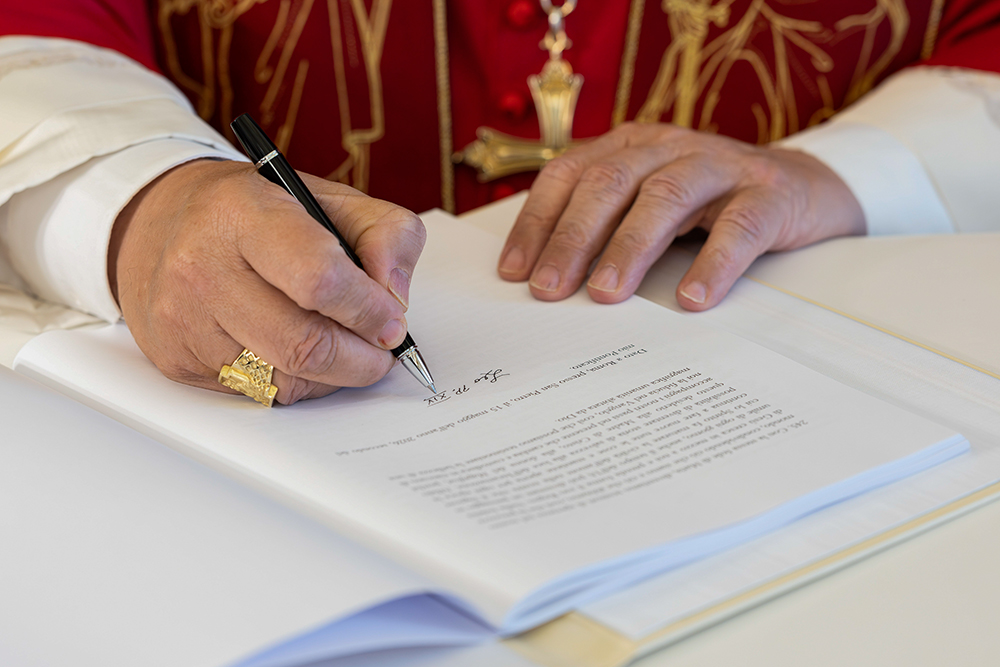
Pope Leo XIV signs Magnifica Humanitas at the Vatican's Synod Hall May 15, 2026. (OSV News/Vatican Media/Simone Risoluti)

by Bruno S. Sergi
Join the Conversation
Send your thoughts to Letters to the Editor. Learn more
Despite teasing a visit in the "next couple of years," Pope Leo XIV has yet to make his first papal visit to the United States. But he has already entered one of America's most consequential debates: artificial intelligence. In his first encyclical, Magnifica Humanitas, published May 25, the pope delivers a direct message to Washington policymakers, Silicon Valley executives and technology developers: No AI system, regardless of its capabilities, can replace human responsibility.
As artificial intelligence increasingly shapes warfare, hiring, healthcare, finance, education and public services, Leo raises a question at the center of the AI revolution: When it causes harm, who remains accountable? His answer is unequivocal. Responsibility cannot be delegated to machines.
The warning appears in Magnifica Humanitas, a document intentionally signed on May 15, the anniversary of a landmark papal letter that addressed the societal upheaval of the Industrial Revolution. By drawing this historical parallel, Leo suggests that artificial intelligence represents a transformation comparable to the rise of factories and mechanized industry, with profound consequences for human dignity, work and social responsibility.
The comparison is striking. More than a century ago, in Rerum Novarum, Pope Leo XIII confronted the challenges created by industrialization and rapid economic change. Today, Pope Leo XIV addresses a new technological revolution, one driven by algorithms, automation and increasingly powerful AI systems.
At the center of Magnifica Humanitas is a striking biblical contrast. In the encyclical, Leo XIV contrasts two biblical building projects. One is the Tower of Babel, a symbol of human ambition without limits. The other is the rebuilding of Jerusalem's walls, where people work together and take responsibility for specific tasks.
For Leo, the key question is whether technology promotes human flourishing or evades human responsibility. That distinction matters because the dominant conversation around AI largely revolves around speed, efficiency, economic growth, and geopolitical competition. Governments race for technological advantage. Investors celebrate scale. Companies compete to build more powerful models.
Lost amid the excitement is the most basic question of all: When AI causes harm, who is accountable?
Advertisement
The problem becomes most glaring when we look at warfare. Militaries worldwide are increasingly investing in systems that can autonomously identify, track and select targets. Proponents of these technologies argue that they can process information more rapidly than humans, potentially reducing certain types of errors.
However, no matter how much faster these systems operate, they do not absolve anyone of moral responsibility. If an autonomous weapon system inadvertently kills civilians, accountability cannot fall on the software alone. It is ultimately the designers, those who approved its deployment, and the authorities who authorized its use that bear the responsibility.
The same concern is emerging throughout civilian life. AI systems increasingly influence hiring decisions, loan approvals, medical assessments, educational opportunities, and access to public services. Yet the more complex these systems become, the harder it becomes for institutions to explain how particular outcomes were reached. When crucial decisions become opaque, accountability becomes easier to evade.
Leo has consistently emphasized a principle that bears repeating: Machines can assist human judgment, but they must never replace it in decisions that affect human lives and dignity. Put more simply, AI can help people make decisions. It cannot assume responsibility for them.
Leo argues that AI is not an autonomous force; it mirrors the values and decisions of its human creators. As advanced AI becomes concentrated among a few tech giants and governments, it raises significant ethical concerns. The key challenge is ensuring that those in power remain accountable for the consequences of their AI systems. Leo is not proposing a detailed regulatory framework, but a more fundamental claim about accountability that must always lead back to a human being.
That is why the pope's message needs to be heard in Silicon Valley as well as in Washington. Before he even arrives in the United States, he has already established the terms of the debate. The central question is whether the U.S. will develop AI with little regard for responsibility or whether accountability will be an essential component of AI innovation.
Leo's biblical vision presents a choice between unchecked ambition and a community where each person answers for their actions. If AI becomes one of the defining technologies of the century, as I believe it will, the path Silicon Valley takes will have far-reaching consequences.