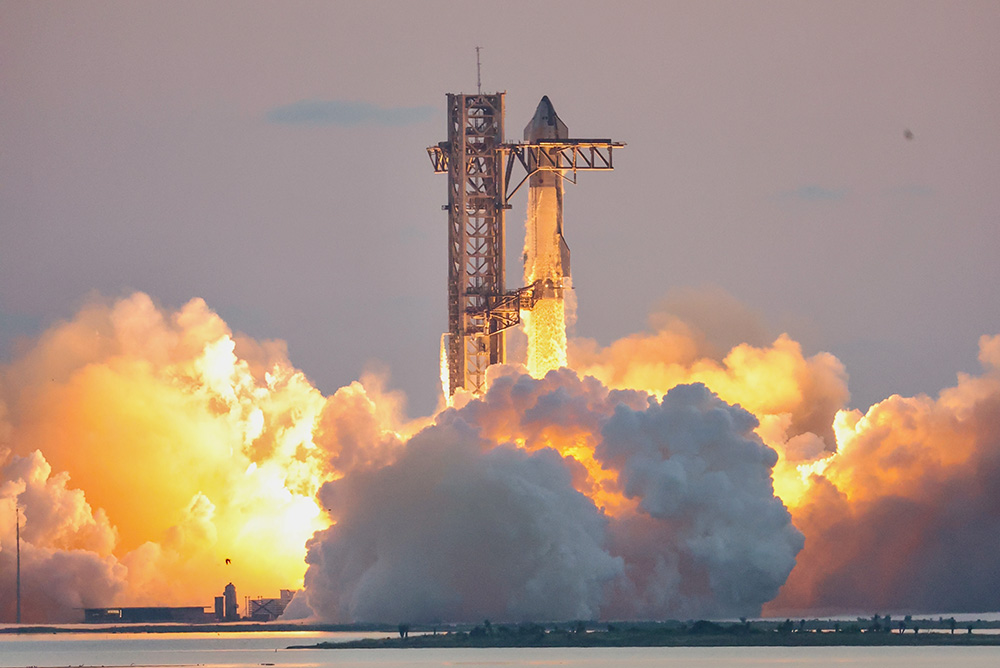
SpaceX's Starship lifts off for its fifth integrated flight test Oct. 13, 2024. (Wikimedia Commons/Steve Jurvetson)

by Scott Hurd
Join the Conversation
Send your thoughts to Letters to the Editor. Learn more
There's been plenty of talk about aliens this past year, thanks to the Pentagon's releasing files about UFOs. That excited a lot of people, because the possibility of UFOs suggests that aliens have come to Earth.
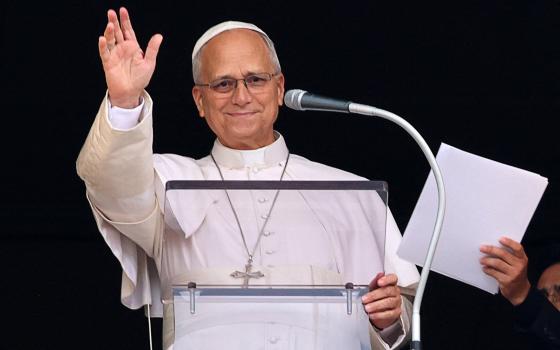
For his part, Pope Leo XIV has said nothing publicly about aliens visiting us on our planet. What he has said, however, has important implications for our visiting aliens on theirs. And given the new space race that's underway, his timing couldn't be better.
Now, you might dismiss talk of aliens as a lot of sci-fi nonsense. Fair enough. But what you may not know is that you probably have already agreed to "recognize Mars as a free planet and that no earth-based government has authority or sovereignty over Martian activities."
What? Yes, that's a direct quote from the user terms of Elon Musk's Starlink satellite Wi-Fi network you likely accepted on your last plane trip. Surprise!
To be fair, that agreement applies only to "services provided on Mars via Starship or other spacecraft." However, what is the name of Musk's new SpaceX rocket ships? You guessed it: Starship. They're already being launched into space. And that might be cause for alarm, given Musk's money, power and dreams.
Leo himself expressed concern about Musk's becoming the world's first trillionaire. "What does that mean, and what's that about?" he wondered in an interview. The slogan on the T-shirt Musk has sometimes worn hints at an answer: "Occupy Mars!"
Occupying Mars has been a primary goal of SpaceX since its inception. At its initial public offering to investors, Musk reiterated that SpaceX seeks to transport people to the moon, Mars, and maybe even beyond our solar system. And his executive pay is tied to his establishing a permanent city on the Red Planet.
Martian cities are unlikely any time soon. But their possibility should be taken seriously now, to prevent outer space from becoming a new frontier for corporate greed, cosmic colonialism or even a combat zone. Because Musk may already be seeking to corner the galactic market with his Starlink user agreement.
Its insistence that no earthly government has sway over Mars is tantamount to Musk saying: "When I get to Mars, I'll do whatever I want." As authors Naomi Klein and Astra Taylor ask in End Times Fascism and the Fight for the Living World, "Has [Musk] already quietly laid corporate claim to outer space and everything he puts there? Can he get away with it?"
Not if his primary competitor, Amazon founder Jeff Bezos, can help it. Over two decades ago, Bezos quietly founded an aerospace company, Blue Origin Enterprises. Today, Blue Origin builds rocket ships, promotes space tourism, is constructing NASA's Mars Telecommunications Network, and plans a colony on the moon.
Blue Origins' pursuits are "the most important work I'm doing," Bezos insists. And as Josh Tyrangiel wrote in his recent cover essay for The Atlantic, "Choose Your Overlord: Musk vs. Bezos," those aspirations include "creating the infrastructure for an off-world economy upon which human civilization might someday depend."
Other tech titans want in on the action too. Sam Altman, CEO of ChatGPT's parent company, OpenAI, recently sought his own rockets as a challenge to Musk. And Silicon Valley wunderkind Leopold Aschenbrenner promised to buy his wife, the chief of staff of Claude's parent company, Anthropic, an entire galaxy of her very own.
In addition to these tech bros' plans, Russia and China have goals to reach Mars and are working together to construct nuclear reactors on the moon for a space station. Not to be outdone, NASA is racing to establish its own moon base, and has invited India as a partner. India itself hopes its astronauts will reach the moon by 2040, and is collaborating with Japan on a lander and rover. The new space race is on.
Advertisement
The last space race was between the U.S. and Russia, who are still in the game today. But they and other countries now have direct competition from private interests like Musk's and Bezos' that, as Leo writes in Magnifica Humanitas, "are endowed with resources and the capacity to intervene that surpass those of many Governments."
The first space race was to simply reach the moon. The new race is about profiting from the moon by extracting its wealth. The lunar surface is rich with resources such as helium, titanium and iron that are critical for today's technologies. And its water-ice deposits could support human settlement and create fuel for rockets that, given the moon's low gravity, are easier to launch from there than from Earth.
In this quest for resources to advance technological ambitions, there's a danger of history repeating itself through the ugly specter of colonialism, which arose from competition between nations and commercial collaborators to secure what was needed for the Industrial Revolution. Colonialism ultimately helped trigger the First World War, which claimed at least 17 million lives.
Concerned by the ambitions of both governments and private companies, in 2023 a group of astronomers warned against a new "colonialism" in space that would exploit resources and cause ecological destruction. More recently, these concerns have surfaced in the media, with both the BBC and The New York Times asking the question: "Who owns the moon?"
Who does own the moon? That's an open question. The Outer Space Treaty, signed in 1967 by the United States, the Soviet Union, and a host of other nations, forbids any country from claiming sovereignty over anywhere in space. It does not, however, preclude them profiting from resources acquired there. In 2015, the U.S. passed a law allowing its national interests to do precisely that. Other nations have since followed suit.
The Vatican hasn't been silent on this. This past April, the Holy See's United Nations mission in Geneva produced a video, "Outer Space and Humanity at a Crossroads: Reflections on a New Frontier of the Common Good," which encourages strengthening the Outer Space Treaty to avoid past mistakes made on Earth, such as unbridled competition and needless deadly conflict.
But it's the encyclical published the following month, Magnifica Humanitas, that might prove most helpful in this present moment. What it says about the new "industrial revolution" unleashed by artificial intelligence can be applied to the new space race, too. Because both, in Leo's words, provide "fertile ground for new wars" and plant seeds for a future that could be "colonial in another form."
Many of the big players in AI and space, such as the U.S., China, Bezos and Musk, are one and the same. Like the race for AI, the space race needs to be "disarmed," as the encyclical puts it, from "the desire to secure geopolitical or commercial dominance." And the encyclical's call for regulations, dialogue, international cooperation, and economic justice are equally applicable to both. As is its warning about unfathomable power concentrated in a few, unaccountable hands.
What about aliens? They're still science fiction. But it's reasonable to fear they'd experience the same domination and exploitation to which humans have been subjected in the brutal quest for money and power. Magnifica Humanitas condemns as "new forms of slavery" the condition of workers who train and extract resources for AI. This "deeply challenges the moral conscience of our time." And is a warning for any future close encounters beyond our galaxy.
Thanks to the encyclical, many today look to the Catholic Church for ethical guidance and hope in a world increasingly saturated with AI. That same document can offer guidance and hope for humanity's new ventures into space. Because by asking, "What are we building?" here on Earth, it implores us to reject "a power that claims to dominate the heavens."