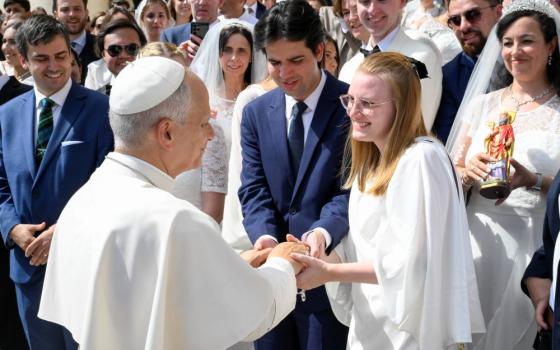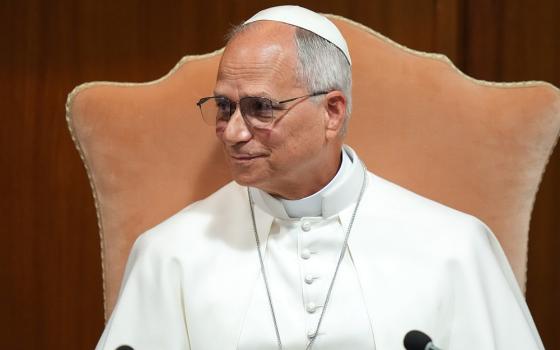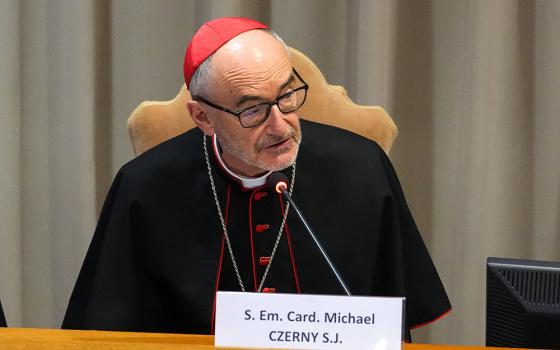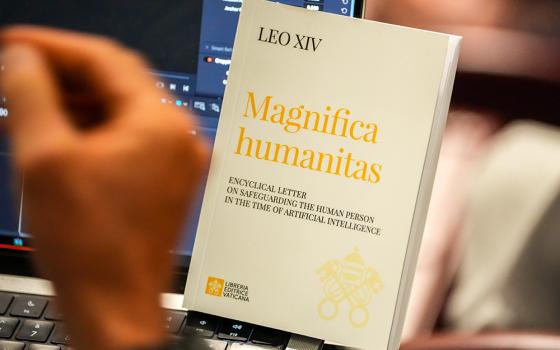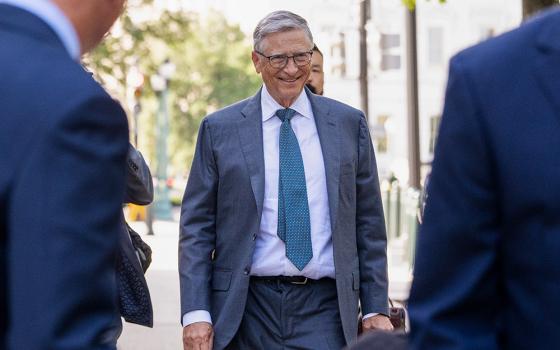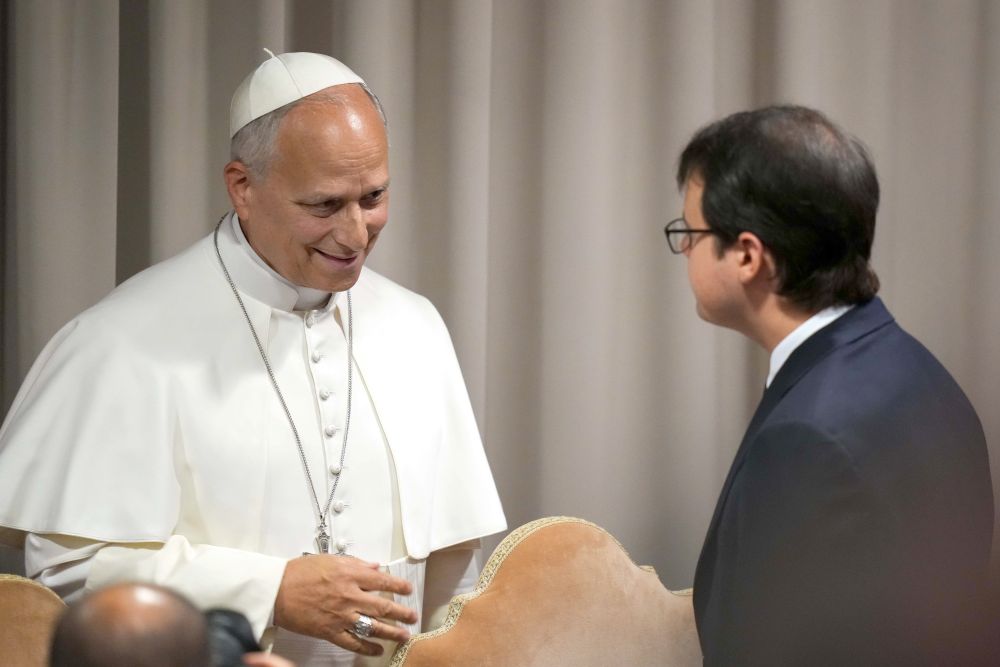
Pope Leo XIV speaks with to Christopher Olah, co-founder of the artificial intelligence company Anthropic, at the conclusion of a presentation on the pope's first encyclical, "Magnifica Humanitas: On Safeguarding the Human Person in the Time of Artificial Intelligence," at the Synod Hall at the Vatican May 25, 2026. (CNS/Lola Gomez)

by Enzo Del Brocco
Join the Conversation
Send your thoughts to Letters to the Editor. Learn more
Magnifica Humanitas opens with two biblical images: the Tower of Babel and the rebuilding of Jerusalem under Nehemiah. The contrast frames Pope Leo XIV's moral vision for the age of artificial intelligence.
Babel represents a civilization driven by concentration, self-sufficiency and technical mastery. Humanity seeks greatness through power and efficiency but loses communion along the way. Babel, Leo writes, "reveals the limits of any effort that, however grandiose, arises from self-affirmation, sacrifices human dignity for efficiency and aspires to reach heaven without God's blessing."
Jerusalem offers another possibility. After destruction and exile, the city is rebuilt not through centralized control but through shared responsibility. Families, workers, priests, artisans and civic leaders each rebuild part of the wall. Diversity is not erased but ordered toward a common purpose. Jerusalem, Leo explains, "is reborn, not through the initiative of one man, but through the shared responsibility of all." Its inhabitants rediscover "a common language — not one of uniformity, but one of communion."
Leo is proposing more than a moral framework for AI. He is offering a vision for how humanity might govern technological civilization itself. "The primary choice," he writes, "is not between a 'yes' or 'no' to technology, but rather between constructing Babel or rebuilding Jerusalem."
Leo presents synodality not simply as ecclesial governance, but as a way of seeking truth together at precisely the moment when artificial intelligence raises questions too vast, interconnected and morally consequential for any single discipline to master.
Public debates about artificial intelligence tend to revolve around familiar binaries: regulation or innovation, optimism or alarm, acceleration or restraint. Magnifica Humanitas reframes the debate. The real challenge is not whether humanity adopts powerful technologies, but whether societies can govern them without sacrificing human dignity, pluralism and democratic responsibility.
What emerges is one of the encyclical's boldest insights: The church's contribution to the AI age may not be a policy blueprint, but a practice of shared discernment. Leo presents synodality not simply as ecclesial governance, but as a way of seeking truth together at precisely the moment when artificial intelligence raises questions too vast, interconnected and morally consequential for any single discipline to master.
Engineers understand systems but not always their social consequences. Politicians regulate technologies they often struggle to comprehend. Economists measure efficiency while overlooking dignity and social cohesion. Educators witness how digital culture reshapes attention and imagination but cannot redesign technological infrastructures. Theologians defend moral anthropology yet cannot resolve technical governance questions.
Artificial intelligence exposes the limits of isolated expertise.
Leo repeatedly warns against what Pope Francis called the "technocratic paradigm." The danger of technocracy is not technology itself, but the assumption that technical expertise alone can solve human problems. Efficiency becomes mistaken for wisdom. Optimization displaces discernment. Human beings risk becoming variables to optimize rather than persons capable of shaping the common good.
Artificial intelligence intensifies this temptation dramatically. A small number of institutions increasingly mediate how people communicate, work, remember, consume information and even form political judgment. Leo observes that technological development is increasingly shaped by "private, often transnational, parties" possessing resources greater than many governments. This concentration of power begins to resemble Babel: one language, one logic, one direction.
The technocratic temptation promises efficiency but risks marginalizing the plurality that sustains democratic life.
Against this tendency, Leo offers synodality as an alternative. Pluralism, he writes, does not collapse into disorder but, "through the practice of synodality, becomes the space in which humanity rediscovers its solid foundations and its final end."
This may be one of the most consequential claims in Magnifica Humanitas, because synodality here ceases to be merely theological. It becomes epistemological.
The question is no longer simply Who governs technology? The deeper question becomes: How do societies know together?
Technocracy offers one answer: Specialists optimize systems for everyone else. Synodality offers another: communities discern together what kind of future deserves to be built.
This matters because the most important questions AI raises cannot be solved through technical calculation alone. What counts as genuinely human flourishing? How should dignity be protected amid automation? What happens to labor, education and political participation when algorithmic systems reshape social life? Who bears responsibility when technologies influence moral decisions?
Synodality becomes relevant precisely because it offers a way of holding together forms of knowledge modern societies often isolate from one another. Rather than allowing technological power to define the horizon of possibility by default, shared discernment asks what kind of future technology ought to serve.
Yet discernment requires a compass. For Leo, that compass is the inalienable dignity of the human person. From this foundation flow the core principles of Catholic social thought — the common good, the universal destination of goods, subsidiarity, solidarity and social justice. Together, these principles offer a moral horizon for judging whether technological development genuinely serves humanity rather than merely efficiency, power or profit.
The church's social doctrine, Leo argues, is "not a handbook of principles and norms to be applied, but a process of shared discernment."
In practice, this means different forms of knowledge contribute to a common good larger than any single sector can define. Scientists clarify technological risks and possibilities. Philosophers refine concepts such as intelligence, freedom and agency. Theologians defend a vision of the person grounded in dignity rather than utility. Educators prepare citizens capable of moral judgment in digital culture. Political leaders establish accountability. Civil society protects vulnerable communities from exclusion and exploitation.
Everyone rebuilds part of the wall.
Leo makes this explicit: "No one can single-handedly bear the weight of the challenges the world is facing, just as no one is so weak that they cannot play their part."
Artificial intelligence, then, cannot remain the concern of engineers, regulators or corporate executives alone. It is also a question for schools, families, religious communities, universities and democratic institutions.
Education becomes especially important. If digital technologies increasingly shape attention, truth and moral imagination, schools cannot limit themselves to technical training. They must cultivate discernment.
Yet Leo's vision is not confined to institutions or regulation. The encyclical calls for an "educational alliance" among families, schools and public institutions capable of helping young people cultivate discernment, resist manipulation and develop the habits necessary for freedom in digital environments.
Advertisement
The challenge of AI, in other words, is not only political or economic. It is also cultural and spiritual. If technologies shape habits of attention, imagination and belonging, then protecting human dignity requires rebuilding the ordinary practices through which persons learn to listen, deliberate and live in meaningful relationship with others.
Leo urges universities to "give fresh impetus" to Catholic social principles and apply them to the digital revolution. Notably, Leo acknowledges that the church cannot confront AI in isolation. Theology requires sustained conversation with philosophy, economics, political theory and the sciences. The church, he insists, "is not afraid to encounter human knowledge" and recognizes the human and social sciences as "essential."
This is synodality in practice: not relativism, but truth pursued collaboratively; not uniformity, but communion.
That vision feels increasingly urgent in democratic societies fractured by mistrust, polarization and algorithmic fragmentation. AI does not simply distribute information; it shapes memory, attention and public discourse itself. The challenge is no longer misinformation alone but the erosion of a shared moral horizon.
Technocracy cannot repair this crisis. Faster systems cannot rebuild trust. Better algorithms cannot substitute for civic responsibility. Efficiency cannot create solidarity.
Jerusalem is rebuilt not through domination but participation. Families, workers, priests and civic leaders rebuild the wall together, each according to their gifts and responsibilities. As Leo writes, "We are to be builders of communion, rather than architects of Babel."