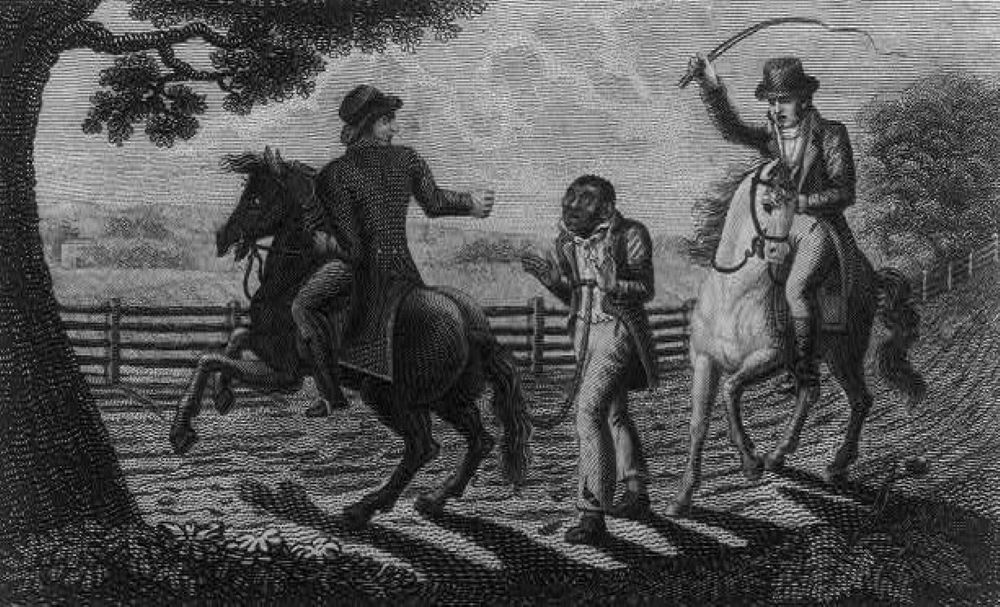
An engraving titled, "Barbarity committed on a free African, who was found on the ensuing morning, by the side of the road, dead!" published in 1822 (Library of Congress/Prints and Photographs Division Washington, D.C.)
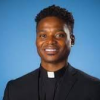
by Patrick Saint-Jean
Join the Conversation
Send your thoughts to Letters to the Editor. Learn more
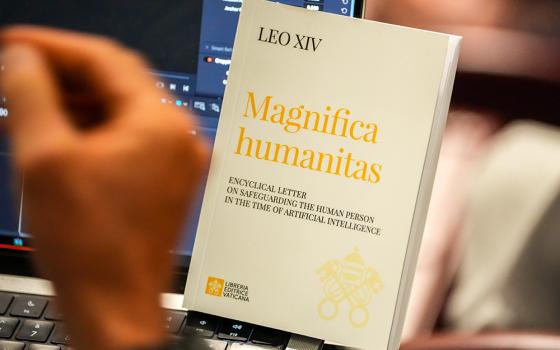
There is a woman I think of when I read Magnifica Humanitas. She has no name in the historical record. She exists only in the diary of Jesuit Fr. Peter Havermans, who wrote about her in November 1838, the month after the Society of Jesus sold 272 enslaved men, women and children to Louisiana plantation owners to pay the debts of Georgetown University.
She was pregnant. She was about to be loaded onto a boat. And before they took her, she knelt in front of Father Havermans and asked him three questions that no one in the two centuries since has fully answered: "If ever someone should have a reason for despair, do I not now have it? I do not know what day the birth will come, whether on land or at sea. What will become of me? Why do I deserve this?"
He gave her a blessing. Then the church loaded her onto the boat.
She has been kneeling for 188 years. Not because she is frozen in time, but because her question — "Why do I deserve this?" — has never received an honest institutional answer. The church that loaded her onto that boat went on to build universities, write encyclicals and produce some of the most sophisticated intellectual output in Christian history. What it did not do, until now, was answer her.
Pope Leo XIV's first encyclical, Magnifica Humanitas, presents the beginning of that answer. I deliberately say "beginning" because one document does not close a wound two centuries deep. But it does something no papal encyclical before it has done: It names the wound by its right name, traces it to its institutional source and asks — with the full, irreversible weight of the magisterium — for forgiveness.
I came to this encyclical wearing three identities at once. As a Black Catholic, I carry in my body the particular exhaustion of belonging to a tradition that has simultaneously nourished and betrayed my people. As a priest, I have stood at altars our ancestors helped build with hands that were not free. And as a clinical psychologist, I have spent years sitting in the sacred silence of other people's wounds, learning what it costs a human soul to bring its trauma to an institution and be handed a timeline instead of a reckoning.
From all three positions, I can say this: Magnifica Humanitas is the most significant map for healing that the papacy has ever placed in the hands of the Black Catholic community. Not because it repairs everything. But because the institution that loaded that unnamed pregnant woman onto the boat has, at last, stopped pretending the boat never sailed.
The church's long refusal to say "we caused this" was itself a word, and a harmful one. Magnifica Humanitas disarms that word. It does not undo the wound, but it does remove the weapon that kept it open.
When the institution responsible for a harm does not clearly acknowledge its fault, healing is extraordinarily difficult — sometimes impossible — for those who were hurt. The wound stays open. It is transmitted from parent to child, generation to generation, inscribed on the collective memory of a people.
This is precisely what Black Catholics have carried. The institution actively authorized — through papal decrees and theological argument — the stripping of dignity from Black human beings. And then, generation after generation, it asked its Black children to pray for unity and reconciliation without ever clearly naming what had been done. The result is what Magnifica Humanitas calls the Babel syndrome: managing injustice through the language of patience and uniformity — building the appearance of communion while confusion and scattering continue beneath the surface.
Against Babel, the encyclical sets Nehemiah. His city lies in ruins. His first response is not a policy proposal — he weeps. He walks the rubble alone at night, taking in the full extent of the destruction before he says a word publicly. Then, having truly seen, he calls the community together: Let us rebuild.
As an American-born pope with Haitian roots, whose own family history includes both enslaved people and slaveholders, Leo has walked those ruins with his eyes open. He has done what the woman on the boat waited her whole life for someone to do. He has named what he saw. Here is where healing begins.
In the Catholic Church, where diplomacy manages appearances and acknowledgment names reality, Leo takes the first full step without softening it: "The Church renews her firm condemnation of all forms of slavery." He notes "the immense suffering and humiliation endured by so many," adding, "For this, in the name of the Church, I sincerely ask for pardon."
And then the words many Black Catholics have waited their entire lives to hear: "Human dignity does not depend on a person's abilities, wealth, or position in life … it is a gift that precedes and transcends each person, endowed by God as an expression of his unfailing love."
Advertisement
The church's long refusal to say "we caused this" was itself a word, and a harmful one. Magnifica Humanitas disarms that word. It does not undo the wound, but it does remove the weapon that kept it open.
Today, for Black Catholics, the rejected stone is not a metaphor but an autobiography. The unnamed pregnant woman was a rejected stone. To hear the pope declare that "the 'rejected stones' … will become the cornerstone, and a solid, welcoming common home will emerge on the earth, where love and faithfulness will finally meet" is to finally hear the institution confess what should have been clear all along: Those it treated as peripheral were always the foundation.
It is no accident that the encyclical closes with Mary's Magnificat, for Mary carries something precious the world is not yet ready to receive. The pope presents her as the one who teaches us how to read history: not from the throne but from below, through the eyes of the widow, the orphan, the stranger, the wounded, the exile and the fugitive.
These are not strangers to Black Catholics. They are the community's own names, carried across the Middle Passage and through centuries of institutional exclusion. And kneeling among them, still unnamed, is the woman from Havermans' diary.
It is now for all of us — bishops and laity, educators and parish councils — to carry Magnifica Humanitas into every space where this conversation has been avoided. Not with neutrality, but in the honest spirit of Nehemiah: weeping first over what has been lost, then rebuilding together, leaving no one's humanity outside the walls.
The unnamed pregnant woman asked three questions. The church spent 188 years not answering them. But now it has, through Magnifica Humanitas, finally begun. Every Christian institution that carries this encyclical honestly — naming the wound, sitting with the rubble and rebuilding — is giving her and every rejected stone that followed her the answer they deserved. There is hope, after all.