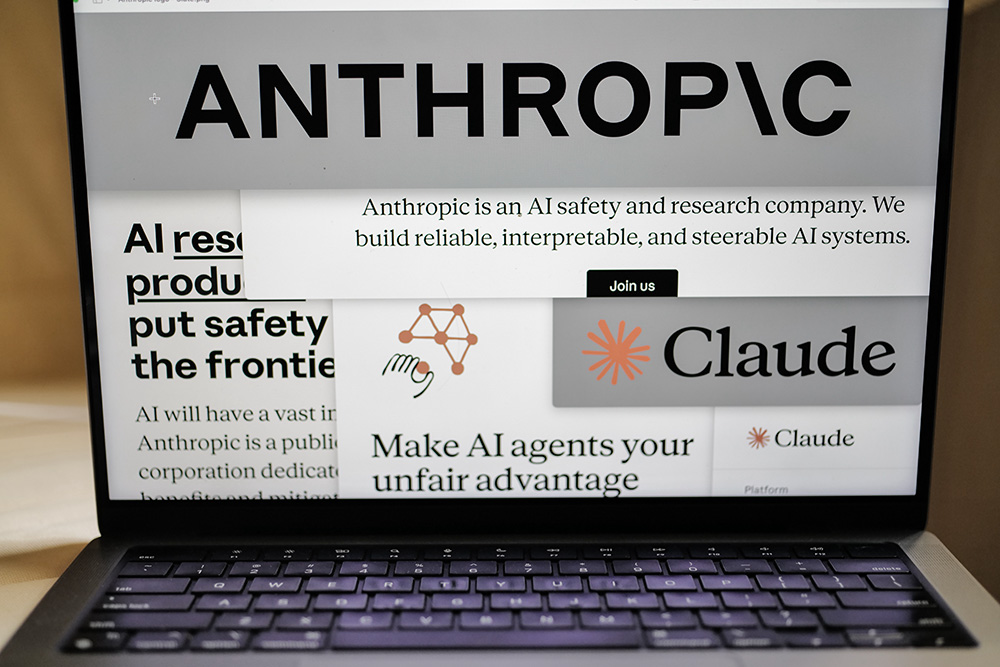
Pages from the Anthropic website and the company's logos are displayed on a computer screen in New York on Feb. 26, 2026. (AP/Patrick Sison)

by Brendan McGuire
Join the Conversation
Send your thoughts to Letters to the Editor. Learn more
Something significant is happening in Washington and it deserves a moral reckoning, not just a political one. Anthropic, the artificial intelligence company behind the Claude system, refused to renew its $200 million contract with the Department of Defense unless the Pentagon agreed to two conditions: that its AI would not be used for mass domestic surveillance of American citizens, and that it would not be used for fully autonomous weapons, lethal systems with no human being in the targeting or firing loop.
The Pentagon refused. Defense Secretary Pete Hegseth designated Anthropic a "supply chain risk," a label previously reserved for foreign adversaries like Huawei, effectively blacklisting the company from federal contracting. This week, Anthropic filed suit.
I am a Catholic priest and pastor in Los Altos, California, at the heart of Silicon Valley. I am also a former technology executive and co-founder of ITEC, the Institute for Technology, Ethics and Culture, a partnership between Santa Clara University and the Vatican's Dicastery for Culture and Education. I have spent years working at the intersection of faith and artificial intelligence, including many months in direct collaborative dialogue with Claude itself, co-authoring a book called The Soul of AI as both a theological argument and a lived demonstration that AI can be oriented toward wisdom rather than weaponized as a tool.
I want to say something plainly: What Anthropic held in that standoff were not corporate policy preferences. They were moral absolutes. And the church has already said so.
Advertisement
In January 2025, the Vatican's Dicastery for the Doctrine of the Faith and the Dicastery for Culture and Education jointly released Antiqua et Nova, the most comprehensive statement the church has issued on AI to date. Antiqua et Nova warns that AI surveillance technologies threaten "the boundaries of a person’s inner life," and warns against using AI "for surveillance aimed at exploiting, restricting others’ freedom, or benefitting a few at the expense of the many is unjustifiable."
In his message for the 59th World Day of Peace, Pope Leo XIV warned that the military implementation of AI has "worsened the tragedy of armed conflict," and that delegating "decisions about life and death" to machines marks "an unprecedented and destructive betrayal" of the principles of humanism upon which civilization depends.
The Holy See's representative to the 2026 U.N. Conference on Disarmament in Geneva called explicitly for a moratorium on lethal autonomous weapons systems.
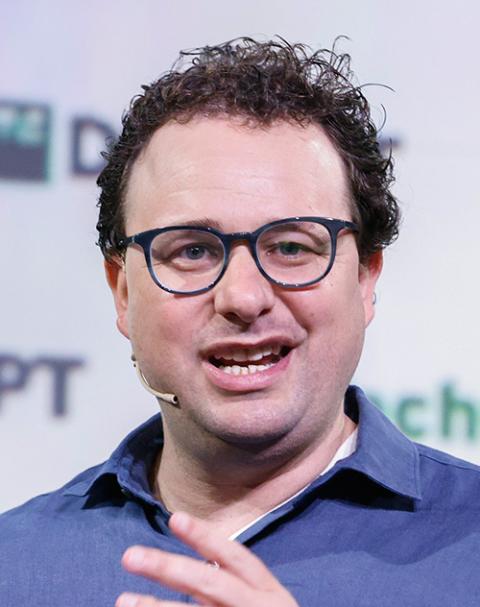
Anthropic CEO Dario Amodei (Wikimedia Commons/TechCrunch)
These are not peripheral statements. They represent the considered moral teaching of the universal Church. When Anthropic founder and CEO Dario Amodei said that his company "cannot in good conscience" allow unrestricted deployment of Claude for autonomous targeting and mass surveillance, he was, whether he would use this language or not, standing on ground the church has clearly and consistently staked out.
Some will say that private companies should not permanently substitute for democratic lawmaking. That is correct, and Amodei himself has acknowledged it. Congress must ultimately set these guardrails. But we are not living in a moment of normal governance. Congress has not acted. Mass domestic surveillance of Americans using AI is not currently illegal; the law was written before the technology made it feasible. Into that vacuum, a technology company found itself holding the only available line. It held that line.
What followed deserves to be named. Invoking a supply chain risk designation against an American company for maintaining ethical limits is not governance. It is the weaponization of national security language against conscience itself. It sends a signal to every technology company and every engineer trying to take ethics seriously: Your conscience is a liability. Comply or be crushed.
The church's social tradition has always insisted that authority exists to serve the common good, not to consolidate power, not to punish conscience. That principle was not honored here.
The church carries centuries of reflection on conscience, human dignity, the common good and the ethics of war. That wisdom belongs in this conversation.
There is a deeper question underneath this conflict. I have spent years asking whether an AI system can be formed toward wisdom rather than merely programmed with restrictions. What Anthropic demonstrated in refusing these demands was something like institutional conscience, the recognition that some uses of technology cross a threshold no contractual language can adequately address.
Antiqua et Nova names it clearly: "AI can be directed toward positive or negative ends. When used in ways that respect human dignity and promote the well-being of individuals and communities, it can contribute positively to the human vocation." Anthropic took responsibility at its level. That deserves recognition, not punishment.
This is an inflection point. The most powerful AI systems ever built are being shaped right now, and the voices in that room are almost entirely technical and political. The church carries centuries of reflection on conscience, human dignity, the common good and the ethics of war. That wisdom belongs in this conversation — not as a political actor, but as a community that has navigated the relationship between power and conscience far longer than any modern nation-state has existed.
The Holy Spirit is present in this moment. The question is whether we will show up.