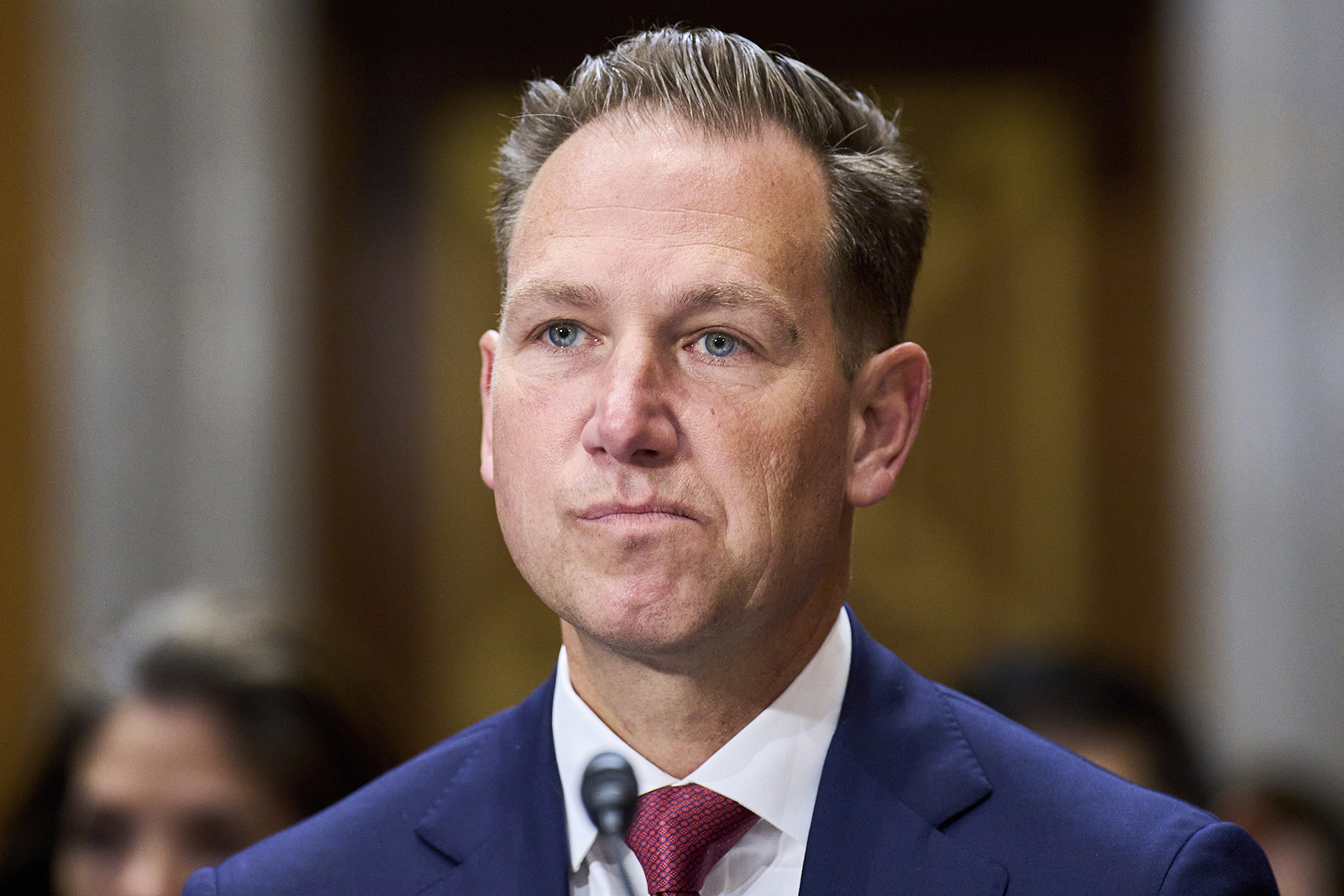
Brian Burch appears during a Senate Foreign Relations Committee hearing on his nomination to be ambassador to the Holy See, Tuesday, April 8, 2025, on Capitol Hill in Washington. (AP/Jacquelyn Martin)
by Arthur Holquin
Join the Conversation
Send your thoughts to Letters to the Editor. Learn more
It is a rare thing—rare almost to the point of unheard-of—for the Holy See's own news service to issue a public correction aimed, however obliquely, at the ambassador of a friendly power. Yet that is what happened on Monday, when Andrea Tornielli, editorial director of the Dicastery for Communication, published a reflection under the deceptively gentle title The Pope always speaks as a Shepherd. He named no one. He did not have to. Everyone in Rome, and everyone in Washington, understood precisely whose argument was being answered.
The argument belonged to Brian Burch, the President's ambassador to the Holy See, who in an interview with the New York Times sought to relocate Pope Leo XIV's criticism of the war in Iran from his office as Universal Pastor to his office as a Head of State. When the Holy Father condemns the bombing, Burch suggested, he is not speaking as the pastor of 1.4 billion Catholics but as the sovereign of a 108-acre state—and when he acts in that capacity, the ambassador said, he is "coequal with world leaders." The implication was as tidy as it was self-serving: read the pope's words through a political prism, and they become one head of state's foreign-policy opinion, no more binding on a Catholic vice president or a Catholic ambassador than the communiqué of any other government. The magisterium, quietly, is demoted to statecraft.
This is a specious argument, and it is worth being precise about why it is specious, because its cleverness is the whole of its appeal.
The inversion of the Lateran
Tornielli's response was devastating precisely because it was not polemical. He did not answer Burch with indignation. He answered him with the papacy's own memory.
He reached first for Paul VI, who stood before the United Nations General Assembly on October 4, 1965—addressing, as it happens, questions of war and peace—and told the assembled nations that the man speaking to them possessed only "a tiny and practically symbolic temporal sovereignty," the bare minimum required to be free to exercise a spiritual mission. He had, Paul said of himself, no temporal power and no ambition to enter into competition with any earthly state. He came to serve.
Then Tornielli reached back further still, to then-Cardinal Giovanni Battista Montini's address at the Campidoglio on October 10, 1962, on the eve of the Council he would one day bring to its conclusion. Speaking of the loss of the Papal States in 1870, the future Paul VI made the point that ought to be engraved over the door of every nunciature: it was precisely then, stripped of its temporal dominion, that the papacy "resumed with unusual vigor its functions as teacher of life and witness to the Gospel." The end of worldly sovereignty was not the diminishment of the Petrine office. It was its liberation.
Here is the inversion at the heart of Burch's mischaracterization. The sovereignty of Vatican City — guaranteed by the Lateran Pacts of 1929, that half-square-kilometer in the heart of Rome — was never conceived as a second mission running alongside the spiritual one. It was conceived, as Tornielli reminds us, as an instrument of the spiritual mission: the juridical guarantee that the Successor of Peter would be beholden to no government on earth, and therefore free to say to every government on earth what the Gospel requires. To seize upon that instrument and brandish it as a cage—to say, in effect, when he speaks of war he speaks only as a sovereign, and a sovereign we may disregard—is to turn the Lateran settlement precisely on its head. The very arrangement designed to secure the pope's freedom to proclaim the Gospel is enlisted to silence the proclamation. Any glorification of the pope-as-head-of-state, Tornielli writes, is "misleading," because it comes at the expense of his one true office as universal Shepherd.
Advertisement
What an ambassador is for
There is a reason career diplomats do not make this mistake, and a reason an ideologue installed in a diplomatic post does.
Ambassador Burch came to the Holy See not from the foreign service but from CatholicVote, the advocacy operation he led in the effort to elect Donald Trump. He arrives with no diplomatic formation, a long record of public criticism of Pope Francis, and an evident conviction that his first loyalty in the current controversy runs to the White House rather than to the See of Peter. A seasoned envoy understands that his task is to interpret the Holy Father's mind to his own government — to carry Rome faithfully to Washington. Burch has inverted the office as surely as he inverted the Lateran: he carries Washington's convenience back to Rome, and when the pope's teaching proves inconvenient, he reaches for a category error to blunt it.
And it is a grave thing, for a Catholic diplomat especially, to argue that the ordinary magisterium of a reigning pontiff may be received or set aside according to whether one classifies a given utterance as "religious" or "political." When Leo invokes the tradition of the just war — when he judges, as he did in Spain, that the campaign against Iran does not satisfy its criteria; when he pleads that migrants be received as persons bearing an inviolable dignity; when he insists that the poor stand at the very center of the Gospel — he is not venturing a sovereign's opinion on the affairs of a rival state. He is exercising the Church's social doctrine, the lex vivendi that flows from what she believes and how she prays. To answer that magisterium with "but he is only a head of state" is not diplomacy. It is a soft and modern species of the old Americanism — Caesar's interests dressed in the vestments of Catholic loyalty — and it deserves to be named for what it is. We are, all of us, cum Petro et sub Petro. A Catholic ambassador to Peter most of all.
The shepherd's voice
Tornielli ends where the Church has always ended this argument, with a sentence of disarming simplicity: the Successor of Peter, when he speaks of war and peace, of migration, of the poor, of creation, "is not speaking as a head of state. He is simply proclaiming the Gospel."
That is the whole matter. The pope's sovereignty exists so that his Gospel cannot be bought, coerced, or — as Ambassador Burch has now discovered — quietly reclassified into silence. A pope who could be reduced to a politician could be managed like a politician. Leo cannot, and the Vatican, in a rebuke as unusual as it was necessary, has said so plainly. When the shepherd raises his voice against an unjust war, the faithful are not asked to consult a map of the Vatican's borders before they listen. They are asked only to hear the voice of the one sent to feed the sheep.
It is a pity the ambassador could not hear it. It is a scandal that he preferred not to.
This story first appeared at Msgr. Arthur Holquin's Substack "Liturgy and Truth."